
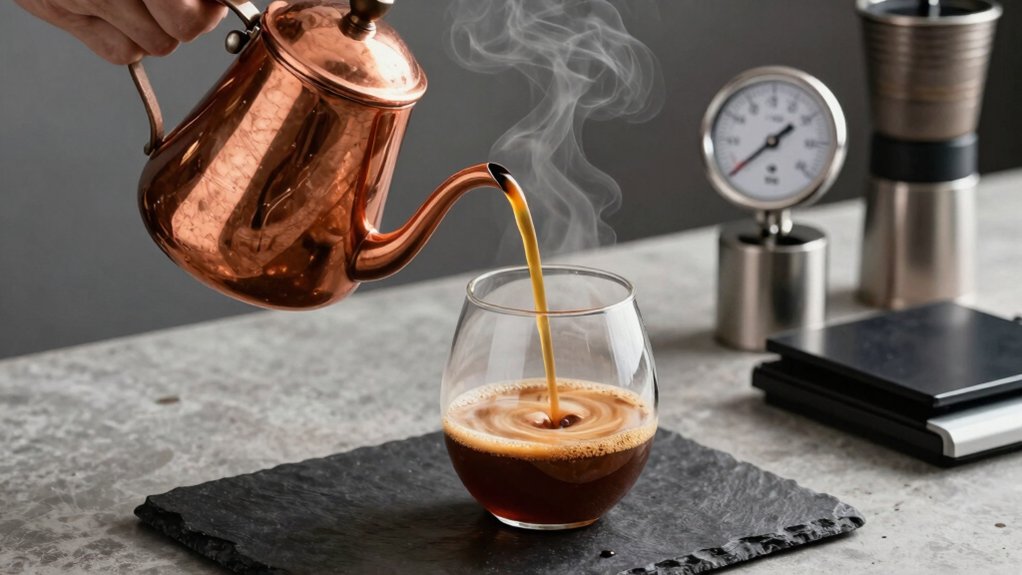
Keep your water in the 195‑205 °F (90‑96 °C) Goldilocks zone and you’ll hit the sweet spot every pull. Use a calibrated group‑head thermometer, let the PID lock the boiler within 1‑2 °F, and pre‑heat the portafilter for thermal mass. Adjust temperature a few degrees higher for light roasts and lower for dark, matching grind size to keep extraction balanced. Watch for sour notes if it’s too cold and bitter if it’s too hot—then you’ll discover the rest of the secrets.
Goldilocks Zone: 195‑205 °F (90‑96 °C) for Espresso
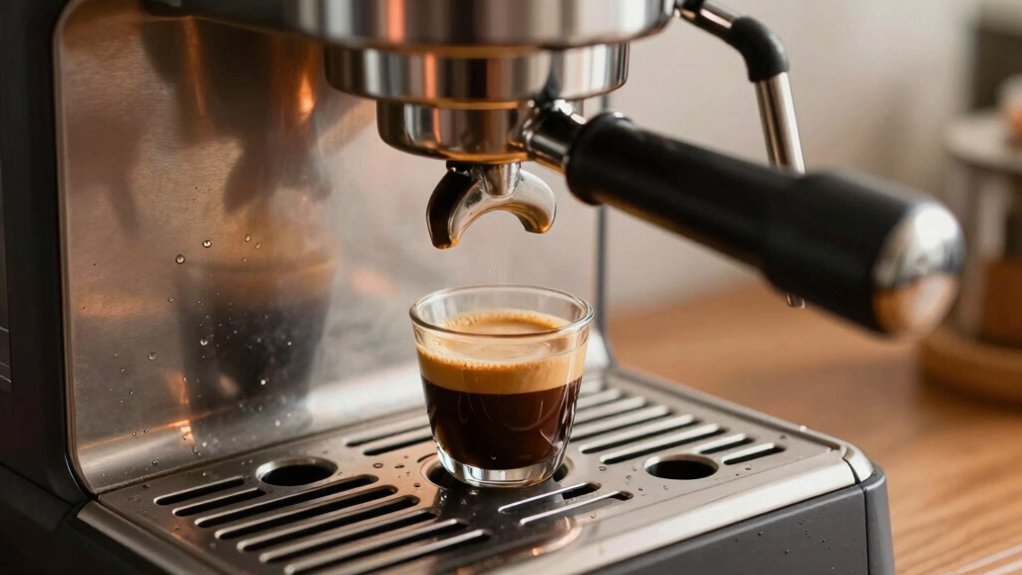
Ever wondered why a perfect espresso feels like liquid gold? You hit the Goldilocks zone when your water temperature sits between 195°F‑205°F, the sweet spot for espresso extraction. In this narrow band, compounds dissolve evenly, giving you a rich, syrupy body without burning the grounds. Temperature stability matters—tiny fluctuations shift the extraction balance, turning a balanced shot sour or bitter. A PID‑controlled boiler locks the heat, so each pull mirrors the last. When the temperature drains from the zone, you’ll taste acidity; above it, bitterness dominates. Mastering this range lets you fine‑tune flavor, aroma, and texture, delivering consistently stellar espresso every time. Burr material choices, such as ceramic or stainless steel, also influence how heat is conducted during grinding and extraction burr material.
Roast & Origin Effects on Ideal Brew Temperature
Your water temperature now meets the Goldilocks zone, but the perfect brew also depends on the beans’ roast and origin. Lighter roast level beans thrive at the higher end of the 90–96 °C (195–205 °F) range; aim for 194–196 °F (90–92 °C) to highlight acidity and fruity sweetness. Darker roast level beans need a slightly lower brew temperature, around 190–192 °F (88–89 °C), to keep bitterness at bay and preserve body. High‑altitude origin beans often demand extra heat because their density slows extraction, so nudging the temperature upward can restore balance. Grind size should be adjusted accordingly: finer grinds for cooler temperatures, coarser for hotter ones, ensuring extraction balance stays consistent across roast levels and origin beans.
Measuring Espresso Water Temperature With a Group‑Head Thermometer
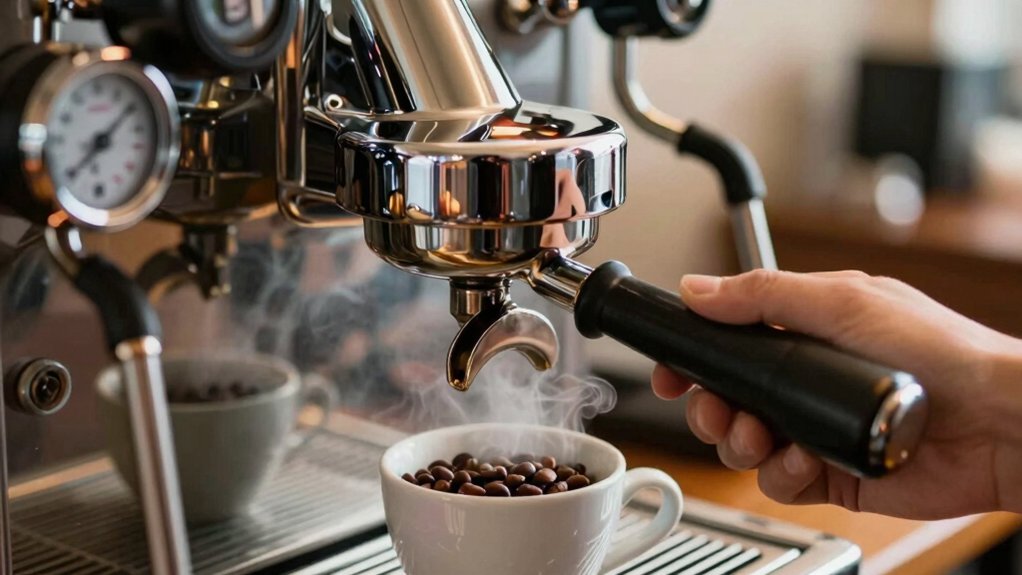
When you slip a group‑head thermometer into the portafilter’s spout and let it sit for about 30 seconds, you’ll capture the exact water temperature that contacts the coffee puck during extraction. The probe should sit in the group‑head area long enough for reading stability, then note the brew temperature. Aim for 90°C to 96°C to balance sweetness, aroma, and body. Keep your group‑head thermometer calibrated regularly; a simple ice‑water test can confirm accuracy. Compare each reading to your boiler or steam gauge to spot thermal drift early. If you notice a consistent offset, recalibrate or replace the sensor. Consistent monitoring ensures every shot stays within the optimal temperature window. Temperature control ensures precise readings align with your brew targets.
PID vs. Thermostat: Which Keeps Espresso Brew Temperature Stable?
How does a PID stack up against a traditional thermostat when it comes to keeping your espresso brew temperature steady?
A PID controller keeps the boiler within 1–2 °F, delivering temperature stability that a thermostat can’t match. You’ll notice the group‑head temperature staying flat even as you pull shot after shot, because the PID reacts instantly to load changes.
A thermostat swings wider and lags, so the brew head can drift, affecting extraction.
Regular calibration with a digital thermometer lets you log deviations and fine‑tune the PID, while analog gauges lag behind.
If you want consistent group‑head temperature and minimal drift, the PID’s precise control outweighs the thermostat’s simplicity.
ATC capability and automatic temperature compensation can further help stabilize readings across varying environmental conditions, ensuring more predictable extractions.
Pre‑Infusion & Bloom: Leveraging Temperature for Even Extraction
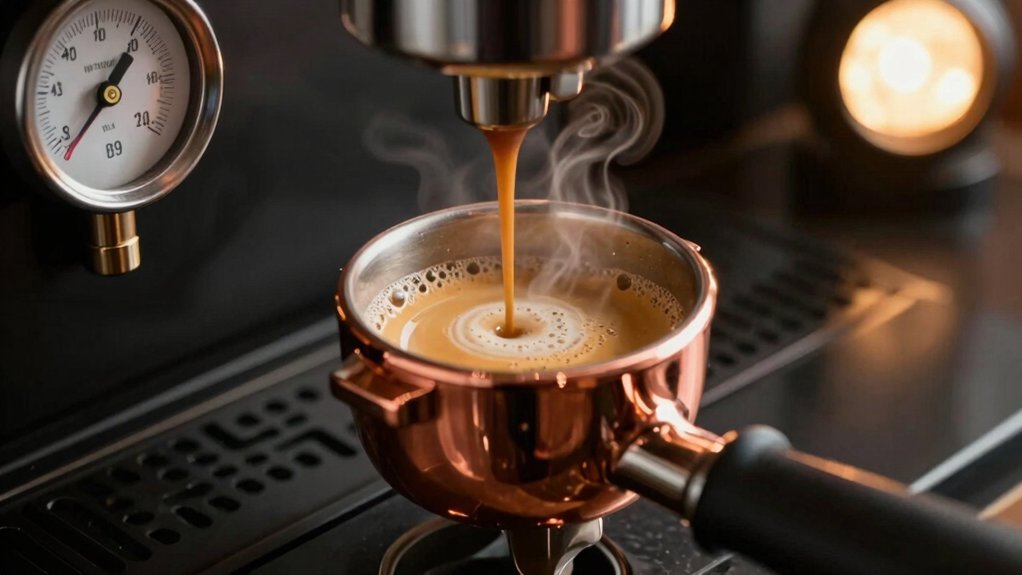
Ever wondered why a gentle pre‑infusion bloom can make your espresso taste smoother? You start with a low‑pressure pre‑infusion that wets the grounds uniformly, letting the temperature sit just below full brew heat. This lower temperature dissolves surface sugars and acids evenly, preventing channeling and setting the stage for even extraction. Keep the bloom for 5‑15 seconds, adjusting for dose and grind size, then ramp the temperature up as pressure builds. A pre‑infusion chamber stabilizes flow, reduces bitter notes, and respects your espresso tolerance limits. By controlling temperature during the bloom, you achieve a balanced, sweet cup with consistent extraction every time. Anti-static technology helps keep grounds from clinging and facilitates cleaner transitions into active extraction.
Using Brew Pressure to Fine‑Tune Espresso Water Temperature
Why not let brew pressure become your temperature dial? By nudging the pump, you can nudge water temperature without touching the boiler. When you raise pressure, the water heats up slightly, speeding up espresso extraction; lowering it cools the brew, extending the 25‑30‑second window. Keep an eye on group‑head temperature to ensure stable extraction, especially on single‑boiler heat‑exchangers where a 1‑degree boiler tweak isn’t linear. Pair pressure tweaks with temperature profiling for a smoother, balanced cup, and you’ll avoid sour or bitter drift. Incremental pressure adjustments provide a practical path for temperature control without major hardware changes, allowing you to tailor the brew to your espresso profile. – Adjust pressure in small increments to fine‑tune water temperature.
Use pressure nudges to fine‑tune water temperature, ensuring stable, balanced espresso extraction.
- Monitor group‑head temperature continuously for stable extraction.
- Combine pressure changes with temperature profiling for balanced espresso.
Compensating for Ambient and Water‑Temperature Variations
Ever notice how a sweltering café or a chilly winter morning can throw off your espresso’s temperature? Ambient conditions can cause temperature drift, so you’ll need to adjust your machine’s set point. When the room heats up, the grinder and boiler retain heat, raising brew temperature by a few degrees. Conversely, a cold space pulls it down. Check water quality, because mineral content and alkalinity affect heat transfer; seasonal changes may require a new calibration to keep extraction balance intact. Use temperature profiling: start at the high end of the standard range on cool days, then dial back when it’s hot. Regularly read the group‑head and record deviations, then tweak the set point until each shot stays consistent. Bean Adapt Technology helps optimize extraction across varying bean profiles and temperatures, guiding you to maintain stable results.
Maintaining Consistent Espresso Water Temperature During Service
You’ll start each shift with a head pre‑heat routine, letting the machine, portafilter, and cups reach steady temperature before the first shot.
Then you rely on a PID controller to keep brew temperature locked in the 195‑205 °F window, adjusting on the fly as the grinder heats up.
Finally, give each shot a brief recovery pause so the system can settle and you can log the temperature alongside grind and dose for consistency.
Head Pre‑Heat Routine
When you start the day, pre‑heat the brew group, portafilter, and cups so the water stays in the 195–205 °F (90–96 °C) window throughout service. Begin with a full machine warm‑up, then run a short thermal soak on the group head and portafilter. Flush the group, pull a blank shot, and check the temperature with a digital thermometer. If the reading is within range, you’ve locked in temperature stability; if not, repeat the soak and flush until the brew water steadies. This routine eliminates cold spots, keeps extraction consistent, and lets you focus on flavor rather than temperature drift.
- Preheat everything before the first pull.
- Use a thermal soak and blank shot to verify stability.
- Monitor with a thermometer after any load change.
PID Temperature Stabilization
How can you keep espresso water temperature steady from the first shot to the last? A well‑tuned PID gives you temperature stability within 1–2 °F, so each pull sees the same group‑head temperature. Pair the PID with a heavy boiler and pre‑heat the portafilter; the thermal mass buffers the system and cuts drift after steam bursts. Log the temperature daily and run a quick calibration whenever the sensor shows lag. This routine catches PID drift early, keeping flavor balance intact.
| Goal | Tool | Effect |
|---|---|---|
| Consistent brew | PID | Tight temperature band |
| Quick recovery | Thermal mass | Reduces temperature loss |
| Long‑term accuracy | Calibration | Eliminates drift |
Shot‑to‑Shot Recovery Time
Why does each espresso shot sometimes taste different even though you’ve set the same temperature? Because temperature stability erodes between drinks. When you pull a shot, the group‑head loses heat, and without enough recovery time the next brew temperature drops, shifting the extraction window and flavor profile. You can fight temperature drift by logging group‑head temperature, flushing the head, and adjusting the boiler setpoint as the grinder warms the beans. Aim for a consistent brew temperature of 90–96 °C and a 25–30 second extraction window; a short pause between shots lets the system settle, preserving the intended taste.
- Monitor and record group‑head temperature to spot drift early.
- Use a timed pause (recovery time) after each shot to let the boiler stabilize.
- Adjust grinder workload or boiler setpoint when grinder heat raises bean temperature.
Spotting Under‑Extraction: Sour Espresso Signals Too Low a Temp
If you taste a sharp, sour bite, it’s a clear sign the brew temperature is too low and the extraction yield is insufficient. Low heat prevents sugars and body‑building compounds from dissolving, leaving only acidic notes.
Check that your water stays steady between 90–96 °C (195–205 °F) throughout the shot to confirm the temperature isn’t the culprit.
Acid Taste Indicators
Ever notice a sharp, sour bite that makes your espresso feel unfinished? That bite is your palate warning you about temperature‑driven acidity. When the group‑head temperature dips below the optimal 90–96 °C range, early‑extracted acids dominate, leaving a pronounced sourness. Under‑extraction amplifies this effect because the later, sweeter compounds never get a chance to balance the acidity. Keep an eye on the brewing temperature, maintain a stable group‑head temperature, and adjust grind and dose to compensate for any low‑temp dip. By managing these variables, you’ll tame the acidity and achieve a smoother, more complete extraction.
- Check group‑head temperature before each shot.
- Use a finer grind if you must brew at lower temperature.
- Verify dose and tamp pressure to avoid under‑extraction.
Low Extraction Yield
When the group‑head temperature slips below the 90–96 °C sweet spot, the espresso can end up under‑extracted, leaving a sharp, sour bite that signals a low extraction yield. You’ll notice the sourness when water temperature is too low to dissolve sugars and other solubles, resulting in a thin body and bright acidity.
Raise the brew temperature back into the 90–96 °C range and check that the group head maintains stability throughout the shot. Consistent temperature prevents under‑extraction, while a stable brew temperature lets the grind, dose, and time work together for a balanced cup.
Regularly measure the group head’s temperature and adjust your machine to keep that stability, and the extraction yield will climb, eliminating the sour bite.
Insufficient Brew Temperature
Why does your espresso taste sharp and sour? Because the water temperature is too low, causing under‑extraction. When the brew sits below the 90–96 °C range, soluble acids dominate and the shot ends up sour. Check your machine’s temperature stability; a sudden drop between shots can ruin extraction time and flavor. Use a calibrated thermometer or a PID‑controlled boiler to keep the water hot and consistent. If you grind coarser or pull a short 25‑30 second shot, the low temperature compounds the problem, leaving the coffee under‑extracted and unpleasant.
- Verify water temperature before every pull.
- Maintain temperature stability at the group head.
- Align grind size and extraction time with the correct temperature.
Spotting Over‑Extraction: Bitter Espresso Signals Too High a Temp
A bitter espresso is a clear sign that the brew temperature is too high, pushing tannins and chlorogenic acids past their balanced point. You’ll notice a sharp, astringent bite as temperature spikes accelerate chlorogenic acid breakdown, amplifying bitterness.
Over‑extraction doesn’t just increase total solids; it skews the profile, letting harsh ketones, aldehydes, and pyrazines dominate the espresso extraction. When you taste that lingering, unpleasant edge, lower the brew temperature by a few degrees and consider a finer grind or reduced dose to rebalance.
Monitoring temperature closely prevents the shift toward bitter compounds, keeping your cup smooth and bright. Adjust promptly, and you’ll avoid the sour‑bitter trap of over‑extracted espresso.
Frequently Asked Questions
How Does Water Hardness Affect Espresso Extraction Temperature?
You’ll find harder water raises the boiling point, so you need to lower the brew temperature to avoid over‑extraction; softer water lets you keep higher temperatures for balanced flavor and proper crema.
Can I Use a Kettle Instead of a Group‑Head Thermometer for Temperature Checks?
Yes, you can use a kettle, but make sure it’s calibrated, and the temperature stays stable; a group‑head thermometer gives more precise readings, while a kettle’s variance may affect extraction consistency.
What Impact Does Altitude Have on Optimal Espresso Brew Temperature?
You’ll need to raise the brew temperature about 1‑2 °C for every 300 m (1,000 ft) of altitude, because lower pressure reduces extraction efficiency, so hotter water compensates for thinner boiling.
Do Different Coffee Brewing Methods Require Temperature Adjustments for Espresso?
Yes, you’ll need to tweak the temperature for each method. French press, pour‑over, and AeroPress each extract differently, so you should lower or raise the water a few degrees to match their ideal brewing profiles.
How Often Should I Calibrate My Temperature Sensor for Accurate Readings?
You should calibrate your temperature sensor at least once a month, or whenever you notice a drift of more than half a degree, especially after moving the device or changing its power source.
In Summary
Mastering espresso temperature is all about staying in the Goldilocks zone—195‑205 °F (90‑96 °C). Adjust for roast, origin, and ambient conditions, then use a reliable thermometer or PID to keep the brew steady. Watch for sour notes that signal too‑low heat and bitter tones that warn of excess heat. By fine‑tuning pre‑infusion, bloom, and service‑time stability, you’ll consistently pull balanced, delicious shots.


