
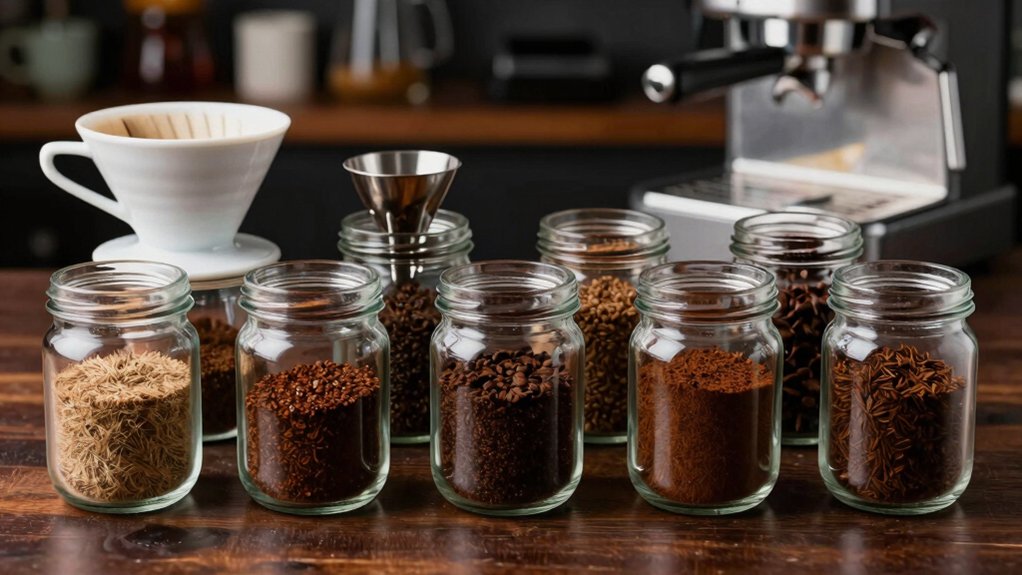
You’ll want a 40‑220 µm dust for Turkish coffee, 180‑380 µm for espresso, 300‑900 µm for drip and percolation, and 320‑960 µm for AeroPress (fine‑mid for standard, finer for inverted). For immersion, aim for 690‑1300 µm in a French press, 800‑1400 µm for cold brew, and 820‑1270 µm for cold drip. Cupping standards sit at 470‑850 µm. Adjust in ~10 µm steps and measure with a sieve to hit the sweet spot, and the next section shows how to fine‑tune each brew.
Turkish Coffee Grind Size: 40‑220 µm
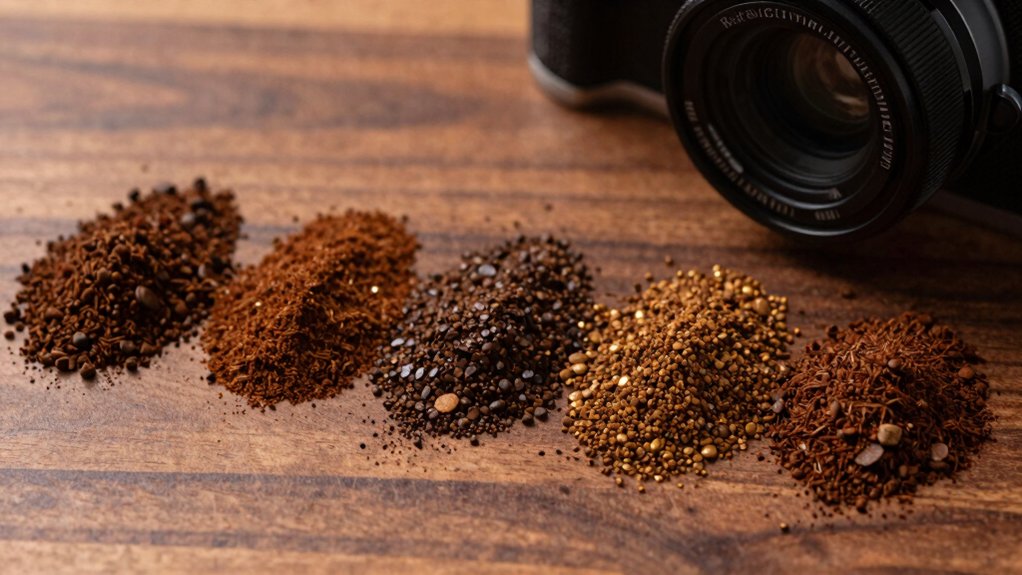
Ever wondered why Turkish coffee feels like a silky powder? You’ll find that the magic lies in the grind size—40–220 microns—producing a fine grind that behaves like a dust. This particle range maximizes surface area for immersion brewing, letting every speck soak in hot water for a prolonged extraction. Because the grounds stay in the cup, the fine particles create a thick body and unleash an intense aroma that fills the room. You’ll start at the finer end of the spectrum, then tweak slightly coarser if the brew feels too heavy or clogged. By keeping the grind within this window, you balance extraction efficiency with a smooth mouthfeel, delivering the characteristic richness of authentic Turkish coffee. Grind Size Range provides a practical frame for dialing in your brew.
Espresso Grind Size: 180‑380 µm
Moving from the powder‑like texture of Turkish coffee, espresso demands a grind that’s a bit coarser yet still fine enough to create resistance for high‑pressure extraction. You’ll target an espresso grind size of 180–380 µm, where fine particles boost surface contact and let the shot pull in 25–30 seconds. Consistent grind prevents channeling, preserves crema, and balances sweetness and body. Small tweaks within the range shift extraction time and flavor dramatically, so dial in precisely. SCA standards and non-reactive materials play a role in maintaining sample integrity during cupping and measurement.
Drip & Percolation Grind Size: 300‑900 µm
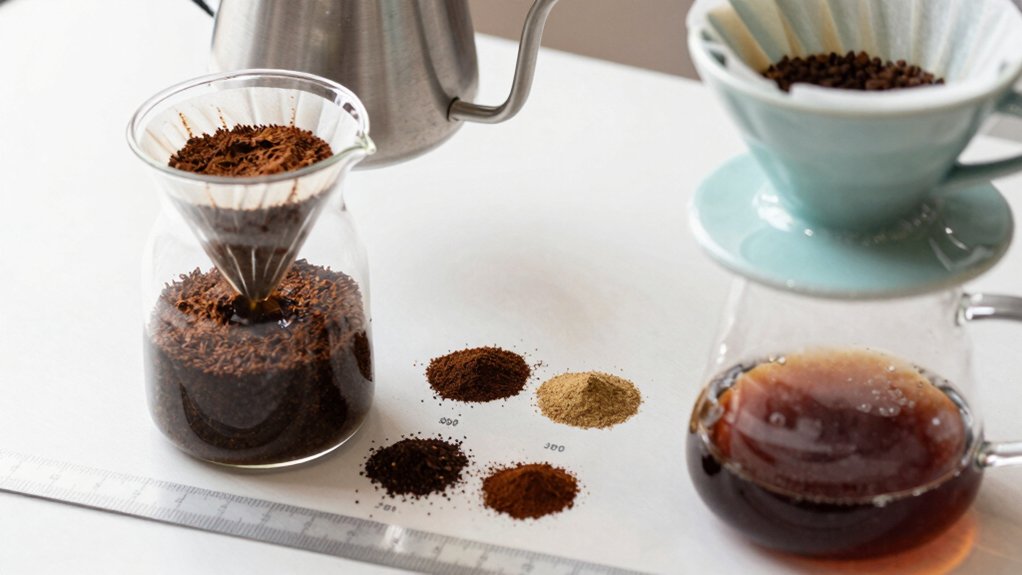
You’ll work within a 300‑900 µm window to hit the sweet spot for drip and percolation brewers. Adjust the grind toward the finer end when you want a slower flow and richer extraction, and coarser when the water rushes through too quickly. These tweaks let you fine‑tune contact time and avoid channeling without overcomplicating the process. For consistency, pair your grind adjustments with a regular grinder maintenance routine to prevent buildup from affecting flow and extraction grinder maintenance.
Medium Grind Range
Wondering how to hit the sweet spot for drip and percolation? Your grind size sits between 300 µm and 900 µm, with a medium grind around 600–800 µm working for most drip coffee and pour‑over setups. Start with that range, then watch brew time and water flow. If the water pools and drips slowly, grind a bit finer; if it rushes through, go coarser. The particle size range aligns with achieving balanced extraction across common filter styles, as seen in how grind consistency supports efficient water flow through the filter media. cross-back design
Flow Control Tips
A good rule of thumb for drip and percolation brewers is to keep the grind between 300 µm and 900 µm, then fine‑tune within that band to control flow. When you tighten grind size toward the lower end, you boost surface area and raise extraction rate, which speeds up percolation brewing and can make drip coffee taste richer. Conversely, coarser particles near 900 µm slow the water channel, giving a gentler flow and preventing under‑extraction.
Aim for consistent grind size across each batch; even small variations can throw off flow control. Adjust your burrs in small increments, test the brew time, and watch the drip rate—this iterative tweaking keeps your percolation brewing predictable and balanced.
AeroPress Grind Size: 320‑960 µm (Standard vs. Inverted)
You’ll find the AeroPress works across a 320‑960 µm spectrum, giving you flexibility for both standard and inverted brews. When you invert the device, you’ll lean toward the finer 320‑600 µm range to boost extraction during the longer steep. For a classic press, stick near the middle of the range to keep the brew consistent without risking filter clogging. The choice of filters, including unbleached disposable options, can further refine bitterness and oil retention in line with your grind. micro-filtration
AeroPress Range Overview
Curious how the AeroPress can handle everything from espresso‑like shots to drip‑style cups? You’ll find its grind size spans 320‑960 µm, a microns range that dwarfs most brewing methods. Start with a medium grind and tweak the density as you experiment; short brews gravitate toward the finer end, while longer steeps favor coarser particles. The AeroPress setup is compatible with standard and inverted methods, both benefiting from a clear understanding of grind impact on extraction and flow grind size range.
Inverted Method Adjustments
Wondering how to dial in the inverted AeroPress for a perfect cup? Start with a medium grind—about 450‑600 µm—then tweak based on immersion and steep time. If you like a short brew, move toward the finer end of the 320‑960 µm micron range; the grounds stay fully submerged, so you avoid premature channeling. For longer steep times, shift to a coarser size, around 600‑700 µm, to keep extraction balanced. When the cup tastes weak or under‑extracted, increase the grind to 600‑700 µm; if it’s bitter or over‑extracted, drop it to 350‑500 µm. This flexibility lets the AeroPress inverted method deliver anything from a crisp drip‑style sip to a rich immersion‑style brew, all by mastering grind size. grind ranges
Standard Brew Consistency
After mastering the inverted method’s fine‑tuning, let’s lock in a reliable grind for the standard AeroPress. You’ll aim for a grind size near the middle of the 320‑960 µm range, because it balances flow and extraction without clogging. With the standard brewing method, you pour hot water over the grounds, stir, then press after about 1–2 minutes of contact time. A medium‑coarse grind lets the water move steadily, giving even extraction while the filter handles the slurry. If the brew tastes thin, shift a few microns finer; if it drips too slowly, go a touch coarser. Consistency comes from keeping the grind size stable, monitoring contact time, and adjusting filtration only when needed.
Immersion‑Style Grind Size: French Press, Cold Brew, Cold Drip
Why does a coarser grind work best for immersion‑style brewing? Because the water stays in contact with the grounds for minutes, so a coarse grind slows extraction, limits fines, and keeps the cup clear and balanced.
| Method | Typical grind size (µm) |
|---|---|
| French Press | 690 – 1300 |
| Cold brew | 800 – 1400 |
| Cold drip | 820 – 1270 |
| General immersion | 700 – 1500 |
When you use a French Press, the coarse grind yields a rich body without sludge. Cold brew’s long steep demands an even coarser grind to avoid over‑extraction and acidity. Cold drip’s slow drip favors a similar coarse range, letting water pull flavor gently over time. Adjusting grind size within these ranges lets you control extraction and time, delivering the desired mouthfeel for each immersion method.
Cupping Grind Size Standard: 470‑850 µm
Ever wondered what grind size keeps your cupping samples consistent? The cupping grind size standard sits between 470‑850 µm, a range the SCA calls a touch coarser than paper‑filter drip and finer than French press.
Aim for about 70‑75 % of particles passing a US Standard sieve 20 mesh, roughly 850 µm, to hit the upper bound. This window ensures aroma and flavor release stay comparable across brewing methods while preserving enough extraction for reliable cu.
Consistency matters: using the same grind size each session lets you attribute differences to beans, not particle variance. Remember, microns matter, and the sieve 20 mesh gives you a practical, repeatable reference point for the cupping standard.
How to Measure and Fine‑Tune Your Coffee Grind Size at Home
Curious how to dial in the perfect grind at home? Start with a burr grinder, because its uniform particles give you reliable grind size and consistency. Pick the typical range for your brewing method—Espresso 180–380 µm, drip 300–900 µm, or the cupping range 470–850 µm—and grind a small batch. Measure the particles with a calibrated sieve or a digital micrometer, then brew and note extraction time and taste. If the shot pulls too fast, increase particle size in 10‑µm increments; if it drags, go finer. Adjust until extraction time lands in the sweet spot for your method. Repeat the measurement and brew cycle until you hit a repeatable, balanced cup. Grind fresh each time to lock in aroma and oils.
Frequently Asked Questions
Can I Use the Same Grind Size for Different Coffee Beans?
You can, but expect flavor shifts; each bean’s density and roast react differently, so the same grind may over‑extract or under‑extract, altering strength and balance across brews. Adjust timing or dose to compensate.
How Does Water Temperature Affect the Ideal Grind Size?
You’ll find hotter water extracts faster, so you should use a coarser grind; cooler water extracts slower, letting you tighten the grind. Adjusting temperature and grind together keeps flavor balanced and avoids over‑ or under‑extraction.
Should I Adjust Grind Size When Using Filtered Versus Unfiltered Water?
Yes, you should tweak the grind. Filtered water often extracts more cleanly, so a slightly coarser grind prevents over‑extraction, while unfiltered water can benefit from a finer grind to balance bitterness.
What Impact Does Altitude Have on Grind Size Selection?
At higher altitudes the water boils at lower temperature, so you’ll need a coarser grind to avoid over‑extraction; the thinner air speeds extraction, and a finer grind would make the brew too bitter.
Do Grind Size Recommendations Change for Decaf Coffee?
Yes, you’ll tweak the grind a bit because decaf beans extract faster; aim for a slightly coarser setting than you would with regular coffee to avoid over‑extraction and bitterness.
In Summary
Now that you know each method’s optimal particle range, you can dial in the right grind, taste the difference, and tweak as needed. A precise grind means consistent extraction, better flavor, and fewer surprises. Keep your grinder clean, measure with a sieve or microscope if you can, and enjoy coffee the way it was meant to be brewed.


