
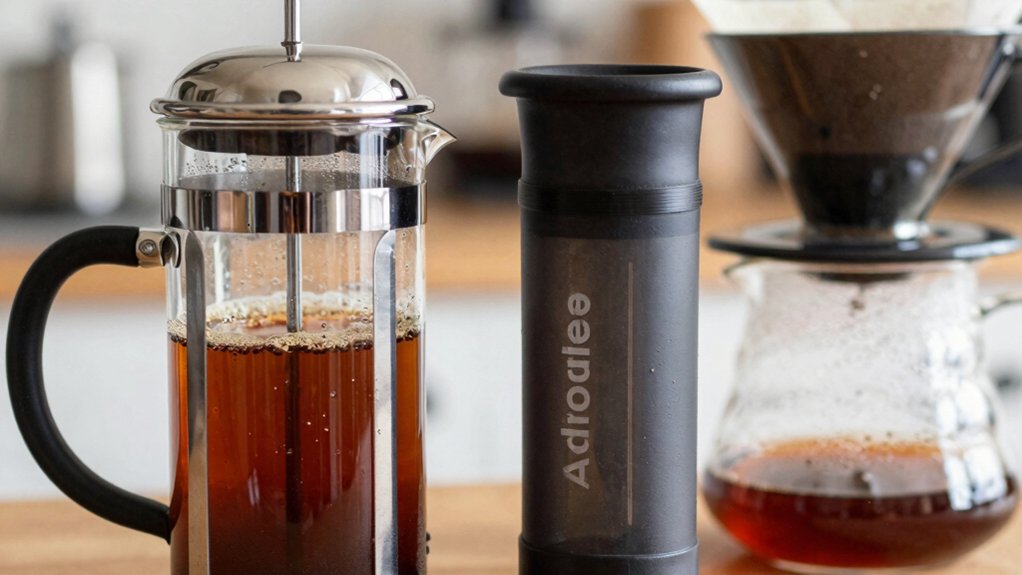
You taste French Press and AeroPress differently because the French Press uses a metal mesh that lets oils and fine sediment stay, giving a fuller, richer mouthfeel and a stronger aroma, while the AeroPress’s paper filter traps most oils and particles, producing a cleaner, brighter cup. The press size, steep time, temperature, and pressure also vary—French Press steeps longer at near‑boiling heat with no pressure, whereas AeroPress extracts quickly under pressure with a finer grind. These factors shape each brew’s body, aroma, and aftertaste, and if you keep going you’ll discover how to tweak them to match the other’s profile.
French Press vs AeroPress: Which Brew Wins Your Palette?
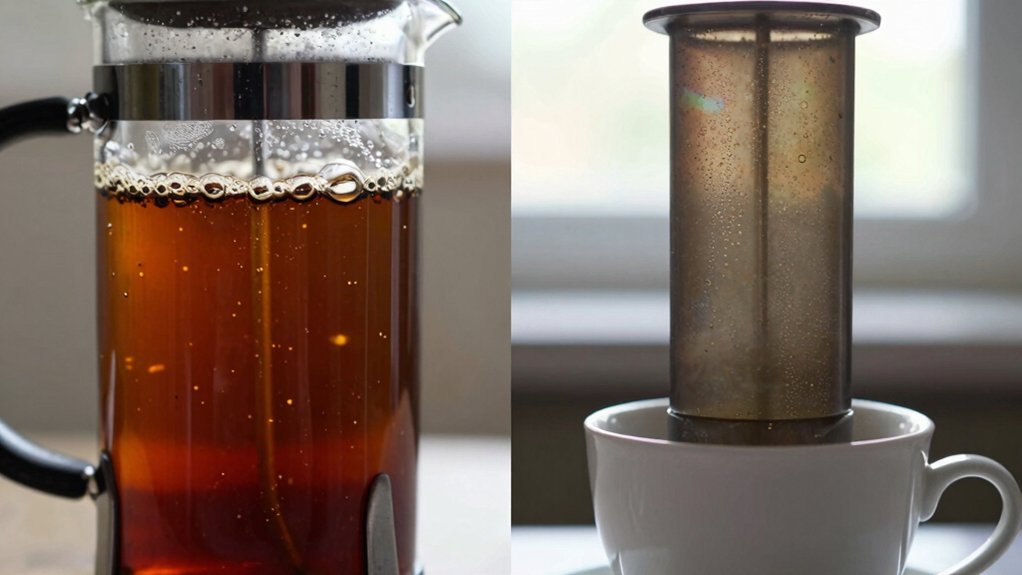
Why does one cup feel bright and clean while the other feels rich and heavy? You notice that the Aeropress, with its paper filter, delivers crisp brightness and nuanced flavor because the filter strips oils and fine grounds, allowing a cleaner extraction.
Paper‑filtered Aeropress yields crisp, bright coffee; metal‑mesh French press delivers rich, full‑bodied brew.
The French Press, using a metal mesh, lets oils and sediment through, giving the brew a fuller body and richer mouthfeel.
When you adjust grind size, temperature, or brew time, the Aeropress highlights acidity and floral notes, while the French Press emphasizes depth and robustness.
Your palate will register the Aeropress’s lighter, clearer profile versus the French Press’s heavier, more pronounced character, each shaped by its distinct extraction and filtration dynamics.
This difference can also be influenced by filter type and brew ratios, which align with the broader idea that equipment design affects oil and sediment passage filter dynamics and how those elements shape the final flavor profile.
How Filtration Shapes Flavor in French Press vs AeroPress
The bright, clean cup you get from an AeroPress and the rich, heavy brew from a French Press both stem from how each device filters the coffee.
With a French Press you use a metal filter that lets oils and fine sediment through, so you taste a fuller body and a tactile mouthfeel.
The AeroPress usually relies on a paper filter, trapping most oils and particles, which yields a brighter, clearer profile with less heaviness.
If you swap the paper for a metal filter on the AeroPress, you’ll notice more oils and a richer texture, edging closer to the French Press character.
Ultimately, filtration determines how much oil‑forward flavor and sediment you retain, shaping the brew’s depth and clarity.
Why Grind Size Matters for Each Brewer’s Mouthfeel
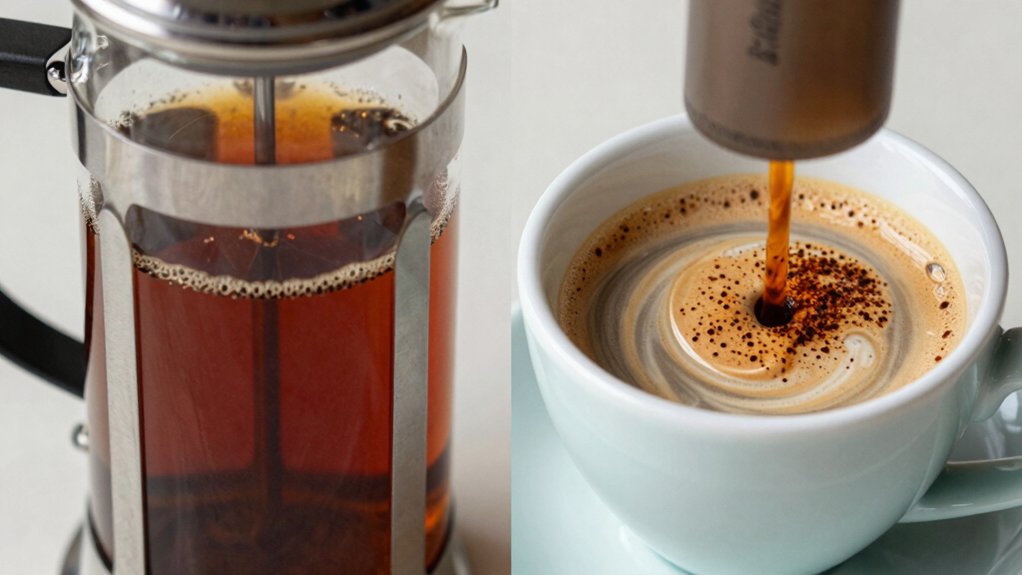
You’ll notice that a coarser grind in a French Press leaves more oils in the cup, giving it a fuller body, while a finer grind in an AeroPress lets the paper filter strip out those oils for a cleaner feel.
The grind size also dictates how quickly the water extracts flavors during the steep, so a longer immersion with coarse particles builds richness, whereas a short, press‑driven brew with fine particles emphasizes brightness.
Keeping the grind uniform is key, because uneven particles cause inconsistent extraction and unwanted texture.
borosilicate glass provides lightweight durability and excellent thermal shock resistance, which can influence how consistently the cup feels from pour to sip.
Grind Coarseness Controls Body
Ever wonder how grind size reshapes the mouthfeel of your brew? Coarseness directly controls the body you experience. In a French Press, a coarse grind slows extraction, lets the metal filter trap sediment, and yields a heavy, full‑bodied cup. In an AeroPress, a medium‑fine grind (around 2 on a Handground scale) speeds extraction under pressure, creating a richer body, while a coarser grind lets liquid flow too quickly, producing a thin, watery feel. Consistent grind size across both brewers ensures predictable body differences and flavor clarity. WRAPAHOLIC 50Pcs Fall Paper Napkins (6.5 x 6.5 In) and other coffee-themed products remind us that design choices can pair with taste experiences to shape mood and perception fall coffee motif and may influence perceived richness in some contexts.
Filtration Impacts Oil Retention
Why does the filter type matter for mouthfeel? Your choice of filtration decides how much oil retention and sediment end up in the cup, shaping body and texture.
A metal filter in a French Press lets most coffee oils and fine particles pass, giving a richer, heavier mouthfeel and noticeable sediment.
When you switch to a paper filter in an AeroPress, it traps many oils and fines, producing a cleaner cup with a brighter, lighter body.
Grind size still matters: coarser grinds reduce sediment for the metal filter but still deliver oils, while finer grinds increase oil exposure in both metal and paper setups, altering perceived bitterness and mouthfeel.
Even using a metal filter in an AeroPress boosts oil retention, narrowing the gap between the two brewers. Filtration design and the way it interacts with grind size can subtly shift how the cup feels on the palate.
Steep Time Alters Extraction
The filter you choose sets the stage, but the time you let the coffee sit determines how much of those oils and fines actually end up in your cup. In a French Press, a 4‑minute steep with coarse grind lets the metal filter allow most oils through, giving a heavy mouthfeel and a rich flavor profile. Shortening the steep or using finer grounds can over‑extract, making the brew bitter. With an AeroPress, a 1‑3 minute steep and medium‑fine grind work with paper filtration to keep the cup bright and clean; a very short steep with ultra‑fine grind pushes intensity but may let bitterness slip through if the filter clogs. The balance between grind size, steep time, and filtration method governs how much oil and fines pass into the cup, shaping mouthfeel and perceived body. Extraction control and the interplay of filtration type (metal vs paper) also influence aroma release and aftertaste, helping explain why similar beans can taste noticeably different when brewed with these two methods. In addition, adjusting the grind to a fine level for AeroPress can rapidly increase extraction if timing isn’t shortened accordingly, while coarser grinds for French Press require careful timing to avoid under‑extraction and a weak cup.
How Brew Time and Water Temperature Influence Extraction
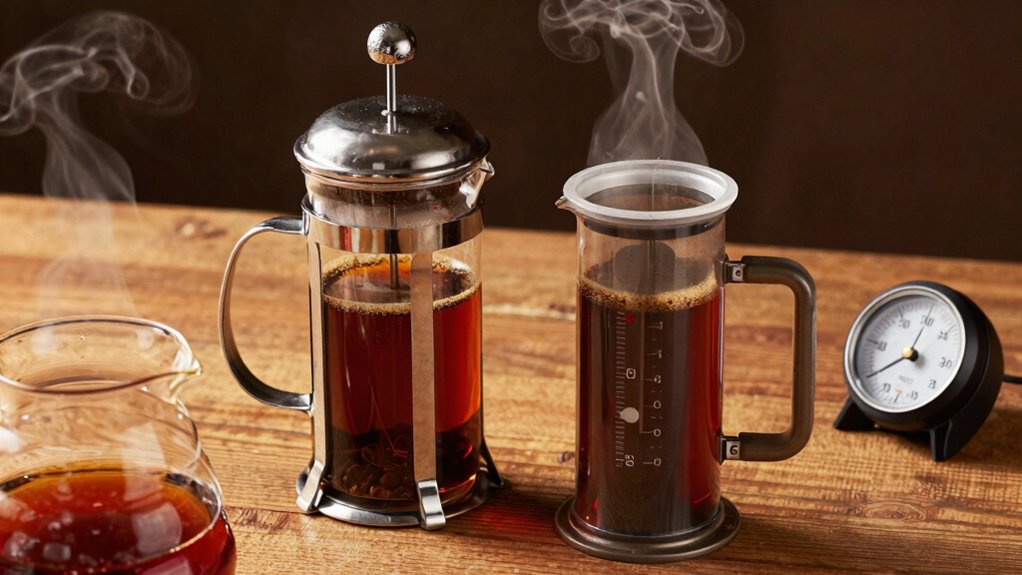
When you adjust brew time and water temperature, you directly control how much of the coffee’s soluble compounds are extracted. In a French Press, a four‑minute immersion at 196‑200 °F pulls out more oils and fines, giving a heavy body and noticeable sediment.
Adjust brew time and temperature to control extraction, shaping body, flavor, and sediment in French Press coffee.
An AeroPress, by contrast, uses the same temperature but a much shorter 1‑3 minute contact, and its paper filter removes much of the oil, resulting in a cleaner cup. Stirring improves contact in both methods, sharpening flavor and consistency.
- Longer brew time → more extraction, fuller mouthfeel (French Press)
- Short brew time → lighter, cleaner cup (AeroPress)
- Water temperature 196‑200 °F optimizes soluble yield
- Immersion depth dictates how many compounds dissolve
- Filtration (paper vs. metal) shapes final texture and clarity
Additionally, the choice of vessel and its design can influence how evenly heat transfers during extraction, subtly affecting flavor development. Biscotti
Pressure’s Role in Brightness and Body for Both Devices
Changing brew time and temperature already set the extraction baseline, but adding pressure shifts how brightness and body manifest in each cup. With the AeroPress you apply pressure to push water through a paper filter, which strips oils and fines. That filtration, combined with a short 1–3‑minute steep, highlights acidity and a crisp, bright mouthfeel. In contrast, the French Press relies on gravity and a metal filter that lets oils and fine particles stay in the brew. The longer immersion extracts more soluble solids, giving a heavier body and richer texture that can mute perceived brightness. So, pressure in the AeroPress amplifies brightness, while the lack of pressure and metal filter in the French Press enhance body. Extraction Process cross-links with how different devices measure TDS and Brix to quantify extraction progress and consistency.
Oil Retention vs. Oil Removal: Aroma and Texture Impact
Oil retention versus removal shapes both aroma and texture, with the French press’s metal mesh letting oils and fine sediments stay in the cup, delivering a richer, fuller-bodied sip, while the Aeropress’s default paper filter strips those oils away, producing a cleaner, crisper cup with brighter, more distinct flavor notes. You’ll notice that oil retention in the French press creates a lingering, robust aroma and a velvety texture, whereas oil removal in the Aeropress yields a sharper nose and a lighter mouthfeel. Switching filtration filters can tilt the balance, but the default setups define the core experience.
- Metal mesh in French press lets oils stay, boosting body.
- Paper filters in Aeropress block oils, sharpening aroma.
- Oil retention forms a surface film, enhancing texture.
- Oil removal reduces oily coating, clarifying flavor.
- Filtration filters dictate the final aroma‑texture profile.
Why Sediment Makes Your Coffee Feel Stronger
Ever wondered why a French press feels more robust than an Aeropress? The metal mesh lets French press sediment, fine grounds, and oils slip into your cup, creating noticeable turbidity and a denser mouthfeel. Those tiny particles carry concentrated compounds, so the coffee texture feels heavier and the body stronger. In contrast, Aeropress paper filters trap most oils and sediment, delivering a cleaner cup with less perceived strength. When particle buildup remains, flavors can become muted because oil‑coated fines alter how you experience each sip. You’ll notice that the visible sediment adds a robust, almost gritty sensation, making the brew seem more intense even if the actual caffeine content hasn’t changed.
Cleaning French Press vs AeroPress: Time and Effort Comparison
Why does cleaning a French press feel like a chore while an AeroPress practically cleans itself? You’ll notice the French Press demands more time and effort because its metal filter and glass carafe trap grounds and oils, forcing you to scrub vigorously. The AeroPress, by contrast, offers a swift cleanup: pop off the filter cap, push the puck out, and rinse the smooth plastic parts. This stark contrast in cleanup effort can influence how often you brew and enjoy each method.
- French Press: metal mesh, stubborn residue, longer scrubbing
- AeroPress: fewer parts, smooth plastic, quick rinse
- Time: AeroPress beats French Press by several minutes per brew
- Effort: AeroPress requires minimal physical work
- Overall comparison: AeroPress wins on speed and ease, making daily coffee less of a hassle.
Practical Tips to Replicate One Brew’s Taste With the Other
Want to make your French Press taste more like an AeroPress? Start with a coarser grind and steep for about four minutes, then raise water temperature to roughly 200 °F. Use a lighter roast to boost acidity and clarity, and keep the 1:16 coffee‑to‑water ratio. If you want the AeroPress to mimic French Press body, switch to a metal mesh filter or skip the paper filter, grind finer, and extend contact time. A finer grind lets more oils and fines pass, thickening the mouthfeel. Adjust grind size and steep length in small steps until the flavor profile aligns. Tweak water temperature and filter type as needed to balance brightness and richness across both methods.
Frequently Asked Questions
Does Aeropress Coffee Taste Different From French Press?
Yes, you’ll notice a difference: the AeroPress gives you a cleaner, brighter cup with less oil and sediment, while the French Press delivers a fuller‑bodied, richer flavor with more texture.
What Is the Criticism of Aeropress?
You’ll hear critics say the AeroPress can be inconsistent, its plastic parts may affect flavor, paper filters strip oils, and short, high‑pressure brews can under‑extract delicate notes, reducing depth and mouthfeel.
Is Aeropress or French Press Easier?
You’ll find the AeroPress easier: its quick, single‑serve routine, simple push‑down action, and disposable paper filters mean less mess and faster cleanup compared to the French Press’s larger, oil‑laden metal mesh and longer steep.
Is It Unhealthy to Drink Coffee From a French Press?
You’re not likely to harm yourself drinking French‑press coffee, but the higher oil and sediment content can increase cholesterol‑raising compounds and may irritate sensitive stomachs, so moderation’s wise.
In Summary
You’ll find that the French press gives you a richer, fuller body because its metal filter lets oils and fine grounds stay in the cup, while the AeroPress delivers a cleaner, brighter cup thanks to its paper filter and short, pressure‑aided extraction. Adjusting grind size, brew time, and temperature lets you fine‑tune each method, but the core difference—how much oil and sediment you retain—still defines the distinct flavors you experience.


