
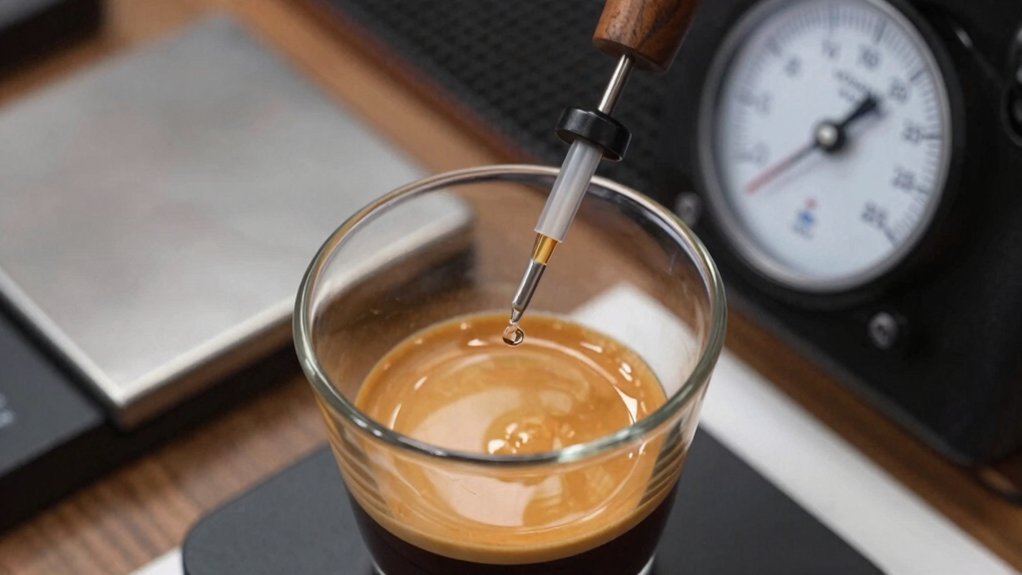
First, zero your refractometer with a drop of room‑temperature distilled water, then filter a 1–2 mL espresso sample through a 0.45 µm syringe filter to remove fines. Place the filtered drop on the prism, let it stabilize for 10–20 seconds, and record the TDS. Weigh your coffee dose and the final beverage, then calculate Extraction Yield as (beverage weight × TDS) ÷ dose weight, aiming for 18‑22 %. If you keep going, you’ll discover how to fine‑tune the process and troubleshoot common errors.
Why Measure Espresso Extraction With a Refractometer?
Why bother measuring espresso extraction with a refractometer? You’ll get numbers, let you fine‑tune your brew. TDS tells you how much solute dissolved in the cup, and from that you compute Extraction Yield, the key quality metric. A well‑calibrated refractometer, after a quick distilled‑water zero, lets you weigh the dose, pull a shot to a target beverage weight, and measure a 1–2 ml filtered sample. Plug the values into EY = (Beverage Weight × TDS) / Dose Weight, and you’ll see, for example, an 18 g dose, 36 g beverage, and 9.5 % TDS give a 19 % Extraction Yield—right in the 18‑22 % sweet spot. Filtration removes undissolved solids that would otherwise skew edge detection, ensuring reliable data for every shot. Extraction Yield helps you gauge how efficiently your grind, dose, and brew parameters extract flavors from the coffee.
What You’ll Need for Accurate Espresso Extraction TDS Readings
You’ll start by calibrating your digital refractometer with distilled water, then filter each espresso sample through a fine‑mesh syringe to remove solids.
To ensure readings are comparable across devices, use a consistent temperature compensation approach (ATC when available) and record the brew’s temperature alongside the TDS value for accurate extraction calculations. Extraction Yield Calculator can help translate TDS readings into extraction yield for a more precise assessment.
Keep the sample temperature within a few degrees of the instrument’s set point so the reading stabilizes quickly.
Distilled Calibration
Ever wondered how to lock in reliable TDS readings for each espresso shot? Start with distilled calibration. Fill a glass eyedropper bottle with fresh distilled water, then place a single drop on the refractometer lens. Zero the device to 0.0 % TDS, making sure the lens dries completely before the next step. Keep the sample within about 5 °C of the instrument’s temperature range, and wait ten to twenty seconds for the reading to stabilize. Rinse and season the lens with distilled water each time you switch from a sample to a new shot. Never use brewing water or reverse‑osmosis water for calibration; they’ll skew the baseline and ruin your extraction data. Keep the bottle handy for quick zeroing before every measurement. Cross-back design helps reduce neck strain during long calibration sessions and keeps your workflow comfortable.
Precise Sample Filtration
From the moment you pull a shot, filtering the espresso sample is essential for reliable TDS readings; a 0.45 µm syringe filter or a built‑in pre‑filter removes undissolved solids that would otherwise blur the refractometer’s edge detection and inflate the measurement. Choose a high‑quality espresso syringe filter with a coarse pre‑filter to handle the dense coffee puck and prevent clogging. Attach the filter securely to a sterile syringe, draw the hot espresso, and press it through slowly to avoid air bubbles. The resulting clear filtrate will produce sharp, consistent edge lines on the VST digital refractometer, which uses a 0.589 µm laser. If you prefer, a brief centrifugation step can replace filtration, yielding identical TDS values while conserving filter consumables. Temperature retention considerations can influence sample stability during waiting periods between extraction and measurement, so perform measurements promptly or maintain consistent conditions for accuracy.
Consistent Temperature Control
After filtering the espresso through a 0.45 µm syringe filter, the next step is keeping the sample and refractometer at nearly the same temperature. You’ll want the sample and instrument within about 5 °C of each other to curb TDS drift. First, zero the refractometer with distilled water at room temperature, then use a glass eyedropper or clean pipette to transfer the espresso, avoiding sudden temperature shocks. If possible, match the sample temperature to the device’s specification and note it in your calibration log. After placing the drop on the lens, wait 10–20 seconds for the reading to stabilize before recording. Consistent temperature control ensures reliable, repeatable TDS measurements. Maintaining stable ambient conditions around the measurement area can further reduce drift during longer sessions temperature stability and help ensure repeatable results across different batches.
Calibrating Your Espresso Refractometer – Step‑by‑Step
How do you guarantee your espresso refractometer reads accurately every time? First, fill a clean dropper with room‑temperature distilled water and place a single droplet on the the. Wait 10–20 seconds for the TDS to stabilize, then adjust the zero until the display reads exactly 0.0 %. Use only distilled water for zeroing, and it do before any coffee measurements. After you set the zero, wipe the lens gently with a paper towel or microfiber cloth to remove any moisture that could skew later readings. Make sure the water temperature stays within ±5 °C of the instrument’s specification; this keeps the refractometer’s index of refraction consistent. Finally, take several readings of the same droplet; if they match, your calibration is solid and you’re ready to measure espresso extraction. ATC ensures readings remain accurate across temperature variations.
Preparing Espresso Samples: Filtered vs. Unfiltered Techniques

Now that your refractometer is calibrated, you’ll want to decide whether to filter your espresso before taking a measurement. If you choose filtered, pull the shot through a 0.45 µm syringe filter or use the machine’s built‑in pre‑filter. This removes fine coffee particles that would otherwise scatter light and produce a fuzzy edge on the refractometer display, giving you a cleaner TDS reading. Filtered samples also prevent clogging when the brew carries a high solids load, keeping the instrument stable across repeats. Unfiltered espresso, by contrast, leaves those particles in the liquid, leading to higher apparent TDS values and less precise data. Follow any model‑specific guidance, but most baristas find filters essential for consistent, reliable measurements. Chargeable battery with docking coaster provides a reliable power option to keep your measurement workflow uninterrupted during long sessions.
Taking Your First Espresso TDS Measurement
First, you’ll filter a 1‑2 ml espresso sample and place it on the refractometer lens, letting it settle for 10–20 seconds. Then you’ll read the TDS value, note the exact beverage weight, and record both numbers before anything else changes. Finally, you’ll use those figures to calculate your extraction yield and see if it lands in the 18‑22 % sweet spot.
Prepare Sample Properly
Ever wondered why your TDS readings seem off? Start by calibrating the refractometer with a drop of room‑temperature distilled water until it reads 0.0 %. Weigh your dose and target beverage weight before pulling the shot—say 18 g dose for 36 g beverage for a 1:2 ratio. After brewing, filter the espresso using a syringe filter or centrifuge; unfiltered liquid gives fuzzy, inflated numbers. Place 1–2 mL of the filtered sample on the prism, wait 10–20 seconds, then record several consistent readings. Use those TDS values in the VST calculation: ExtractionYield = (Beverage Weight × TDS) ÷ Dose Weight, aiming for 18–22 % to keep your extractionYields on target.
Read and Record Accurately
One quick step before you start pulling shots is to make sure your refractometer is calibrated to 0.0 % with room‑temperature distilled water. After you pull the espresso, weigh the dose (e.g., 18.0 g) and note the beverage weight (e.g., 36.0 g for a 1:2 ratio).
Place 1–2 ml of filtered espresso on the prism, keeping the sample within ~5 °C of the instrument’s temperature. Wait 10–20 seconds for the readout to stabilize, then record the TDS value.
Jot down dose, brew mass, and beverage weight alongside the TDS so you can compute Extraction Yield later. Using a filtered sample prevents fuzzy readings and ensures the Extraction Yield calculation reflects true solubles.
Sampling Espresso Slurry for Mixed‑Method Yield
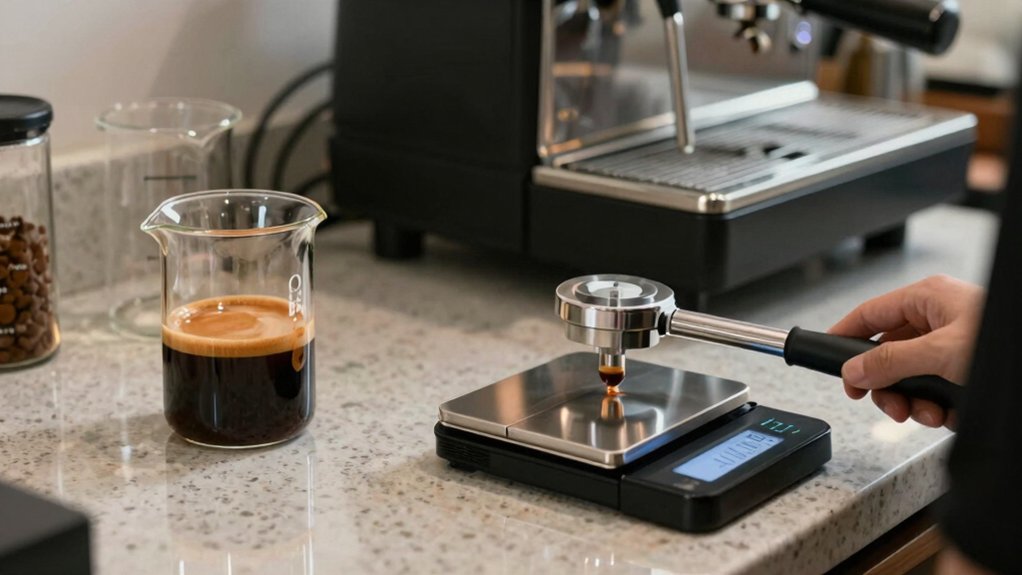
How do you capture the true end‑point of an espresso extraction? You collect the last few drops as they leave the brewer, then perform slurry sampling with the same TDS method you used for the main brew. Transfer the drops into a clean container, filter them exactly as you’d the full shot, and measure their TDS. Matching timing, filtration, and measurement conditions guarantees that the slurry TDS reflects the concentration of solids still evolving in the final portion, giving you a more accurate extraction yield across methods.
- Use identical filters and refractometer settings for both samples.
- Record the exact moment you stop the flow to keep timing consistent.
- Apply the slurry TDS value in the mixed‑method EY equation for a reliable end‑point metric.
Applying Slurry Data to Mixed‑Method Extraction Calculations
Now that you’ve captured the final‑drop slurry and measured its TDS, you can plug that value into the mixed‑method extraction yield (EY) equation. First, enter the slurry TDS and the corresponding fabs (fraction of water embedded in particles) into the calculator. The tool adds the slurry‑derived term to the brew‑derived term, each weighted by the beverage‑to‑dose ratio and total brew volume. If you’re comparing percolation and immersion methods, remember the simplifications: percolation slurry TDS = 0 % and immersion slurry TDS = brew TDS, with fabs = 0 for baseline comparisons. This unified calculation yields a single EY figure that reflects both the end‑point slurry and the overall brew, letting you assess extraction consistency across any espresso or alternative brewing technique.
Calculating Extraction Yield for Drip/Percolation Espresso
Ever wondered how to turn a simple TDS reading into a meaningful extraction yield for drip‑style espresso? You start by weighing the final cup, note the dose, and measure TDS with a refractometer. Then plug those numbers into EY = (beverage weight × TDS) / dose weight. A 36 g brew, 18 g dose, and 9.5 % TDS gives EY ≈ 19 %, right in the 18‑22 % sweet spot. Keep the sample and the main cup consistent in timing and method, or the calculation skews.
- Verify that the TDS value comes from the same brew batch.
- Aim for EY between 18 % and 22 % to avoid sour or bitter extremes.
- Use the formula each time you tweak grind, time, or temperature to track extraction changes.
Calculating Extraction Yield for Immersion‑Style Espresso
When you move from drip‑style to immersion‑style espresso, the extraction‑yield calculation shifts to a single‑step formula that uses the final cup weight, the dose weight, and the TDS reading of the brewed liquid.
First, weigh the coffee dose before brewing.
Weigh the coffee dose before brewing to establish the baseline for extraction calculations.
After the immersion brew finishes, weigh the entire beverage, then measure its TDS with a calibrated refractometer.
Compute Extraction Yield by multiplying the TDS (as a percent) by the beverage weight, dividing by the dose weight, and multiplying by 100.
This gives you a percentage you can compare to the 18‑22 % target range.
Consistent sampling at the brew’s end and proper refractometer calibration ensure the TDS value truly reflects the final concentration, keeping your Extraction Yield accurate and repeatable.
Troubleshoot Common Espresso Refractometer Errors
Why do your refractometer readings drift or spike? You’re probably missing filtration, temperature balance, or calibration. Unfiltered espresso leaves particles that scatter the 0.589 µm laser, creating fuzzy lines and inflated EY values. Even tiny undissolved solids linger, so always run the shot through a 0.45 µm syringe filter or the built‑in pre‑filter before placing it on the prism. Keep the sample within 5 °C of the instrument and wait 10–20 seconds for stabilization; temperature lag skews TDS. Finally, reset the refractometer to 0.0 % with room‑temperature distilled water before each session.
- Use proper filtration to prevent clogging and improve consistency.
- Verify sample temperature matches the device before measurement.
- Calibrate with distilled water each time you start a new batch.
Frequently Asked Questions
How to Measure Extraction of Espresso?
You weigh the dose, brew the shot, filter the espresso, then use a calibrated digital refractometer to read TDS; plug the values into EY = (beverage × TDS) ÷ dose to get extraction.
What Is the 80 20 Rule for Coffee?
You apply the 80/20 rule by focusing on the 20 % of variables—grind size, dose, brew ratio, and extraction yield—that deliver 80 % of flavor, letting you tweak just those key factors for consistent espresso.
How to Use a Refractometer for Coffee?
You calibrate the refractometer with distilled water, then place a filtered 1‑2 ml coffee sample on the prism, wait ten seconds, read the TDS, and calculate extraction yield using the dose‑and‑beverage weights.
What Is the Best Refractometer for Espresso?
You’ll get the most reliable espresso readings with the VST Lab Refractometer; its 0.589 µm laser, quick zeroing, and espresso‑specific calibration give precise TDS, easy filtration, and consistent results.
In Summary
Now you’ve got the tools, calibration steps, and calculations you need to gauge espresso extraction with a refractometer. By measuring TDS, applying slurry data, and computing extraction yield—whether you brew drip, percolation, or immersion—you can fine‑tune your grind, dose, and pressure for consistent, balanced shots. Keep troubleshooting errors, and you’ll consistently hit the sweet spot in every cup.


