

Start with fresh, cold milk and fill the pitcher to about a quarter‑third full so you have room for aeration. Purge the wand, then angle it 20‑30° toward you and submerge the tip slightly off‑center to create a tight vortex. Introduce a little air until the milk hits around 37 °C, then lower the wand and keep the vortex steady while you texture to 55‑60 °C. Tap, swirl, and pour to settle the micro‑foam, then wipe the wand and store the pitcher upright. Keep these steps consistent and you’ll master flawless steaming, and the next tips will fine‑tune your latte art.
Choose the Right Milk & Set the Proper Volume
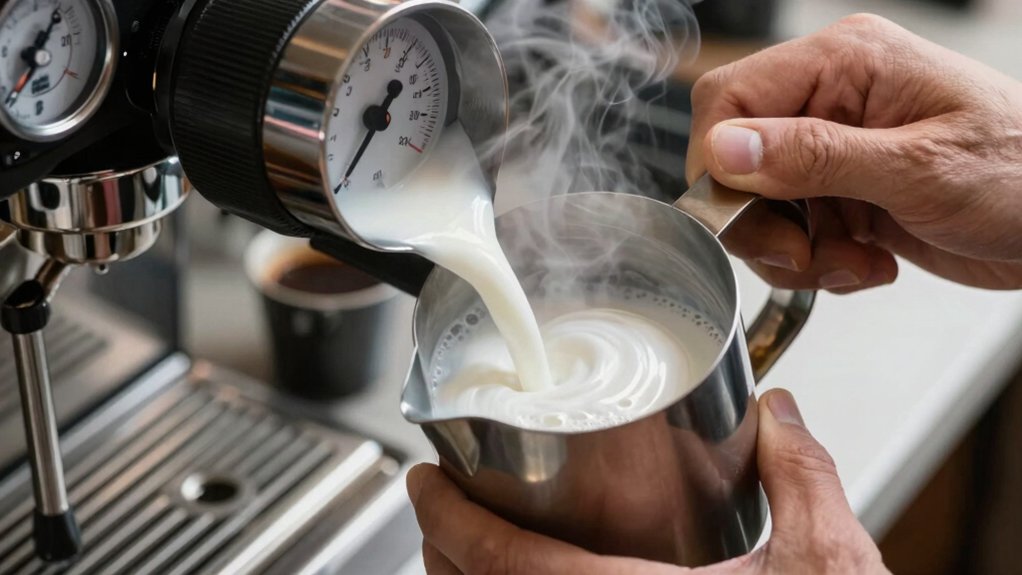
Fill your milk jug to about one‑quarter to one‑third full; this steaming volume leaves room for proper aeration and prevents overflow. Always start with a clean jug and purge the wand, so no residue contaminates the milk. Using disposable filters can simplify cleanup after steaming filter choices and maintain consistent taste.
Angle the Steam Wand for Controlled Aeration in Milk Steaming
When you angle the steam wand 20‑30 degrees toward yourself, you create a tight vortex that pulls air in evenly without forming big bubbles. This steam technique lets you control aeration while keeping the wand tip submerged and slightly off‑center, so the milk steaming process yields silky microfoam instead of frothy clumps. The steady vortex also helps integrate the microfoam with the milk for a smoother texture and more consistent latte art potential. aeration control is enhanced by maintaining a consistent depth and adjusting the angle as you approach the target temperature. 1. Hold the jug parallel to the counter, guiding the wand into a gentle whirl. 2. Start with shallow depth to introduce air, then lower gradually for steady vortex. 3. Tilt the jug just enough to balance air intake and shear. 4. Stop aeration once the temperature reaches 37 °C, then continue steaming for textured milk.
Form a Vortex & Check Temperature While Milk Steaming

Tilt the jug a few degrees and lift it about 1 cm so the steam wand dives deeper, creating a milk vortex that swirls air evenly. Position the wand off-center at a 20–30° tilt angle toward you; this induces rotation without big air bursts, fostering uniform microfoam. Begin with gentle aeration to build volume, then keep the wand at a steady depth as you texture the milk. Perform a temperature check early, aiming for roughly 37 °C (99 °F) while the vortex forms, then continue steaming until the milk reaches 55–60 °C (130–140 °F). Stop at that range to preserve foam stability and prevent the microfoam from collapsing. USB-C rechargeable options in some models support consistent power delivery during longer steaming sessions, helping maintain steady performance.
Swirl, Tap & Pour for Latte‑Art‑Ready Milk Steaming
Ever wondered why some latte art looks flawless while other cups just melt into a dull swirl? You’ll master the swirl, tap, and pour routine that turns ordinary milk into latte‑art‑ready microfoam.
First, create a milk vortex by lifting the jug a centimeter and tilting the wand; this steady aeration blends air evenly. As the vortex forms, practice jug tapping to feel the temperature rise and to pop big bubbles. Also, maintain compatibility with your machine’s cleaning and maintenance routines to ensure consistent performance across brews universal descaler compatibility.
Lift the jug, tilt the wand, and tap to blend air, monitor temperature, and pop bubbles.
When the milk hits about 37 °C, stop aeration and focus on texturing, then give the pitcher two firm bangs to settle the foam.
Finally, pour with confidence, letting the smooth microfoam swirl into crisp latte art.
- Lift & tilt for a tight vortex.
- Tap the jug to monitor temperature control.
- Stop aeration at 37 °C, start texturing.
- Bang the pitcher, then pour for latte art.
Clean the Wand & Store the Pitcher for Consistent Results

Why does a spotless wand and a properly stored pitcher matter for every cup you pull? You purge steam wand before and after texturing to clear condensation and deliver clean steam. Then you wipe wand with a damp, dedicated cloth, preventing milk residue that ruins foam. Use a clean pitcher, preferably a dedicated steaming pitcher, and store upright when idle to avoid cross‑contamination. After steaming, place the pitcher on the counter instead of holding it, ensuring heat‑safe handling for the next step. This routine keeps flavor pure, maintains consistent temperature, and protects equipment. By treating the wand and pitcher as essential tools—cleaned, purged, and stored correctly—you guarantee reliable texture, taste, and latte‑art quality in every brew. SCA standards
Frequently Asked Questions
How Do Cafes Steam Milk so Well?
You start the wand at the surface, create a vortex, keep it off‑center, steam to 140‑150 °F, then swirl, tap, and pour quickly. This yields uniform microfoam and consistent latte art.
How to Get Perfectly Steamed Milk?
You’ll start with a brief aeration, then submerge the wand to spin a vortex, keep the milk around 37 °C, lift the jug a centimeter, and stop at 55‑60 °C for silky, stable microfoam.
What Makes Barista Milk Special?
You love barista milk because its balanced fat‑protein mix creates velvety microfoam, its temperature‑controlled steaming preserves protein structure, and its homogenized texture yields consistent bubbles for flawless latte art.
How to Steam Milk Perfectly in Good Coffee?
You start with cold milk, submerge the wand just below the surface, create a gentle vortex, and stop at 55‑60 °C, then swirl to eliminate large bubbles and achieve silky, pourable microfoam.
In Summary
Mastering the perfect milk steam is all about consistency and control. Pick fresh, cold milk, fill the pitcher to the right level, and angle the wand to introduce just enough air. Keep the pitcher spinning for a tight vortex, watch the temperature hit 140–150 °F, then swirl, tap, and pour for silky, latte‑art‑ready foam. Finally, clean the wand and store the pitcher properly so every shot feels flawless.


