

Keep your brew water at 90‑96 °C by using a well‑insulated, high‑mass dual‑boiler and a finely tuned PID that isolates brewing from steaming. Place a fast‑response sensor near the group head, calibrate it with an ice‑bath or certified thermometer, and adjust the proportional, integral, and derivative settings until the temperature stays within ±0.5 °C. Warm up the machine, portafilter, and cups for at least 20 minutes, and regularly clean and re‑calibrate the sensor. Following these steps will give you consistent flavor and set you up for deeper insights.
Why Thermal Stability Matters for Espresso
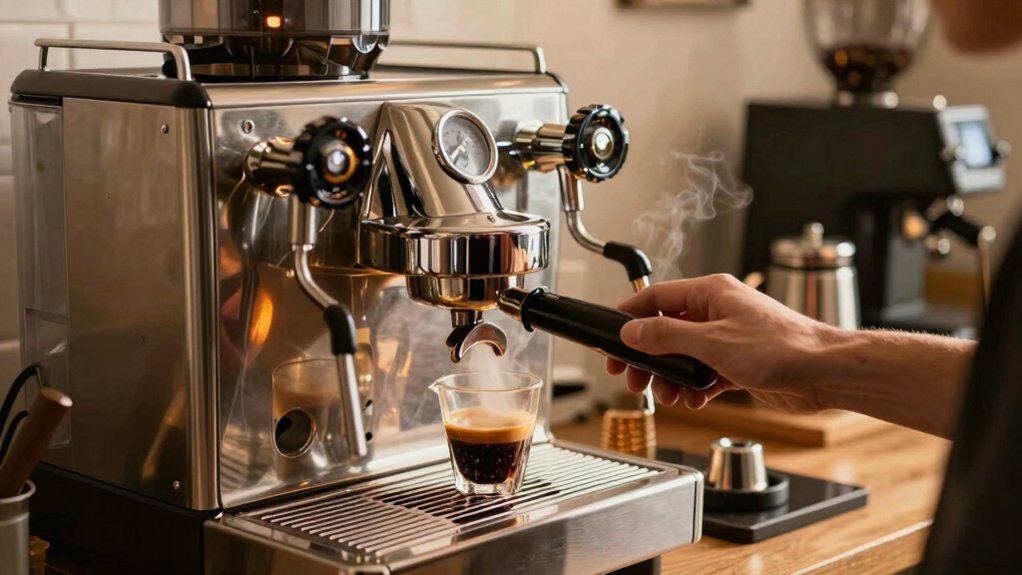
Why does thermal stability matter for espresso? You’ll notice that a few degrees shift can swing your shot from sweet to sour or bitter. When the water stays within ±0.5–1 °C of the target 90‑96 °C, you preserve body, acidity, and consistency. A PID controller delivers that tight Temperature control, reacting instantly to demand changes, while a dual‑boiler setup isolates brewing from steaming, preventing heat bleed. Without stable temperature, cooler water under‑extracts, yielding thin, sour coffee; hotter water over‑extracts, producing harsh bitterness. Machines that score high on thermal stability earn better flavor ratings, making PID‑driven dual‑boiler systems the benchmark for reliable espresso extraction. BirdRock Home 36 Peg Wall-Mounted Coffee Mug Organizer
Boiler Size, Thermal Mass, and Espresso Machine Thermal Stability
Ever wondered how a larger boiler actually steadies your espresso? A bigger boiler size boosts thermal mass, so more energy is needed to shift water temperature. That inertia damps swings, keeping brew temperature consistent.
The extra mass in pipes, group head, and portafilter also buffers heat loss as water moves, further smoothing temperature stability. When you pair that heft with PID control, you can lock temperature within ±0.5 °C, far tighter than the ±1–4 °C drift of lighter machines.
Dual‑boiler designs exploit this principle by isolating brew and steam circuits, letting each boiler settle with greater inertia and less cross‑talk. Just remember: high thermal mass slows warm‑up, so plan your pre‑heat routine to avoid overshoot.
PID Controllers and Espresso Machine Thermal Stability
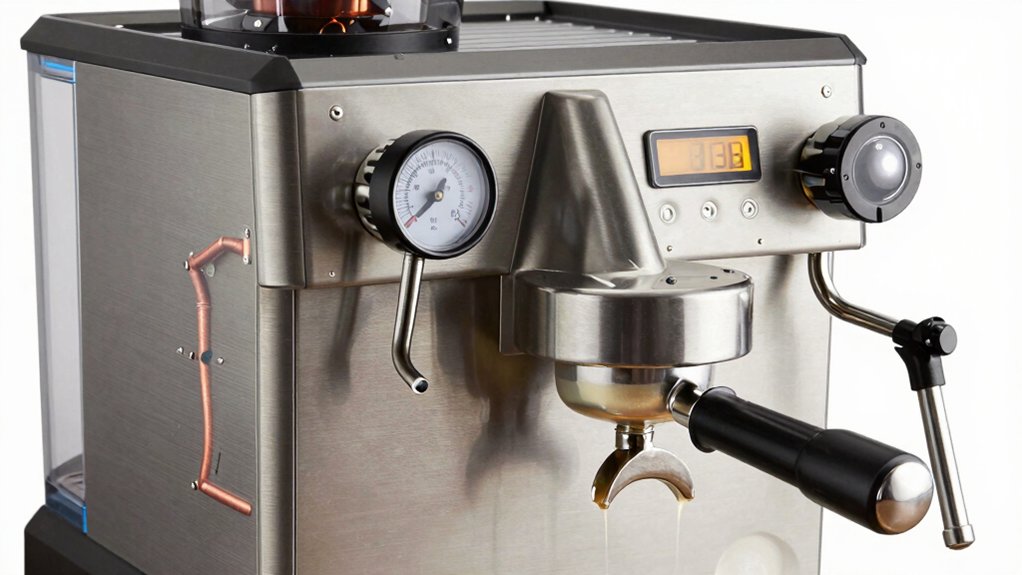
A larger boiler gives you the thermal mass to keep temperature steady, but without a PID controller that steadiness quickly drifts. PID controllers continuously modulate heating, keeping brew temperature within ±0.5 °C of the setpoint instead of the wide swings caused by on/off thermostats. The proportional term tackles the immediate gap, the integral term erases accumulated offset, and the derivative term predicts future change to avoid overshoot. In dual‑boiler machines, you’ll typically set a tighter PID on the brew boiler for precise brew temperature, while a looser PID on the steam boiler lets steam recover quickly. Adaptive learning and auto‑tuning features help maintain café‑level thermal stability even during peak usage, reducing manual recalibration needs and aligning with device trends such as multi‑unit controls and data tracking across brewing workflows. PID control
How Different Boiler Designs Affect Temperature Stability
When you compare boiler designs, the type you choose directly determines how steady your brew temperature will stay. A dual‑boiler configuration gives the highest temperature stability because each PID can focus on a single task: the brew boiler stays within ±0.5 °C‑±1 °C while the steam boiler recovers quickly, minimizing drift.
Heat‑exchanger (HX) machines improve on single‑boiler units, but they still swing ±2 °C‑±3 °C and often need temperature surfing to stay on target.
Thermoblock and single‑boiler designs suffer the widest swings, typically ±3 °C‑±6 °C, due to on/off cycling and heat‑sink loss at the group head. In practice, a well‑insulated, large dual‑boiler with precise PID control delivers the most consistent brew temperatures across shots.
PID Tuning Tips for ±0.5 °C Consistency
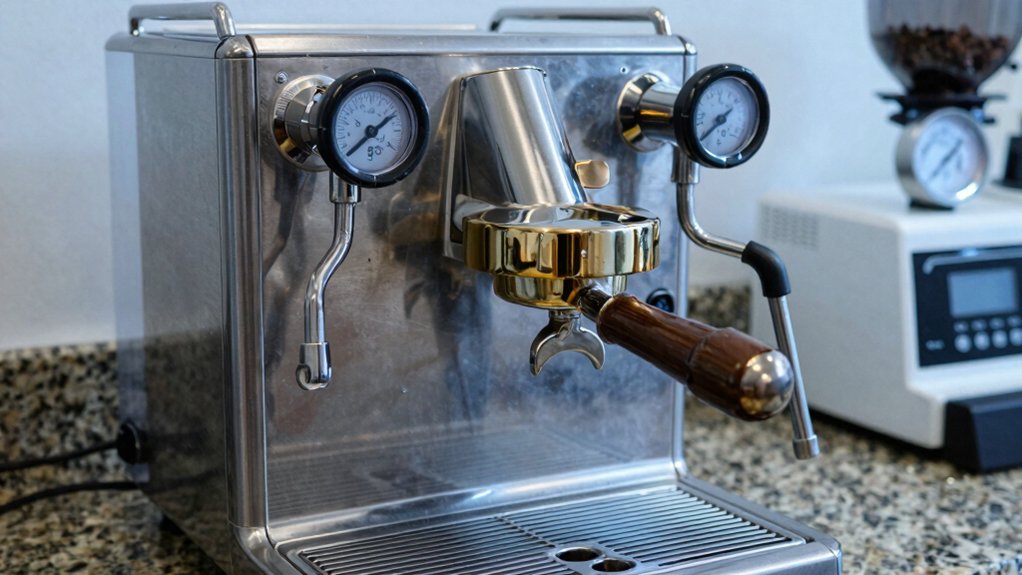
Place your temperature sensor as close to the brew head as possible so you capture the true brewing temperature, then fine‑tune the PID parameters in small increments, watching each shot for drift.
Raise the proportional gain just enough to speed the response without causing overshoot, and adjust the integral and derivative values to lock the temperature within ±0.5 °C. Direct-trade sourcing helps you understand the consistency of the beans and how fresh roast timing can impact the thermal stability during extraction.
Temperature Sensor Placement
Ever wondered why your espresso temperature drifts by a degree or two? The trick lies in temperature sensor placement. Mount the sensor as close as possible to the brew water path—inside the boiler or right near the group head—so it reads the true water temperature instead of ambient heat. Choose a fast‑response RTD or high‑quality thermocouple and insulate its leads; this cuts lag and keeps readings stable within ±0.5 °C. Keep the sensor away from direct steam jets or boiling surfaces to avoid hotspot distortion. Finally, run a calibration against an ice‑water bath or a certified thermometer, then verify it shot‑by‑shot. Regular checks and calibration keep your thermal stability on point. USB-C rechargeables can further streamline power stability for smart brew cycles and consistent readings across sessions.
PID Parameter Refinement
Why settle for temperature swings when you can lock your brew within ±0.5 °C by fine‑tuning the PID? Start with the factory PID values and n each parameter in tiny increments—raise P from 2.0 to 2.5, n I from 0.8 to 1.0, keep D around 0.2–0.3. Run a series of back‑to‑back extractions and watch the water temperature drift. If the drift widens, pull I back or lower P to curb overshoot. For dual‑boiler machines, keep the brew‑boiler PID tighter (higher P, modest I, conservative D) while allowing the steam boiler a looser setting for quick milk recovery. Target setpoints by roast level—Light 93.5–94 °C, Medium 92.5–93 °C, Dark 91–92 °C—to guide initial tuning. Advanced users can enable adaptive auto‑tuning to maintain ±0.5 °C consistency without manual tweaks. PID tuning
How to Cut Warm‑Up Time and Keep Your Machine Stable
When you pre‑heat your espresso machine with a smart plug or timer 30–45 minutes before brewing, you cut the idle warm‑up time dramatically and set the stage for stable temperature control. A PID‑driven boiler maintains a tight curve, so the machine stays on target once the group head finally stabilizes.
Lock an empty portafilter in place and run a 5‑second flush, then repeat without the filter to push residual heat into the group. Use warm cups and pre‑heated vessels to minimize heat loss during extraction.
Prioritize larger boilers with integrated PID; they take longer to reach peak temperature but deliver the most consistent stability.
Blank shots after the initial warm‑up transfer heat quickly, shaving minutes off the overall cycle.
Measuring Group‑Head Temperature Accurately
You’ll want to place the probe just above the group‑head’s metal surface, avoiding the portafilter’s edge to catch the true brew‑path temperature. Calibrate the thermometer against a known reference, like boiling water, before each session to keep measurements spot on. Then read the numbers and compare them to your 90–96 °C target, adjusting pre‑heat or flush routines whenever the reading drifts. A high‑quality thermometer with fast response helps maintain consistent microfoam and reduces overshoot during heating temperature control and is especially important when using integrated heating and frothing functions.
Probe Placement Best Practices
Where should you position the temperature probe to capture the true shot temperature? You place it as close as possible to the group head, ideally touching the metal surface. Use a high‑heat rated thermocouple or RTD, mount it securely, and avoid any movement during extraction. Record readings at rest and during pre‑infusion, and take measurements at several spots—near the gasket, at the center, and at the portafilter interface—to map spatial variance. Consistent probe placement lets you track group‑head temperature accurately, a cornerstone of thermal stability and reliable temperature measurement. A careful approach also benefits from monitoring using durable, refillable diffuser options to maintain consistent environmental conditions around the machine that can influence heat transfer and aroma consistency.
Calibration Techniques for Accuracy
If you want truly reliable temperature readings, start by using an infrared thermometer to scan the group head across the 90‑96 °C range and verify that each shot yields consistent numbers.
Next, insert a probe into the hot‑water flow to compare portafilter temperature with the group head, confirming heat retention.
Perform a blank shot and record the group‑head temperature every few seconds; map that data to reveal temperature drift and adjust the PID parameters accordingly.
Follow with a water‑into‑cup test, measuring cup temperature after pre‑infusion and checking that it stays within ±0.5 °C of the target.
Run at least five trials at the same setpoint, flagging any outliers beyond ±0.5 °C and tweaking the calibration until repeatability meets your standards.
Interpreting Temperature Readings
After calibrating the PID, the next step is to interpret the temperature data you collect. You’ll notice that group head temperature can drift from the boiler reading because of heat sink effects, so you must compare multiple temperature readings. Take readings after a full warm‑up, during steady‑state brewing, and clean the probe each time. Aim for a ±0.5 °C band around 195–205 °F (90–96 °C). Use three points—group head surface, portafilter surface, and a water test—to confirm thermal stability.
| Point | Target (°F) |
|---|---|
| Group head surface | 195‑205 |
| Portafilter surface | 195‑205 |
| Water test | 195‑205 |
If any point falls outside the band, adjust the PID or improve insulation to reduce heat sink effects. This systematic check keeps your espresso consistent.
Maintaining Sensor Accuracy: Cleaning, Calibration, and Replacement
How can you keep your espresso machine’s temperature sensor reliable? Start by wiping each temperature sensor with a soft cloth dampened in isopropyl alcohol after every brewing cycle; this removes coffee oils that cause drift. Schedule calibration monthly: compare the machine’s readout to a validated reference thermometer at 92 °C, 94 °C, and 96 °C, then tweak the PID controller until the numbers align. Keep a log of calibration dates and note any ±2–3 °C drift, which signals a failing probe. If you spot persistent drift or visual fouling, replace the sensor immediately—delays only degrade brew consistency. Finally, inspect wires and connectors for corrosion before each replacement to ensure secure, stable readings.
Thermal Stability Strategies for High‑Volume Espresso Operations
Keeping your temperature sensor spot‑on is only half the battle; in a busy café the whole heating system must stay steady. A dual‑boiler machine with a well‑tuned PID gives you the ±0.5 °C to ±1 °C thermal stability you need for back‑to‑back pulls. Set the brew boiler PID tighter and the steam boiler PID looser so extraction stays consistent while milk recovery remains fast.
Warm up the group head, portafilter, and cups for 20–45 minutes, then purge and flush before service.
Insulate portafilters, cups, and lines, and schedule breaks to avoid sudden ambient shifts. Test by pulling ten consecutive shots and keep the brew water temperature within a narrow band, confirming your system’s stability.
Troubleshooting Common Thermal Instability Issues and When to Call a Technician?
Why does your espresso machine’s temperature wobble after a few shots? You may be missing a thermally stable espresso baseline, and the cause is often hidden in three areas.
- Boiler recovery – If the boiler can’t regain heat between shots, temperature drifts beyond ±1 °C.
- PID tuning – An improperly set PID will over‑ or under‑compensate, creating rapid swings.
- Group head heat loss – A cold group head acts as a large heat sink, pulling temperature down quickly.
Before calling a technician, run a warm‑up routine, pull blank shots, and measure group head temperature with an infrared thermometer. Pre‑heat your portafilter and cups, then re‑check PID settings. Persistent swings, sensor error codes, or heating‑element leaks mean it’s time for professional service.
Frequently Asked Questions
What Is the 80 20 Rule for Coffee?
You follow the 80/20 rule by focusing on the 20 % of variables—grind size, dose, tamp pressure, and water temperature—that deliver 80 % of flavor, letting you prioritize those for consistent espresso.
What Is the Temperature Stability of an Espresso Machine?
You’ll find that most PID‑controlled espresso machines hold brew temperature within ±0.5 °C to ±1 °C, while non‑PID single boilers drift ±4 °C to ±6 °C, HX units ±2 °C to ±3 °C, and thermoblocks about ±3 °C to ±5 °C.
What Is the 30 Second Rule for Espresso?
You run hot water through the group for about thirty seconds before brewing, flushing the system and equalizing temperature, which steadies the group head and reduces cold spots in the portafilter.
How to Keep Coffee Warm for 2 Hours?
You keep coffee warm for two hours by pre‑heating your mug, using an insulated carafe, covering the cup, storing the machine in a draft‑free room, and minimizing exposure to air.
In Summary
By keeping the boiler’s thermal mass balanced, fine‑tuning the PID, and regularly checking sensor accuracy, you’ll lock in a stable temperature that delivers consistent shots. Whether you’re pulling a single espresso or serving a high‑volume line, these practices prevent temperature drift, reduce channeling, and preserve flavor. Stay proactive with maintenance, and you’ll enjoy reliable performance without constantly chasing the perfect brew temperature.


