
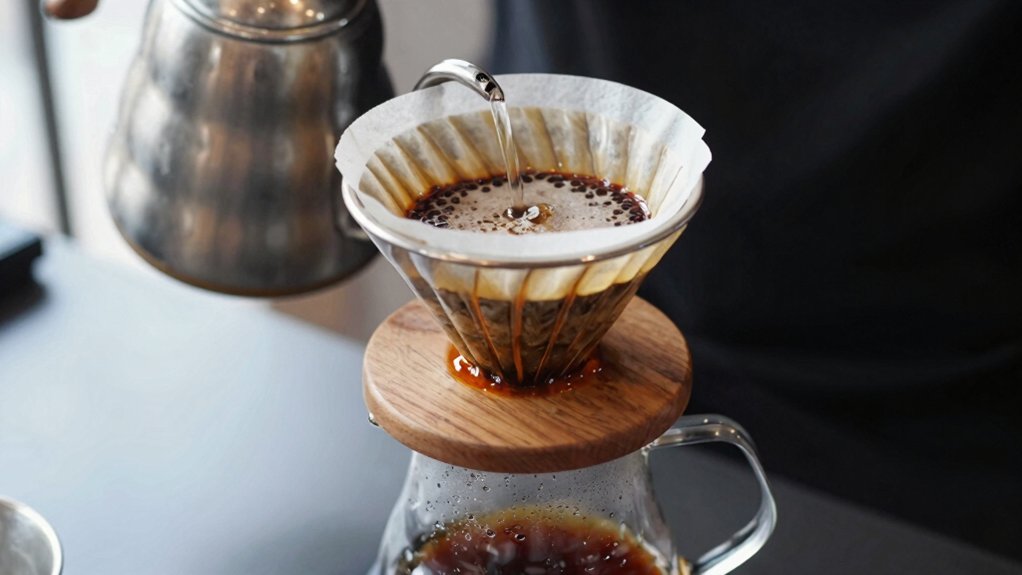
You’ll hit perfect extraction by using a 1:15‑1:17 coffee‑to‑water ratio, tweaking it for grind size, roast level, and your brewer. For a V60 aim for 1:14‑1:16, Kalita Wave works well at 1:17, and Chemex shines at 1:15‑1:16. Light roasts favor 1:16‑1:17 with finer grounds and 92‑94 °C water; dark roasts do better at 1:15‑1:16 with coarser grind and 90‑92 °C. Adjust brew time to 3‑4 minutes, bloom 30 seconds, and fine‑tune temperature to balance brightness and body. The next steps will guide you through exact calculations for any cup size.
What Is the Ideal Water‑to‑Coffee Ratio for Pour‑Over?
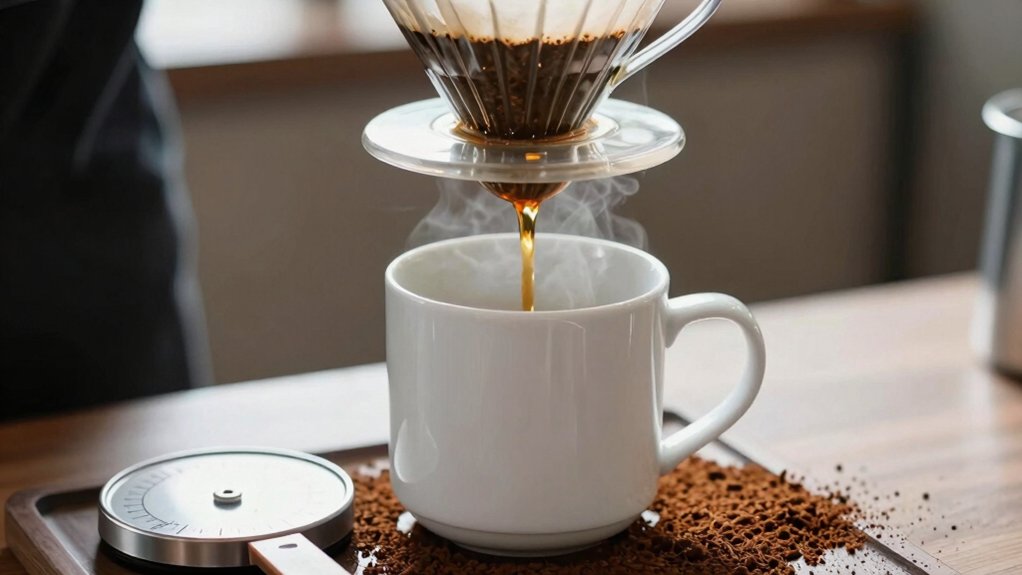
Wondering how much water you should use for a perfect pour‑over? You’ll want a coffee‑to‑water ratio between 1:14 and 1:16, depending on how strong you like your cup. A common starting point is 1:17, which balances clarity and body without over‑extraction. Measure both ingredients in grams for consistency—say, 700 g water to 42 g coffee for a 1:16 ratio.
If your grind is finer, bump the ratio up a touch to keep the brew from turning bitter; coarser grinds can handle a lower ratio for extra strength. Roast level and bean type also shift the sweet spot, so tweak the grams until the pour‑over brewing feels just right. This simple ratio guide lets you dial in flavor every time. The process can be enhanced by using a refractometer to monitor extraction metrics TDS and extraction and adjust your grind and pour accordingly for consistent results.
Device‑Based Ratio Shifts for Pour‑Over (V60, Kalita Wave, Chemex)
You’ll find the V60 shines at a 1:14‑1:16 ratio, delivering bright, clean cups. In practice, many setups also benefit from starting the first pour with a gentle bloom to enhance aroma, while maintaining a steady pour rate for even extraction automatic low-voltage shutdown.
V60 Ratio Guidelines
V60 ratio guidelines hinge on a 1:15–1:17 coffee‑to‑water balance, where 1:15 gives a fuller body and 1:17 produces a lighter cup. Start with 15–18 g of coffee per 250 g of water, then fine‑tune within the 1:15–1:17 range. Choose a grind size a little finer than Chemex but coarser than espresso; this keeps extraction in the 3‑4‑minute window. Begin with a 30‑second bloom, pouring just enough water to saturate grounds, then pause. Follow with a slow, spiraling pour technique that maintains even saturation and avoids channeling. Adjust pour speed if the brew runs too fast or slow, and watch the brew time to hit your target ratio. This approach delivers consistent flavor clarity and body control. A consistent pour tempo helps maintain a stable extraction water distribution.
Kalita Wave Consistency
Moving from the V60’s conical flow to the Kalita Wave’s flat‑bottom design changes how the ratio translates to flavor. The flat‑bottom filter gives you consistent extraction, so a 1:17 coffee-to-water ratio works well for balanced clarity and body. Aim for a brew time of about 3–4 minutes and keep your grind size similar to the V60, but you may need a slightly finer setting to maintain saturation. Because the Wave’s wave‑filter spreads water evenly, small grind tweaks produce predictable strength changes without sudden clarity shifts. Slow your pour just enough to keep the flow steady, and you’ll avoid under‑extraction while preserving the smooth, uniform profile the Kalita Wave is known for. Consistency benefits help stabilize flavors across pours and allow for repeatable results with this method.
Chemex Flow Adjustments
Since the Chemex relies on a thick paper filter and a flat‑bottom dripper, you’ll need a slower, steadier pour and a slightly coarser grind to stay within the 3‑4‑minute window. Aim for a brew ratio of 1:14‑1:16; a 1:16 ratio (≈42 g coffee to 700 g water) gives a lighter cup, while 1:14 yields more concentration. When you tweak Chemex flow adjustments, focus on bloom saturation—pour just enough water to wet all grounds, then wait 30‑45 seconds. Use a steady, circular pour pattern to keep extraction balance even across the flat bottom. If the brew runs fast, coarsen the grind size slightly; if it drips too slowly, fine‑tune the grind or increase the brew ratio toward the higher end. Flow control can help you better manage extraction consistency across different batch sizes.
Roast‑Based Ratio Adjustments in Pour‑Over (Light, Medium, Dark)
Ever wonder why a light roast sometimes tastes brighter than a dark one in the same pour‑over? The secret lies in tweaking the coffee ratio to match the roast level, grind size, and water temperature, which all shape extraction. Light roasts usually need a slightly higher ratio (1:16‑1:17) to soften acidity, while dark roasts thrive at 1:15‑1:16 for richer sweetness. Medium roasts sit comfortably in the 1:16‑1:17 window, delivering balanced body and aroma. Small adjustments of ±0.5 in the ratio can dramatically affect extraction speed and flavor clarity.
- Light roast – 1:16‑1:17, finer grind, 92‑94 °C water
- Medium roast – 1:16‑1:17, medium grind, 93‑95 °C water
- Dark roast – 1:15‑1:16, coarser grind, 90‑92 °C water
- Test ±0.5 ratio tweaks to fine‑tune extraction precision.
Grind‑ & Brew‑Time Ratio Refinement for Pour‑Over
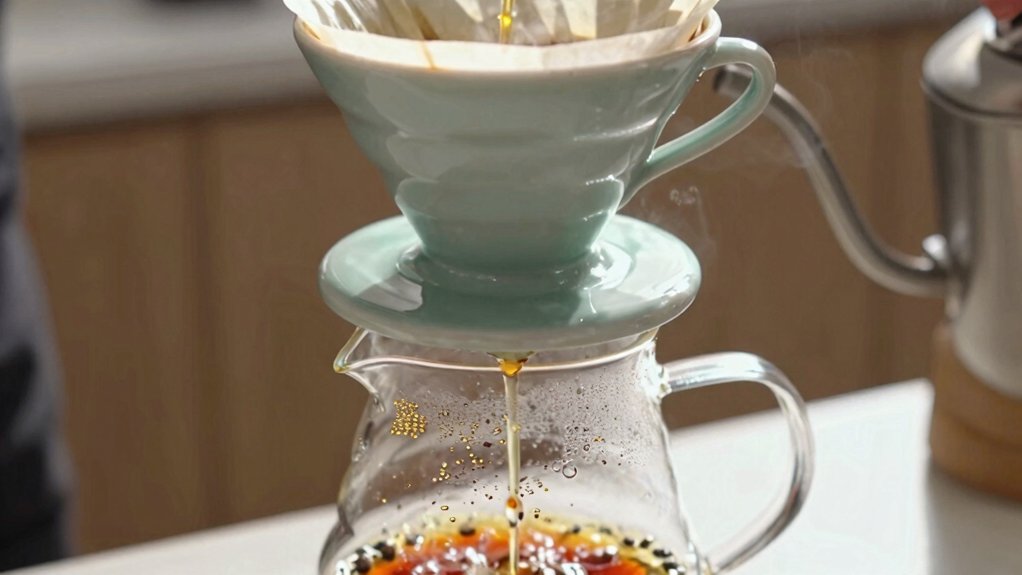
You’ll start by matching your grind to the brewer—finer for a V60, coarser for a Chemex—then tweak the brew time to stay within the 3‑4‑minute window. If the pour finishes too fast, tighten the grind or add a bit more coffee; if it drags, go coarser or cut the dose. A controlled, spiraling pour with a gooseneck kettle helps keep the water level steady and the extraction consistent. Moisture absorption and surface protection considerations in coaster choice can influence your setup and keep your brewing area clean and organized for repeatable pours surface protection and clamp down on slips and spills during your session.
Grind Size Optimization
What grind size should you choose to hit the perfect 3‑4‑minute pour‑over? You’ll start with a medium‑fine grind for a V60 and a medium grind for a Chemex, then tweak based on flow. A consistent grind size distribution from a quality burr grinder gives steadier brew time and reliable extraction balance. If the water rushes through, the grind is too coarse; if it drips slowly, it’s too fine. Adjust in small increments until you land in the 3‑4 minute window.
- Measure your current grind with a scale.
- Observe the flow rate during the first pour.
- Fine‑tune the burr grinder a notch coarser or finer.
- Re‑test brew time and note the taste shift.
Brew Time Adjustment
How can you fine‑tune your pour‑over brew time to land squarely in the 3‑4‑minute window? Start with a consistent bloom, then pour in 3–4 even pours while watching the level. If the total brew time ends up near 2 minutes, grind finer; the finer particles slow extraction, extending the brew. If it drifts toward 5 minutes, coarsen the grind so water moves faster. Adjust the pour rate—slower pours lengthen extraction timing, faster pours shorten it. Keep the vessel about half to two‑thirds full after bloom to maintain steady flow. By tweaking grind size and pour rate in real time, you align brew time with the ideal 3‑4‑minute window and achieve balanced extraction.
Water‑Temperature Adjustments for Pour‑Over Extraction
Adjusting water temperature lets you fine‑tune extraction, balancing brightness and body in a pour‑over. Most recipes target 195–205°F (90–96°C). Start at 205°F, then let the water sit 30 seconds off the boil to lock in a stable brewing temperature. If your coffee leans dark or you notice excessive bitterness, drop a few degrees; for light, floral beans, keep it near the high end. Remember that water temperature, grind size, and brew ratio work together—finer grinds or stronger ratios usually benefit from a slightly lower temperature to avoid over‑extraction.
- Boil, then rest 30 seconds.
- Aim for 195–205°F.
- Adjust down for dark roasts.
- Adjust up for bright, floral beans.
How to Calculate the Right Ratio for a 250 ml, 350 ml, or 500 ml Cup
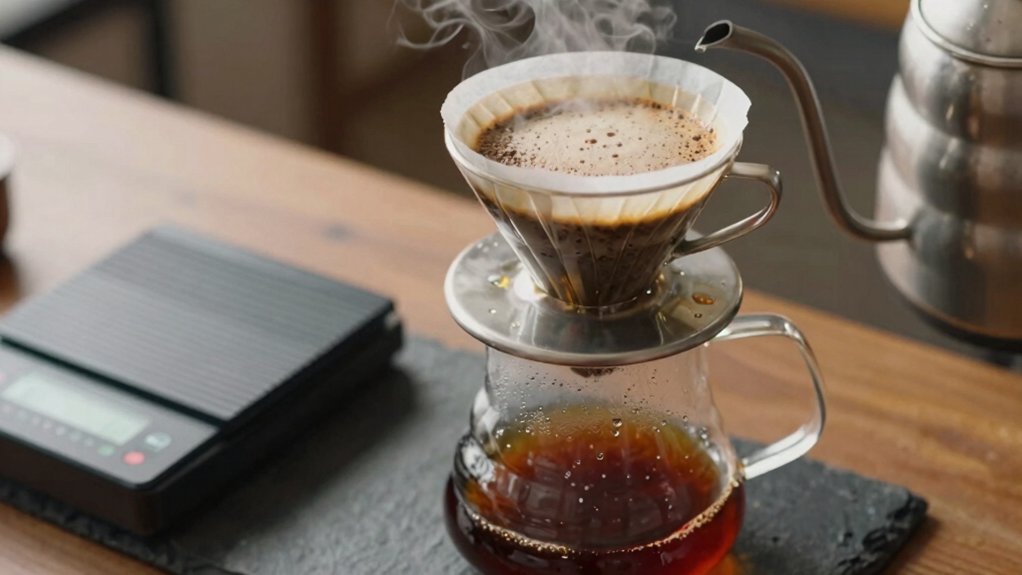
Wondering how much coffee you need for a 250 ml, 350 ml, or 500 ml pour‑over? Start with a coffee‑to‑water ratio of 1:15‑1:17 for a 250 ml cup—about 16–17 g of coffee.
Start with a 1:15‑1:17 coffee‑to‑water ratio for a balanced 250 ml pour‑over.
For a 350 ml cup, aim for a 1:16 ratio, which means roughly 22 g.
For a 500 ml cup, the same 1:16 ratio calls for about 31 g.
If you prefer a stronger brew, shift toward the 1:15 end; for a lighter cup, drift to 1:17‑1:18.
Adjust these numbers based on your grind size and brew method: finer grinds often need a slightly lower ratio to prevent over‑extraction, while coarser grinds may tolerate a higher ratio.
This quick calculation keeps each cup balanced and consistent.
When Your Pour‑Over Is Too Bitter or Weak: Ratio Fixes
Ever notice a pour‑over that tastes harsh or flat? You can dial in flavor by tweaking your coffee-to-water ratio, grind size, and brew time. If the cup feels over‑extracted and bitter, try a coarser grind and a lighter ratio like 1:16 or 1:17. For an under‑extracted, weak brew, boost coffee dose or drop water to a 1:15–1:16 ratio. Keep brew time around 3–4 minutes; adjust the ratio within 1:14–1:18 if the pour runs too long or short.
- Coarser grind + 1:16 ratio → less bitterness
- Finer grind + 1:15 ratio → more body
- Extend brew time 4 4 min → deeper extraction
- Shorten brew time <3 min → lighter cup
Frequently Asked Questions
What Is the Perfect Pourover Ratio?
You’ll hit the sweet spot with a 1:15 coffee‑to‑water ratio, adjusting between 1:14 and 1:16 based on grind and taste; start at 1:15 and tweak until the extraction feels balanced.
What Is the 15-15-15 Rule for Coffee?
You follow the 15‑15‑15 rule by weighing 15 g of coffee and pouring 225 g of water, achieving a 1:15 coffee‑to‑water ratio that delivers a stronger, fuller‑bodied brew.
What Is the Perfect Coffee Extraction Ratio?
You’ll hit perfect extraction by aiming for about 18‑22 % solubles, which usually means a 1:17 water‑to‑coffee weight ratio, adjusting grind, temperature, and brew time until the taste balances sweet and bright.
Which Coffee Is Better, 80/20 or 60/40?
You’ll find 60/40 usually better for clarity and balance, while 80/20 gives richer body and sweetness. Choose 60/40 for bright, lighter roasts, and 80/20 for darker, more robust beans.
In Summary
Mastering pour‑over is all about tweaking the water‑to‑coffee ratio to match your device, roast, grind, and taste preferences. By adjusting the ratio, brew time, and temperature, you can dial in the perfect extraction for any cup size. Keep experimenting, trust your palate, and you’ll consistently pull a balanced, flavorful brew—whether you like it bright, mellow, or bold.


