
You’ll boost rush‑hour throughput by pre‑setting every pitcher, hopper, syrup, cup and lid before opening, testing grinders and steamers, and arranging a tight U‑shaped bar to cut travel time. Batch‑steam milk and pull parallel espresso shots when orders align, then fast‑track simple drinks with visual boards and color‑coded cues. Use keyboard shortcuts and mobile orders to prep modifiers instantly, and keep stress‑resilience techniques handy for peak pressure. Keep reading to discover the detailed step‑by‑step workflow.
What’s a Rush‑Hour Break‑Down Flow and Why Should You Care?
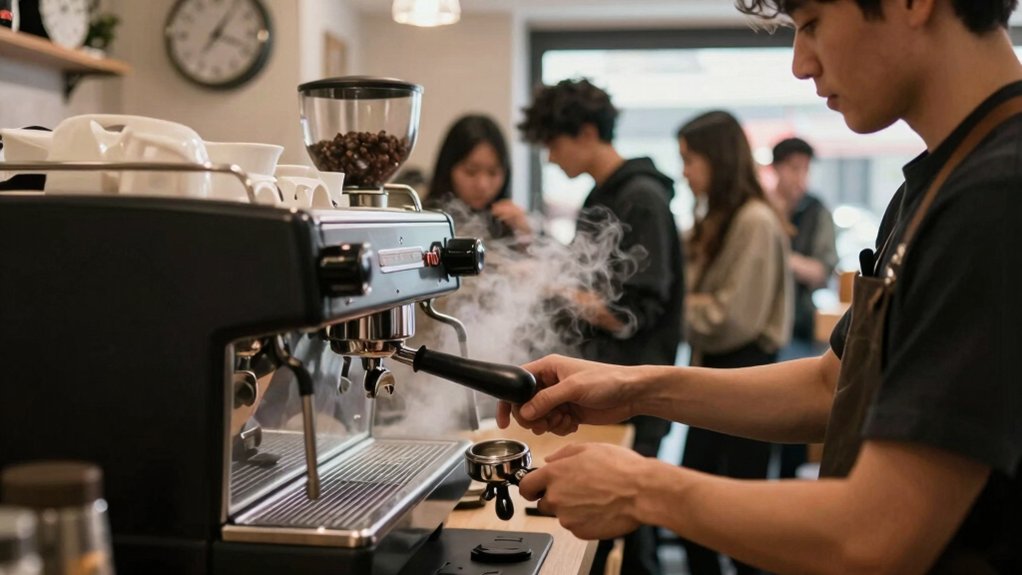
Ever wondered how a well‑orchestrated rush‑hour breakdown flow can keep your coffee bar humming? You start with a pre‑opening mise en place, then follow a consistent station sequence—grinder, knock box, espresso machine, milk jugs—so every barista knows exactly where to go. By batching similar drinks and pulling multiple espresso shots at once, you keep the espresso machine humming without idle time. Steaming large milk quantities to a uniform temperature lets you serve several drinks quickly, while bulk‑prepped cold bases cut prep steps. Real‑time coordination via order displays and standardized call‑outs groups orders by complexity, maintaining a steady rhythm. Cross‑training and backups keep the workflow alive even when equipment or staff falter, preventing cascading delays.
Master the Pre‑Rush Mise En Place Checklist for Zero‑Delay Starts – Rush Hour Barista Efficiency
How do you guarantee a zero‑delay start when the first rush hits the door? You nail preparation by arranging every pitcher, hopper, syrup, cup, lid, and sleeve before opening. Test grinders, steamers, and brewers, then lock in automatic temperature and consistency checks. Keep tamping tools and milk stations within arm’s reach, and set non‑negotiable quality standards with quick visual assessments. When a mistake occurs, a backup process lets you stay moving. The approach aligns with sustainable packaging and product integrity practices such as using standardized cold‑process formulations and maintaining consistent aroma profiles across batches. Packaging sustainability supports efficient stock rotation and reduces waste during peak service periods.
Set Up a U‑Shaped Bar Layout to Remove Bottlenecks
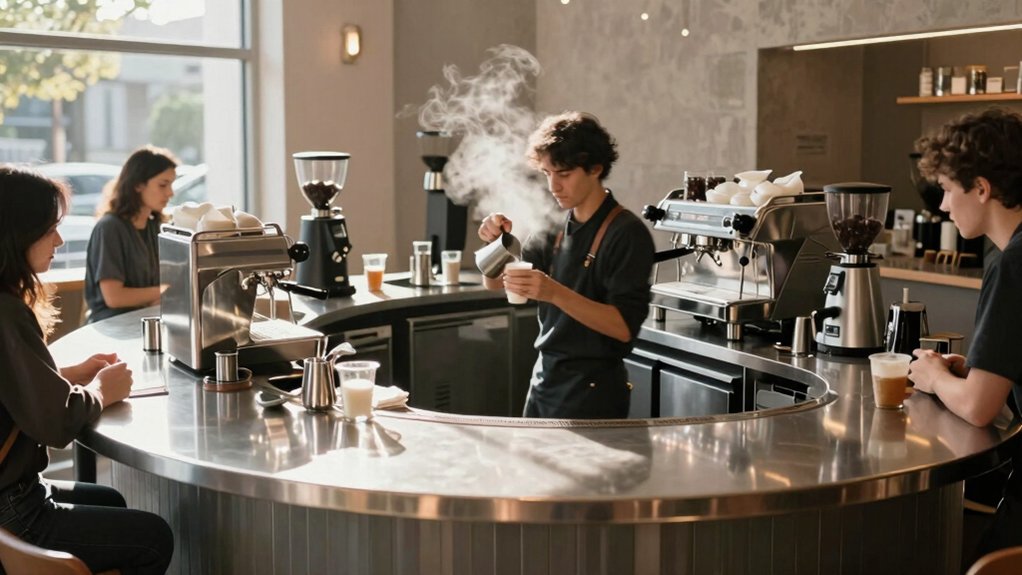
You’ll notice that placing the grinder, espresso machine, and milk station in a tight U‑shape cuts travel time and keeps everything within arm’s reach. By routing foot traffic around the curve, you prevent crossing paths and keep the bar moving smoothly. This clear, standardized zone lets each team member follow a single, repeatable sequence, eliminating handoff delays during rush hour. The layout also accommodates a dedicated display area for streamlined product visibility and quick staff reference display area.
Optimize Equipment Placement
Where does the flow of a rush‑hour bar break down? You’ll spot it when bar must chase tools across the counter, interrupting the workflow. To fix that, arrange your equipment in a tight U‑shaped line: grinder, knock box, espresso machine, then milk jugs. Keep tamping tools next to the grinder and stash milk jugs, cloths, and a stocked fridge within arm’s reach of the milk station. Position a bin and sink beside the espresso machine so waste and dishes disappear instantly. Pre‑place cups, lids, sleeves, and syrups in logical groupings at each station. Assign clear roles—greeting, register, shot, milk, runner—so each person stays within the U‑shaped workflow, eliminating bottlenecks and keeping rush‑hour service smooth. Workflow efficiency is enhanced by positioning the espresso station as the central hub of activity.
Streamline Foot Traffic
When you stop chasing tools across the counter, the next step is to clear the floor for smooth movement. A U‑shaped bar lines the grinder, knock box, espresso machine, and milk jugs into a single, linear workflow, letting foot traffic glide past rather than weave through stations. By keeping everything within arm’s reach, you cut reach-time, keep the bin and sink close to the machine, and eliminate frantic searches for tamping tools. The defined sequence—greeting, register, shot, milk, runner, serving—syncs with the layout, preventing bottlenecks and boosting throughput. Positioning the grinder at the left curve fosters efficient access and supports a steady rhythm during peak hours reusable filtration.
Standardize Work Zones
Ever wondered why a U‑shaped bar eliminates the chaos of rush‑hour traffic? You’ll notice the grinder, knock box, espresso machine, and milk jugs line up in a single loop, letting you move from shot to steam without back‑tracking.
Keep portafilters, tamping tools, and milk jugs within arm’s reach at the milk station, so you never waste a step.
Assign clear responsibilities—greeting, register, shot, milk, runner/serving—and let the U‑shape dictate the sequence; the flow becomes natural, and bottlenecks disappear.
Group equipment by function, stash cleaning cloths, sanitizers, and spare cups nearby, and maintain a tidy organization.
This consistent workflow lets you pull shots, steam milk, and finish drinks in one uninterrupted path, boosting throughput and slashing remakes. Operational efficiency
Batch‑Steam Milk and Pull Parallel Shots to Maximize Rush Hour Barista Throughput

How can you keep your line moving when the clock ticks down? You’ll boost throughput by steaming milk in bulk and pulling espresso shots in parallel, turning downtime into productive flow. When you batch‑steam milk to a consistent temperature, you eliminate repeated re‑thermalization and keep multiple drinks ready. Simultaneously, run several groups at once whenever orders align, cutting shot latency and freeing the portafilter for the next batch. This rhythm lets you serve more customers without sacrificing quality. Additionally, using a high‑quality, fast‑frothing machine helps you maintain stable microfoam for flat whites and lattes during peak periods efficient workflow. 1. Steam a pitcher of milk to the target temperature, then keep it in a thermos for quick pours. 2. Load the group heads with enough coffee for two or three shots, then pull them together. 3. Align orders so that every batched shot matches a milk‑ready drink. 4. Use the brief pause between pulls to restock cups and wipe the steam wand.
Fast‑Track Simple Orders First to Keep the Line Moving
Why let a single‑serve latte hold up the whole line? You spot the simple orders as they flash on the screen and push them to the front, letting you clear the queue before complex drinks arrive. By batching identical drinks—two cappuccinos, three black coffees—you pull espresso shots and steam milk in one go, slashing prep time and boosting throughput. Keep cups, lids, syrups, and milk options within arm’s reach, so you never waste a step searching. Use the order display to flag straightforward items, then hand them off to teammates for a rapid finish. Early identification of time‑intensive drinks lets you allocate extra minutes later, while the fast‑track lane keeps customers moving and the line humming.
Two‑Step “Prep‑Then‑Finish” System for Complex Modifiers
What if you could lock in every preparatory step before the first espresso shot hits the group head? The Two‑step “prep‑then‑finish” system lets you batch‑prepare grounding, tamping, milk, and ingredient setups during downtime, so you never pause a shot for a modifier. When the base drinks are ready, you add customizations in seconds, keeping the line fluid and quality intact. Use a visual cue to signal when the prep phase ends, then execute the finish stage with a standardized abbreviation list in order notes. Practice with timed role‑plays to cement speed and consistency. Batch‑prep common modifiers (syrups, alt milks, toppings). Map each modifier to a concise sequence and note it. Signal prep completion with an audible or display cue. Finish drinks by applying the listed modifiers instantly. Event suitability
Set Up Visual Order Boards for Real‑Time Team Alignment
Locking in the prep steps with the two‑step system works best when the whole crew can see exactly where each drink stands, and a real-time visual order board provides that shared view. You’ll attach a board at the service line and list every ticket with stages—espresso shot, milk prep, topping, runner—so each barista knows what to do next. Color-code orders by complexity and wait time; simple drinks flash green, high-priority lattes glow red, letting you batch similar drinks during the rush. When a ticket changes, update the board instantly; the board stays sync with your workflow, preventing missteps. Use standardized shorthand for modifications and dietary notes, so the team reads updates at a glance. This visual order boards approach creates real-time alignment, slashing handoffs and keeping the line moving. Integrating a durable, heavy-duty rack setup can support the equipment and supplies needed for rapid service heavy-duty construction and keep your station organized during peak hours.
Quick Hand‑Signal Scripts for Order Communication
You’ll start by mastering the hand‑signal basics, using a few intuitive gestures to convey the most common modifications. Next, adopt the standard icons for things like extra shots, soy milk, or sugar‑free syrups, so every teammate reads the same visual shorthand. Finally, follow a clear call‑out sequence—name, size, and any special notes—to let customers grab their drinks without interrupting the flow.
Signal Hand‑Signal Basics
When the line surges, a concise hand‑signal script lets you convey order tweaks in a split second, keeping the flow smooth and the drinks consistent. You’ll rely on a small set of hand signals that translate instantly into clear communication across stations. Mastering these basics cuts chatter, prevents mistakes, and lets you keep up with the rush without breaking rhythm.
- Thumb‑up + index finger – “Order received, start shot.”
- Open palm, palm‑down – “Modify: extra syrup, no foam.”
- Closed fist, then flick – “Finished drink, ready for pickup.”
- Two‑finger tap on wrist – “Need assistance, pause current task.”
Standard Modification Icons
After mastering the basic hand‑signal cues, you’ll add a set of standard modification icons that instantly flag common tweaks—extra shot, no foam, light ice, decaf, or ingredient swaps—so every barista and runner reads the same visual shorthand at a glance. You place these icons on a laminated cheat sheet above the order station, mapping each symbol to the café’s terminology. During rushes, you glance, decode, and apply the icons without speaking, cutting verbal back and boosting efficiency. Run “Roleplay and Instant Replay” drills so staff internalize the symbols, quantities, pumps, and hot‑vs‑iced distinctions. Consistent signage and ticket integration cement the habit, turning every modification into a rapid, error‑free handoff.
Efficient Order Call‑Out
Ever wonder how a few swift hand signals can turn a chaotic rush into a seamless handoff? You’ll master order call-out efficiency by pairing clear gestures with brief scripts, so every latte, espresso, or cold brew lands in the right hands without delay. Use standardized terminology on the signal board, then follow a friendly, concise line—“Your latte’s ready, sugar?”—to keep warmth while cutting chatter. A quick checklist (name, modifications, pickup cue) stays in your mind, and a synchronized “drinks ready” cadence with runners trims idle seconds. Train yourself to read tickets at a glance and relay the essentials to teammates in one smooth motion.
- Thumb‑up + index‑point for “hot drink ready.”
- Two‑finger wave for “cold drink ready.”
- Palm‑down tap for “add‑on needed.”
- Circular motion for “order complete, hand off.”
Quick Quality Checks You Can Do on the Fly
A quick, on‑the‑fly quality check starts with pre‑warmed pitchers and jugs, letting you confirm milk‑temperature targets and spot‑check espresso shot timing and crema consistency between batches without missing a beat. You glance at the shot weight and extraction time, then tap the timer to verify it lands in the 25‑30‑second window. While the milk steams, you feel the surface for silky milk texture, adjusting the wand if it’s too thin or grainy. A brief verbal cue—“One shot, two‑second pull”—keeps the line moving, and a color‑coded syrup label reminds you of the correct flavor. Before handing off, you double‑check order mods, dairy alternatives, and toppings against the ticket, then wipe the station with a cloth to stay clean‑as‑you‑go. This rapid routine catches errors in five seconds and keeps service humming.
Use Keyboard Shortcuts and Mobile Orders for Pre‑Prep Drinks
Why waste time fumbling with menus when a few keystrokes can cut seconds off every order? Mastering keyboard shortcuts lets you fire off common modifiers—extra shot, oat milk, extra sugar—without navigating endless screens. Pair that speed with mobile orders, and you can pre‑prepare drinks before the customer even steps up, turning a rush into a smooth handoff. By aligning pre‑prepare drinks with batch‑friendly tasks, you keep quality high while shaving minutes off each service cycle.
Keyboard shortcuts slash menu navigation, letting baristas pre‑prepare drinks and speed up every order.
- Map the top five order patterns to single‑key combos.
- Enable mobile orders to trigger pre‑prepare drinks as soon as the app confirms.
- Sync shortcuts with the POS screen to avoid mis‑reads under pressure.
- Stage assembled components so the final build happens in seconds.
Stress‑Resilience Techniques for Baristas During Peak Hours
| Technique | When to Use | Benefit |
|---|---|---|
| Controlled breathing | Between orders | Stabilizes heart rate |
| Shoulder rolls | After a long pour | Relieves shoulder tension |
| Wrist stretches | Before grinding | Prevents stiffness |
| Mental checklist | At peak moments | Guarantees consistency |
| Team support | When line exceeds 5 | Shares workload quickly |
Backup Plans for System Outages in Rush Hours
How do you keep service flowing when a machine quits mid‑rush? You lean on solid Backups that protect throughput and keep customers moving. Build redundancy into every station, so a single failure doesn’t stall the line. Keep pre‑positioned hoppers, spare syrups, and extra milk jugs within arm’s reach. Train the crew on emergency switches and quick quality checks, letting them pivot without losing speed.
Redundant stations, pre‑positioned supplies, and trained crew keep service flowing when a machine fails.
- Power‑fail safety – plug in UPS units and keep a battery‑backed espresso grinder ready.
- Spare equipment – store a backup espresso machine and steam wand for instant swap.
- Ingredient stockpiles – position extra beans, syrups, and milk to avoid bottlenecks.
- Rapid QA checkpoints – use fast visual inspections to verify drinks before switching procedures.
Review, Refine, and Repeat Your Process After Each Rush
After the backup plan keeps the line moving, the next step is to dissect the rush itself. You review the exact sequence of steps, spotting bottlenecks like mistimed milk prep or delayed drink pickup, then tweak the workflow to shave seconds off the next cycle. Record concrete metrics—beverages per hour, remake rate, wait times—and set incremental speed targets that preserve quality. Revisit mise en place: check cups, lids, syrups, milk choices, and ensure stock and equipment match the prior rush’s demand pattern. Gather barista feedback on friction points, then refine roles, handoffs, and communication cues. Test small changes—batch‑pull shots earlier, pre‑warm pitchers—and verify their impact before rolling them out wider. This repeatable loop drives continual improvement.
Frequently Asked Questions
What Is the 4 Minute Rule at Starbucks?
You meet the 4‑minute rule by finishing each drink—from grinding beans to adding final mods—within roughly four minutes during peak rush, ensuring smooth flow, low remake rates, and consistent quality.
What Is the 15-15-15 Coffee Rule?
You follow the 15‑15‑15 coffee rule by preparing ten drinks in twenty minutes, balancing speed and quality. It tests your ability to maintain consistency, execute proper order, and meet peak‑hour standards.
How Long Does It Take to Be an Efficient Barista?
You become efficient after roughly three weeks of daily shifts, logging 30‑40 minutes of focused practice each day, mastering repeatable sequences, and consistently hitting ten drinks in twenty minutes.
What Is the 80 20 Rule for Coffee?
You apply the 80/20 rule by focusing on the 20% of coffee tasks—pre‑measure beans, grind‑to‑push, batch‑prep drinks, keep milk at consistent temperature, organize cups—because they deliver 80% of speed and quality.
In Summary
By mastering the pre‑rush checklist, arranging a U‑shaped bar, batching steam and pulling shots in parallel, you’ll shave seconds off every drink. Prioritize simple orders, use shortcuts and mobile prep, and stay calm with stress‑resilience tricks. Have a backup plan for outages, then review and tweak the flow after each rush. Consistently applying these steps boosts throughput, cuts wait times, and keeps both customers and you smiling.


