
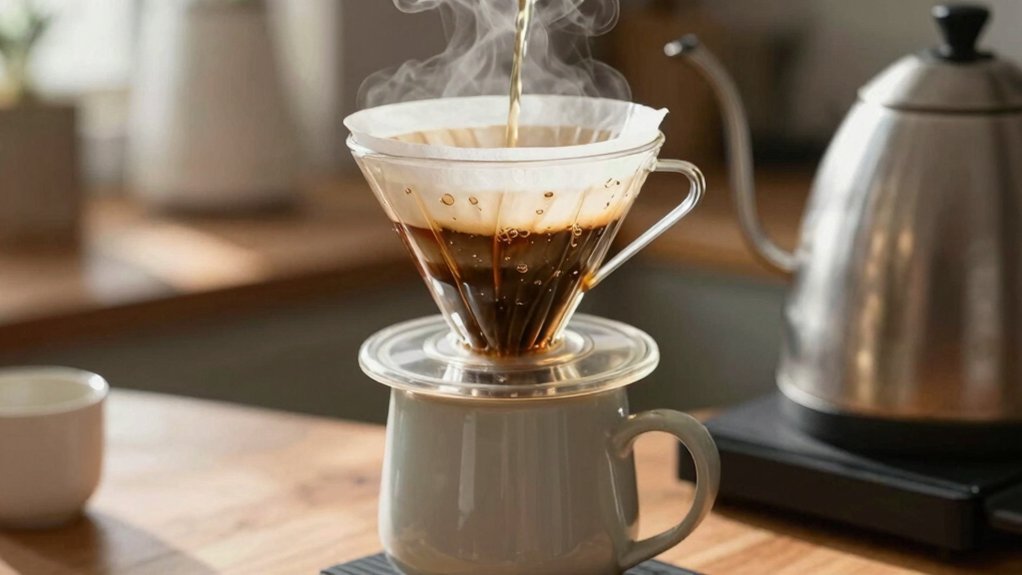
A slow, steady pour lets every coffee particle soak evenly, so you extract balanced flavors without the sourness of under‑extraction or the bitterness of over‑extraction. The gentle bloom pre‑wets the grounds, releasing gases and preventing channeling, while a circular, continuous flow maintains uniform saturation. With a gooseneck kettle you can control rate and temperature, hitting the 2–4 minute “Goldilocks” window and a 1:17 ratio for consistent results. Keep the rhythm smooth and you’ll discover even deeper nuances.
Why Pour Speed Matters for a Slow Pour Over
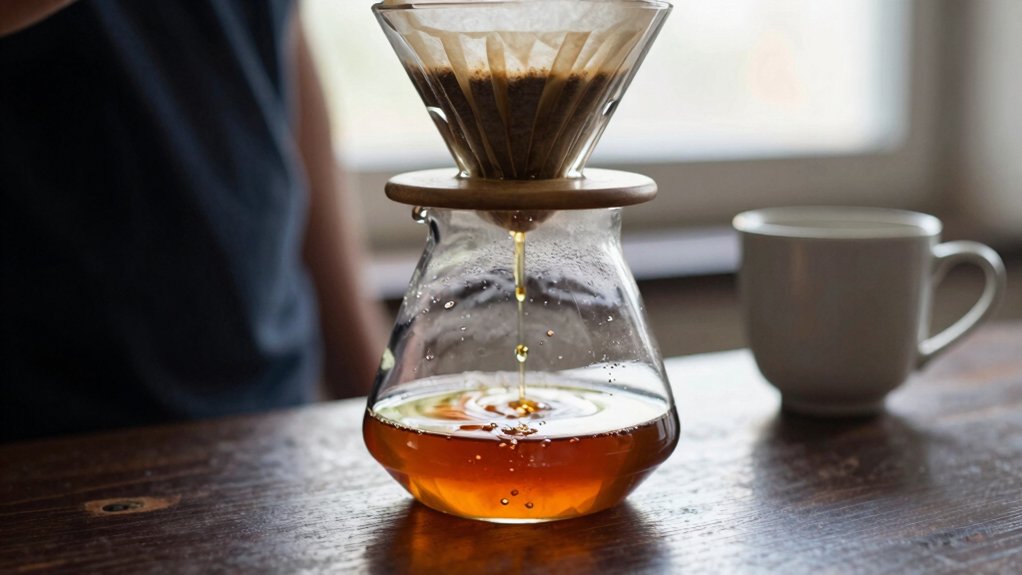
Why does the pace of your pour matter? You control extraction, balance, and clarity with pour speed. A steady, even flow keeps water in contact with every coffee particle, avoiding channeling that lets water shortcut the bed and leave sour, weak notes.
A steady, even pour ensures uniform extraction, preventing channeling and yielding balanced, nuanced coffee.
If you rush, you under‑extract; the brew finishes before the bloom phase fully awakens the grounds, yielding a thin, acidic cup.
If you linger too long, you risk over‑extraction, pulling bitter tannins that muddy the flavor.
Aim for a middle‑ground rhythm that fits the 2.5–4 minute brew window, allowing the bloom to develop while maintaining consistent saturation.
This tempo delivers a balanced cup without harshness or flatness, letting each nuance shine. Sustainable packaging
How the Bloom Phase Improves Slow Pour Over Extraction
A steady pour won’t reach its full potential without a proper bloom, and that brief pre‑wetting step sets the stage for even extraction. When you add a small burst of water—about twice the coffee weight—you give every particle a chance to wet, creating true saturation across the puck. This 30‑second bloom releases trapped gases, prevents channel formation, and primes the grounds for a balanced extraction. After the bloom, you follow with a slow pour, moving in a gentle circular motion from center outward to keep uniform contact. The controlled flow lets flavors unfold gradually, reducing bitterness and muddy texture. By letting the bloom do its work, you ensure the slow pour extracts the full spectrum of solubles without over‑extraction.
Finding the Goldilocks Brew Time (2–4 min)
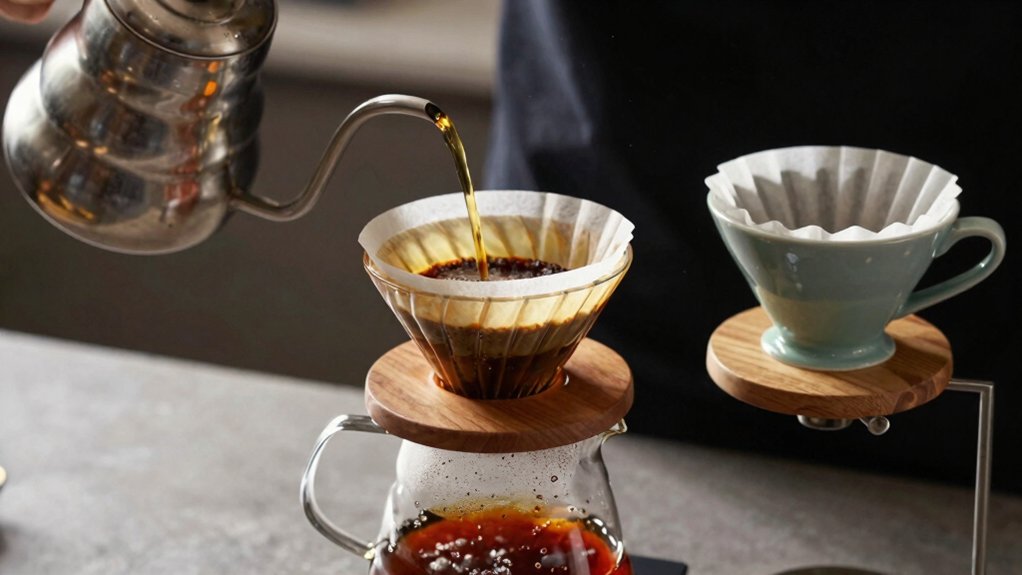
Ever wondered how to hit that sweet spot where your pour-over finishes in just the right window? You’ll aim for a brew time of two to four minutes, a range that balances flavor without bitterness. Start with a bloom of 30 seconds to a minute, then keep a slow pour that evenly saturates the grounds. If your timer ticks past four minutes, coarsen the grind; if it rushes under two, grind finer. The middle-ground pour rate lets water flow steadily, avoiding both under- and over-extraction. By watching the clock and tweaking grind size, you lock in that Goldilocks brew time, delivering a cup that’s bright, smooth, and perfectly extracted. Grind size adjustment can help you fine-tune extraction for consistent results.
How to Execute a Steady, Circular Slow‑Pour Technique
How can you keep the water flowing smoothly while coaxing every coffee particle to release its flavor? Start with a bloom: pour a splash of hot water over the grounds, let it sit 30‑60 seconds, then begin the steady pour. Grip the gooseneck kettle, tilt it low, and maintain a constant height. Begin a circular pour from the center, spiraling outward in a smooth, even motion. Keep the stream thin and continuous; avoid pauses that cause channeling. As you circle, watch the level rise, adjusting speed to stay within the 2‑4 minute brew time window. Finish with a gentle outer ring to wet the edges, then let the coffee drip through. This rhythm yields balanced extraction and full flavor. World Coffee Recipe Cards provide cultural context that can deepen understanding of diverse brewing methods while you practice this technique.
Choosing a Gooseneck Kettle That Maximizes Slow‑Pour Control
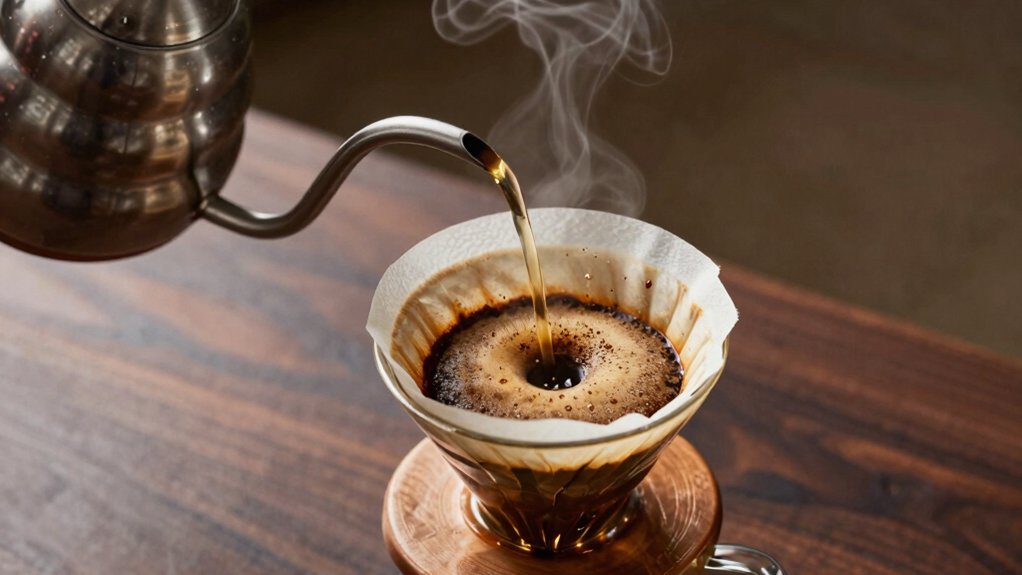
You’ll want a kettle that lets you fine‑tune the flow, so look for a narrow, well‑shaped spout that keeps the stream steady and controllable. Good heat retention means the water stays in the 195‑205 °F window longer, preventing temperature drops mid‑brew. Choose a model with a solid base and precise pour control to keep your circular, slow pour consistent. For best results, consider how a gooseneck kettle’s durability and material choices align with long‑term use and maintenance color‑coded organization to stay organized over time.
Precise Flow Control
What makes a slow‑pour over brew truly shine is the ability to control every drop of water, and a gooseneck kettle gives you just that. The kettle’s narrow spout lets you set a steady pour rate, which in turn fine‑tunes flow control and keeps brew time within the 2.5–4‑minute window for balanced extraction. You’ll notice even saturation across the grounds because the stream stays consistent, eliminating channeling and preventing over‑ or under‑extraction. When you pair the gooseneck kettle with a digital scale and timer, you lock in repeatability, so each cup mirrors the previous one. This precise handling lets darker roasts or delicate beans reveal their full flavor without flooding the bed. Flow Control is enhanced by selecting a precision kettle that maintains a consistent pour, reducing variability across brews.
Spout Design Matters
Precision starts with the spout, and a well‑designed gooseneck kettle lets you shape every drop. Its tapered neck curbs impulse, so you keep a steady pour rate instead of sudden bursts. That spout design channels water into a smooth, centered stream, letting you trace a gentle spiral from the coffee bed’s center to its rim. You’ll notice even saturation and far fewer channels, which translates to balanced flavors across the 2‑4‑minute brew window. Fine‑tuned start‑stop control lets you pause for bloom or adjust the flow without breaking rhythm, making each pour‑over reproducible. For newcomers, the gooseneck kettle becomes the foundation of reliable brew control, teaching a steady hand and consistent extraction every time. This approach also aligns with how gradual, controlled pours support optimal extraction across different pour‑over setups spout design principles.
Heat Retention Performance
A well‑designed spout sets the stage, but the kettle’s ability to hold heat determines whether that steady pour stays within the prime temperature window. Thick walls and a tight‑fitting lid help keep water near 195‑205 °F during the 2‑4 minute brew, supporting a consistent pour rate and avoiding cold spots that would over‑extract. This stability also reinforces a reliable bloom, enabling grounds to release CO₂ before you adjust grind size. Because the water stays hot, you can maintain the ideal ½‑⅔ filter‑bed level without rushing, and the even extraction you achieve translates into smoother, more balanced coffee. heat retention
Which Pour‑Over Device Works Best for a Slow Pour?
Ever wondered which pour‑over device lets you master a slow, steady pour? A gooseneck kettle gives you the flow control you need for a true slow pour, and pairing it with a Kalita Wave makes the process even easier. The Wave’s flat bottom creates a uniform bed, so you can maintain an even extraction without constantly adjusting your hand.
If you prefer a cone‑shaped brewer, the Hario V60 or Chemex can still work, but they demand tighter pressure management to keep the pour slow and consistent. Preheat your brewer, use quality water, and aim for a 3‑4‑minute brew time. That rhythm lets the pour‑over device deliver balanced flavor every cup.
Tuning Temperature, Ratio, and Grind for a Slow Pour
How do you balance temperature, ratio, and grind to nail a slow pour? Start with a gooseneck kettle so you can keep water temperature steady at 195–205 °F and pour with a controlled stream. Aim for a coffee-to-water ratio around 1:17, then adjust grind size to hit a brew time of 2.5–4 minutes. If the brew finishes too quickly, grind finer; if it drags, go coarser. During the bloom, use roughly twice the coffee weight in water and wait 30–60 seconds for uniform saturation. Keep the pour gentle and continuous, watching the clock. When the total brew time lands in the target window, you’ve achieved balanced extraction without over‑ or under‑extraction.
What Goes Wrong When You Pour Too Fast or Too Slow – and How to Fix It?
You’ve set the temperature, ratio, and grind, but if the pour isn’t in the Goldilocks zone the brew collapses. Pouring too fast spikes the pouring rate, creates channels, and leaves the grounds unevenly saturated, so extraction stalls early and you taste sour, thin notes. To fix it, slow the flow, keep the gooseneck kettle steady, and let the water bloom gently.
Pouring too slowly drags the brew time past the optimal window; the water sits too long, extracting tannins and woody compounds that turn the cup bitter and muddy.
Balance the pour by maintaining a consistent, moderate rate, aiming for even saturation and a total brew time of roughly 2.5–4 minutes. This steadies extraction and restores flavor harmony.
Tools & Habits for Repeatable Slow‑Pour Results
Where does consistency start? It begins with a gooseneck kettle that lets you control the pour rate and direction, so you can execute a steady bloom and subsequent pours.
Consistency starts with a gooseneck kettle, letting you control pour rate and direction for a steady bloom.
Use a digital scale with a timer to measure each phase: 30‑second bloom, mid‑pour, and finish.
Preheat the brewer, then grind fresh beans just before brewing, aiming for a 1:14‑1:20 water‑to‑coffee ratio.
Keep the total brew time between two and four minutes, adjusting the pour rate until the extraction feels balanced.
Record your timings and weights, then repeat the same sequence each day.
Slow Pour Over FAQ: Answers to Your Top Questions
Ever wondered why your slow‑pour coffee sometimes tastes flat while other times it’s richly balanced? The trick lies in mastering the variables that drive even saturation and balanced extraction. You’ll learn how to tweak grind size, control the bloom, and keep your pour‑over rhythm steady so each cup hits the sweet spot.
- Bloom timing – Start with 30‑45 seconds of gentle water to awaken the grounds; this primes even saturation before the slow pours begin.
- Grind size – Aim for a medium‑fine texture; too coarse under‑extracts, too fine over‑extracts, especially when you linger on the pour.
- Pulse pattern – Use 3‑4 slow, circular pulses, keeping the brewer half‑full, to maintain a consistent drain and avoid channeling.
Frequently Asked Questions
Can I Use a Metal Filter for Slow Pour‑Over Without Affecting Flavor?
You can use a metal filter for slow pour‑over, but expect a slightly heavier body and brighter acidity; the metal lets more oils through, altering flavor compared to paper, yet still delivering a solid brew.
How Does Water Hardness Influence Extraction in a Slow Pour‑Over?
Hard water’s calcium and magnesium bind coffee acids, slowing extraction and muting brightness. You’ll get a heavier body but less nuanced flavors, so you may need a finer grind or longer brew to balance.
Should I Pre‑Wet the Coffee Grounds Before the Bloom Phase?
Yes, you should pre‑wet the grounds before the bloom. It primes the coffee, releases trapped gases, and ensures even extraction, leading to a smoother, more balanced cup.
What Impact Does Ambient Temperature Have on Brew Consistency?
You’ll notice that warmer ambient temperatures speed extraction, making the brew stronger and less consistent, while cooler air slows it down, yielding a milder, more uniform cup if you adjust pour timing accordingly.
Can I Brew Cold Brew Using a Slow Pour‑Over Technique?
Yes, you can brew cold brew with a slow pour‑over; just use coarse grounds, cool water, and a long, steady pour. The gradual extraction yields smooth, low‑acid coffee without heating.
In Summary
Mastering the slow pour over lets you control every variable—bloom, temperature, grind, and timing—to coax out a balanced, aromatic cup. By keeping the flow steady and circular, you avoid under‑ or over‑extraction and hit that sweet 2‑4‑minute window. Choose a precise gooseneck kettle, dial in your ratio, and stick to repeatable habits. The result? Consistently rich, nuanced coffee that rewards patience and precision.


