

You’ll find the coffee flavor wheel turns your subjective aroma and taste impressions into a shared, visual vocabulary, so you can calibrate your palate and compare coffees with repeatable intensity scores. It eliminates personal quirks, aligns your notes to the World Coffee Research lexicon, and lets you communicate findings clearly with roasters, buyers, and baristas. By using the wheel’s reference standards and structured process, you’ll boost consistency and accuracy—plus the next sections will show you how to apply it in practice.
Why a Standard Cupping Method Matters for the Coffee Flavor Wheel
Why does a standard cupping method matter for the Coffee Flavor Wheel? You align your grind, water temperature, and crust‑breaking routine, then you slurp consistently. This Cupping Method creates a repeatable baseline so every taster uses the same reference points on the Flavor Wheel. Standardization eliminates personal quirks, letting the Sensory Lexicon’s calibrated definitions and intensity scales translate directly into wheel attributes like fruitiness, acidity, or sweetness. When you taste side‑by‑side, the uniform process sharpens discrimination, making subtle differences obvious and comparable. By following the same steps each session, you reduce variability, improve communication, and ensure that your notes map cleanly onto the wheel’s structured taxonomy. Heat-resistant bristles and maintenance considerations from espresso brush guidelines remind us to keep equipment clean and in good condition, which supports consistent cupping results and hygiene for tasting sessions.
How the Coffee Flavor Wheel Bridges Language Gaps in Cupping
Ever wondered how a simple visual tool can make your cupping notes speak the same language as a colleague halfway across the world? The Coffee Tasters Flavor Wheel gives you a shared, structured vocabulary that turns vague impressions into precise, repeatable terms. By pairing each segment with the World Coffee Research sensory lexicon, you instantly align your cupping language with standardized descriptors, reducing misinterpretation and speeding up training. The wheel’s connected cells reveal relationships between attributes, so you can navigate flavor families without guessing. This alignment supports consistent data tracking and cross-lab comparisons, especially when integrating app-enabled workflows and cloud-stored notes. World Coffee Research lexicon provides the standardized definitions that strengthen your reading across contexts.
Explore the Center, Mid‑Ring, and Outer Ring of the Coffee Flavor Wheel
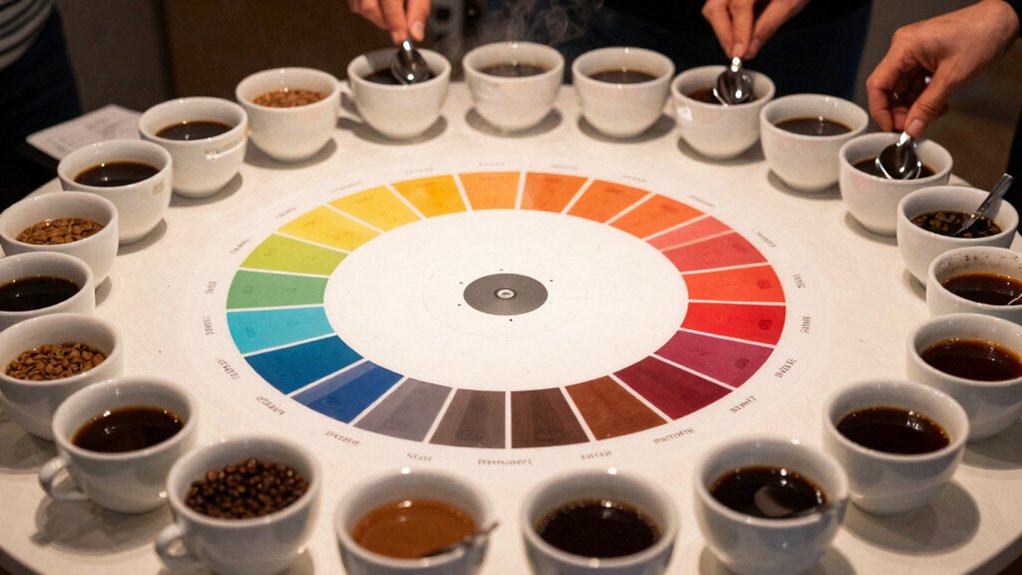
Curious how the Coffee Flavor Wheel guides you from broad impressions to pinpointed notes? Start at the center, where you label a general attribute like floral or roasted, then move outward, using the wheel’s concentric structure to sharpen your sensory language during cupping. In practice, using a structured approach can help you standardize notes across different coffees and cupping sessions Flavor Wheel Structure.
The mid‑ring narrows those categories into subfamilies—fruit becomes berry or citrus, spice splits into clove or cinnamon—letting you differentiate similar aromas.
Finally, the outer ring offers precise descriptors such as blackberry, burnt caramel, or cacao nib, completing the journey from center to outer ring.
Identify Primary Aromas and Flavors Quickly With the Wheel
You’ll spot the dominant aroma in seconds by starting at the wheel’s central categories and moving outward. The color‑coded layout and neighboring cues let you map that primary note to a precise flavor descriptor without hesitation. This focused approach speeds up identification and keeps your cupping notes consistent across every brew.
Rapid Aroma Identification
How can you pinpoint a coffee’s dominant notes in seconds? You start with the Flavor Wheel, letting its central categories pull your focus, then radiate outward to finer descriptors. The wheel’s structured layout pairs each scent with a calibrated lexicon, so you match what you smell to a predefined term without hesitation. By noting the dry‑ground fragrance first, then the crust aroma, you lock in the primary profile before the palate even joins the conversation. The connected cells reveal relationships, letting you infer a close substitute when the exact word slips your mind. This systematic approach turns aroma identification into a rapid, repeatable step in cupping.
- Begin at the center: fruity, floral, spicy.
- Move outward to specific notes (e.g., citrus, jasmine).
- Use the lexicon’s intensity scale for quick anchoring.
- Record dry‑ground scent before tasting.
- Leverage adjacent cells for near‑matches.
Focused Flavor Mapping
Where does the wheel’s concentric design give you the fastest path to a coffee’s core aroma? You start at the center, label a broad category, then jump outward to the first specific note that pops up—say, a bright citrus. This stepwise jump is the essence of focused flavor mapping in coffee cupping.
The flavor wheel’s inner ring narrows the sensory lexicon, so you lock onto a primary aroma before drifting into minutiae. Connected cells cue related flavors; spotting blackberry instantly suggests black‑fruit or jam‑like sweetness.
Because the lexicon standardizes each term, you and consistent, repeatable notes with teammates. The result is a rapid, organized capture of dominant flavors that guides deeper analysis without losing the big picture.
Calibrate Your Palate Using the Wheel’s Reference Standards
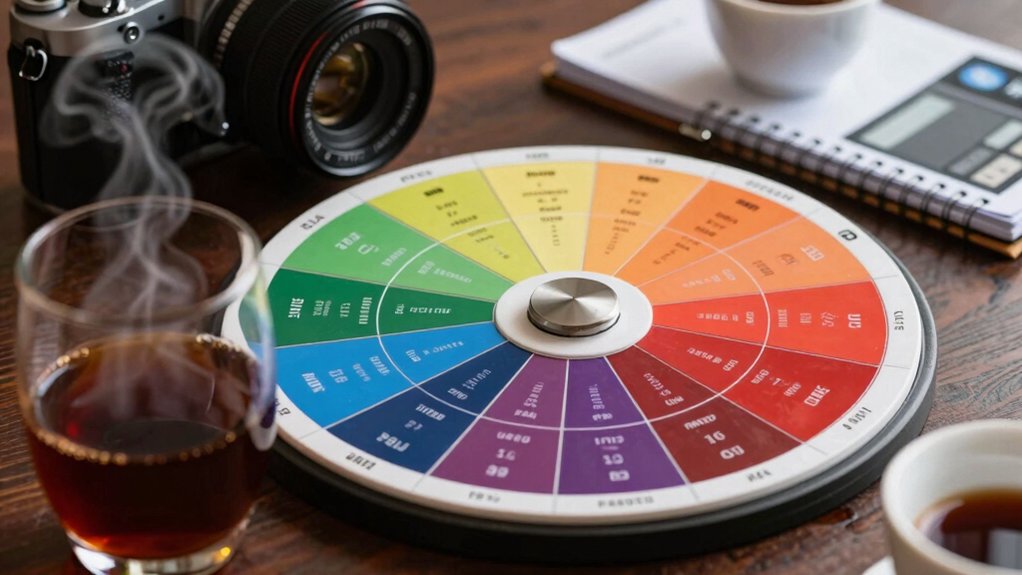
The World Coffee Research Sensory Lexicon serves as the benchmark for calibrating your palate, offering precise definitions and reference aromas—like a defined blackberry scent—for each wheel attribute.
When you use the Lexicon, you anchor your perception to concrete references, making calibration repeatable across sessions.
You compare neighboring cells, notice subtle shifts, and adjust your scaling from the center outward, ensuring every taster speaks the same language.
- Identify the reference aroma for each attribute before tasting.
- Taste a control sample that matches the reference (e.g., blackberry).
- Compare the cup’s aroma to the reference, noting intensity differences.
- Use adjacent cells to confirm or refine your descriptor choice.
- Re‑calibrate periodically, moving outward from the wheel’s core to maintain consistency.
Translate Sensory Perception Into Precise Coffee Flavor Wheel Terms
You’ll start by mapping each aroma you detect to the wheel’s nearest cell, using the Lexicon to lock in a precise term.
Then you’ll define the flavor with the same precision, turning broad impressions like “fruity” into specific notes such as “blackberry” or “citrus.”
This systematic approach keeps your cupping language consistent and your palate calibrated across every panel.
Mapping Aroma to Wheel
How do you turn a fleeting scent into a concrete term? You start with aroma mapping on the Coffee Taster’s Flavor Wheel, using its sensory lexicon to anchor each whiff to a calibrated reference. Begin at the center, pick a broad family—floral, fruity, spicy—then spiral outward, narrowing to a precise label that fits your cupping notes. The wheel’s connected cells cluster related aromas, while color‑coded sections cue you to the right flavor family. Reference scales from World Coffee Research keep intensity consistent, turning vague impressions into shared language.
- Identify the dominant scent category first.
- Consult the wheel’s reference images (e.g., blackberry jam).
- Follow the outward path to more specific terms.
- Use color cues to align with flavor families.
- Record intensity using the sensory lexicon’s scale.
Defining Flavor With Precision
Ever wondered how to lock a fleeting aroma into a concrete wheel term? You can translate a sip’s subtle notes into the Flavor Wheel by using the Lexicon’s calibrated scale and the step‑by‑step guide. Start at the center with a broad descriptor, then move outward to pinpoint “bright citrus” or “earthy chocolate.” The Lexicon’s definitions keep your Cupping notes consistent, while connected cells show how “floral” relates to “herbal” and “spice.” Practice with reference standards, assign intensity 1–15, and you’ll turn subjective perception into measurable, repeatable descriptors.
Coffee Mate Original Liquid Creamer Singles (180-Pack) are shelf-stable and provide a practical reference point when calibrating taste impressions during cupping sessions, helping you compare baseline creaminess and mouthfeel across different coffees. Flavor Reference
Spot Defects and Off‑Flavors Using the Wheel’s Negative Category
Where do those sour, musty, or burnt notes belong in your cupping notes? You spot defects by matching them to the wheel’s negative descriptors during the crust‑breaking aroma stage. The adjacent positive cells act as reference points, letting you gauge intensity and confirm whether a note is a true off‑flavor or a subtle nuance. This comparative approach sharpens cupping calibration, ensures consistent terminology, and prevents misinterpretation across the team.
Match sour, musty, or burnt notes to negative wheel descriptors, using adjacent positives for intensity calibration.
- Identify the exact negative term that mirrors the perceived defect.
- Compare its intensity to neighboring positive attributes.
- Record the off‑flavor in the appropriate column of your cupping sheet.
- Use the Lexicon definitions to standardize your description.
- Re‑evaluate after each sip to confirm the fault’s persistence.
Additionally, reinforce your evaluations by noting how the defect interacts with different foams and textures in your samples, which can be influenced by brewing and milk frothing variables discussed in related flavor wheels. a 1-4 word phrase
Practice Exercises to Apply the Wheel Across Multiple Coffees
Ready to sharpen your palate? Start each session at the center of the flavor wheel, naming broad categories like fruity, floral, or nutty. Then move outward, pinpointing specific tasting notes—blackberry, almond, citrus—while cupping two or three coffees side‑by‑side. Compare acidity, sweetness, body, and aroma, using the wheel to articulate each contrast. Refer to the Lexicon for precise definitions; for example, match “Blackberry” to Smucker’s Blackberry Jam to achieve sensory calibration. Evaluate ground fragrance, wet aroma after pouring hot water, and palate flavors, mapping each to its sector. After each round, return to the center, broaden descriptors, and repeat. This disciplined practice builds a shared vocabulary and refines your cupping skill. Flavor wheel reference
Build Consistent Cupping Notes With the Coffee Flavor Wheel
After practicing the wheel across multiple coffees, you can turn that skill into reliable cupping notes. The flavor wheel guides you from broad categories to precise descriptors, while the sensory lexicon defines each term’s meaning. By anchoring each observation to the wheel’s hierarchy, you create a standardized language that other tasters instantly recognize. This method reduces ambiguity, speeds up note‑taking, and builds confidence in your assessments. In cupping sessions, refer to the SCA-aligned sample sizes to ensure consistency with professional standards SCA 4–5 ml and keep your notes aligned with industry benchmarks.
Enhance Communication Between Roasters, Buyers, and Baristas
Leverage the coffee flavor wheel to bridge the gap between roasters, buyers, and baristas, turning subjective aromas into a shared, precise language. When you conduct cupping, the wheel’s visual cues and color‑coded terms let you point to red fruit or brown notes instantly, so everyone hears the same descriptor. The lexicon supplies calibrated attribute terms, so you and your client discuss acidity, sweetness, or body without guessing. By moving from the center outward, you add specificity step by step, preventing misinterpretation when you recommend a roast profile or blend. This structured communication streamlines negotiations, aligns expectations, and builds trust across the supply chain, all while keeping notes concise and actionable.
Add the Coffee Flavor Wheel to Digital Cupping Sheets and Apps
You can embed the coffee flavor wheel directly into your digital cupping sheets, giving tasters a ready‑made list of adjectives that standardizes every entry. This integration lets you autocomplete and search by flavor families, so you capture precise notes without mislabeling. Linking the wheel to your scoring scales then turns those consistent descriptors into actionable insights across the whole cupping workflow.
Ized Integration
How can you make cupping notes instantly comparable across roasters and origins? By using Flavor Wheel integration within your digital cupping workflow, the align each entry with the sensory lexicon and standardized descriptors that the SCA and World Coffee Research define. The app guides you from broad categories—fruit, sweetness, roast—down to pinpoint notes like blackberry or citrus, anchoring every pick to a calibrated scale. Real‑time, auditable note‑taking links each attribute to definition references, cutting misinterpretation and making data instantly comparable across sessions.
- Drag‑and‑drop wheel sections onto the sheet
- Auto‑populate intensity sliders for each descriptor
- Click for instant lexicon definitions
- Sync notes to a central database for cross‑origin analysis
- Export standardized reports for roasters and buyers
Enhanced Data Consistency
Ever wondered why cupping notes from different roasters rarely line up? Adding the Coffee Flavor Wheel to your digital cupping sheets locks each attribute into a calibrated spot, turning vague impressions into standardized notes. The wheel’s lexicon‑backed definitions for 110+ flavors give every taster the same vocabulary, boosting inter‑taster reliability when you log data in cupping software. Linked cells highlight neighboring attributes, so you can see flavor clusters emerge in real time. Structured leading and broadening steps guide you from general to specific descriptors, making cross‑sample comparisons effortless. Over weeks, the digital wheel aggregates trends, helping you profile roasts, compare origins, and tighten quality control—all without guesswork.
Beginner Mistakes With the Coffee Flavor Wheel and How to Fix Them
Ever found yourself reaching for the outer ring of the coffee flavor wheel before you’ve mastered the core categories? You’re probably making common beginner mistakes that blur your cupping notes. Start in the center, use the Lexicon, and keep conditions stable to build a reliable flavor wheel framework.
Begin with broad categories (floral, fruity, roasted) instead of jumping to specific descriptors.
Start with broad categories—floral, fruity, roasted—before narrowing to specific coffee descriptors.
Consult the Lexicon for precise definitions; avoid vague terms like “nuttiness.”
Cross‑check every attribute with World Coffee Research’s sensory references.
Score consistently and repeat sessions to track palate development.
Standardize temperature, grind size, and cup cleanliness to eliminate extraneous flavors.
Future Trends for the Coffee Flavor Wheel: Expanded Lexicons & Multimodal Mapping
As the coffee world pushes forward, researchers are expanding the flavor wheel’s lexicon beyond its 110‑plus descriptors, adding finer nuances of aroma, texture, and aftertaste with standardized intensity scales.
You’ll soon see multimodal mapping that ties visual cues—color bands on the wheel—to sensory data, letting you cross‑reference hue with flavor notes instantly.
Expanded lexicons will include tiered versions, from beginner to expert, and multilingual tags that reflect regional palate vocabularies.
Digital sensory calibration tools, anchored in the World Coffee Research Sensory Lexicon, will align panel judgments, boosting inter‑lab consistency.
AI‑driven platforms will generate personalized aroma‑flavor databases, adapting to your tasting history and reputation, making cupping more intuitive, precise, and globally accessible.
Frequently Asked Questions
What Is the Point of Coffee Cupping?
You cup coffee to objectively assess aroma, flavor, acidity, body, and aftertaste, ensuring quality, guiding purchases, and refining roast profiles, all while training your palate and standardizing sensory language.
What Is the Coffee Flavor Wheel?
You use the coffee flavor wheel to map aromas and tastes onto a structured diagram, letting you identify, compare, and communicate specific notes like floral, fruity, nutty, or chocolate with consistency.
What Is the 15-15-15 Coffee Rule?
You follow the 15‑15‑15 rule by spending exactly fifteen seconds sniffing the dry aroma, fifteen seconds inhaling the wet aroma, then fifteen seconds tasting, ensuring consistent, disciplined cupping assessments.
What Is the Cupping Protocol for Coffee?
You start with 8.25 g coffee and 150 ml water at 195‑205 °F, steep 4 minutes, break the crust, sniff the wet aroma, then slurp, note acidity, body, flavor, and aftertaste.
In Summary
By using the coffee flavor wheel, you’ll standardize cupping, bridge terminology gaps, and sharpen your palate fast. It lets you pinpoint aromas, calibrate taste, and speak the same language as roasters, buyers, and baristas. Adding it to digital sheets keeps notes consistent, while avoiding common beginner pitfalls ensures accurate profiling. As the wheel expands with richer lexicons and multimodal data, it’ll become an even more powerful tool for every coffee professional.


