
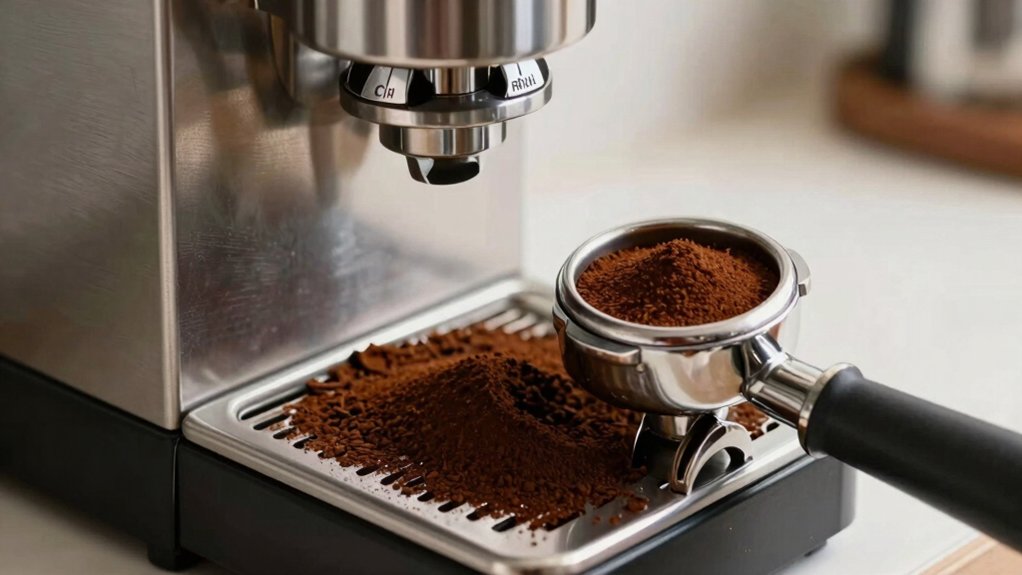
Use a high‑quality burr grinder—flat burrs for uniform particles or conical for gentler heat—and keep it clean and stable. Clean the burrs weekly, purge between grind settings, and monitor temperature to avoid expansion. Pair the grinder with a precision scale and sensor so you can lock the dose and get real‑time feedback, then make micro‑adjustments while it runs to keep extraction time in the 25‑30 second window. Follow a consistent routine each shift and log every shot to spot drift, and you’ll discover deeper tips ahead.
Why Grind Size Determines Espresso Extraction

Grind consistency also helps stabilize extraction yield, especially when using tools like a digital refractometer to monitor TDS and Brix readings Automatic Temperature Compensation.
Choose the Right Grinder and Burr Type for Consistency
What grinder you pick determines whether your espresso stays consistent shot time to. You should opt for burr grinders, because they control particle size distribution far better than blades. Look for models with micrometric adjustment so you can dial in grind consistency for each bean and roast level without guesswork. Flat burrs often deliver the most uniform grind, while conical burrs are gentler on the burrs and keep heat down. Premium units include dosing programs that dispense the same grounds weight each pull, stabilizing extraction across shifts. Regular maintenance and a clean, well-adjusted grinder help prevent dull or clogged burrs from widening particle size distribution and ruining consistency. Choose the grinder and burr type that match your workflow, and keep them clean for reliable espresso. Anti-static technology can also contribute to cleaner grounds and more predictable dosing.
Keep Your Grinder Stable: Temperature & Burr Alignment

Ever notice how a grinder’s temperature spikes during a busy rush, softening the burrs and widening the particle size distribution? That heat can shift burr alignment, causing drift and uneven extraction. Keep the burr carrier firmly seated and check it weekly; a tight fit guarantees grind stability and consistent dosing. Monitor ambient temperature and avoid placing the machine near ovens or direct sunlight to maintain temperature stability. Inspect burr wear regularly—worn edges change taper and ruin particle uniformity. When you switch between fine and coarse settings, purging between grind settings clears airflow and prevents cross‑contamination. By controlling temperature and burr alignment, you lock in repeatable grind quality and eliminate drift, giving every shot the same baseline.
Lock in Espresso Grind Dose With Scales & Sensors
Ever wondered how you can lock a perfect espresso dose without guessing? You can, by pairing high‑precision scales with sensors in a GbS (Grind‑by‑Sync) loop. The scale captures each grind dose to 0.1 g, while the sensor monitors burr distance, feeding real-time data logs to the app. When the dose drifts, the system nudges the burr motor, keeping extraction consistency spot‑on. Calibration takes seconds—about 10 s versus the usual ten minutes—so you stay productive. Cloud sync lets every barista see the same dosing accuracy across shifts, and the logs record actual dose, yield, and flow rates for quick diagnostics. This tight feedback loop eliminates guesswork and guarantees repeatable espresso shots. Universal Descaler Tablets provide an overarching maintenance comparison that helps ensure the machine stays in spec between uses.
Make Micro‑Adjustments While the Grinder Is Running

You’ll tweak the burr gap while the grinder spins, using the live dose feedback to guide each tiny turn. This approach can help minimize channeling by maintaining a stable grind size, especially when using 64mm flat burrs with precise 0.1-second timing. Anti-static technology helps reduce mess and buildup during these on-the-fly adjustments, keeping your workspace cleaner. Those micro‑adjustments let you fine‑tune the extraction timing on the fly, keeping the shot within your target range.
When the flow, crema, and taste settle, lock in the new setting and note the exact change for next time.
Adjust Burr Gap
A steady grind hinges on making micro‑adjustments to the burr gap while the grinder is running, letting you fine‑tune extraction without pausing the shot. First, engage burr stabilization to lock the burrs in place; this prevents drift when you tweak the gap. Then, turn the adjustment knob in 0.01–0.05 mm increments, immediately brew a single shot, and observe flow time and taste. Finally, purge grounds to clear residual particles, then log the exact change and resulting metrics in your calibration log for future reference. Regularly verify the cooling method compatibility of your grinder setup, especially if you switch between frozen water chamber systems or rapid cooling tech calibration consistency.
- Lock burrs before moving the gap.
- Adjust in tiny steps, test, and record.
- Purge grounds, then update the calibration log.
Live Dose Feedback
How can you keep your espresso dose spot‑on while the grinder spins? Live dose feedback pulls real-time data from the integrated scale, spotting dose drift the moment it starts. Flow Rate Mode helps monitor how quickly the mass builds during the pull, enabling even finer micro‑adjustments without stopping the grind.
Dynamic Extraction Timing
Live dose feedback keeps the shot on target, and now you can fine‑tune that target on the fly. Dynamic extraction timing lets you tweak grind size while the grinder spins, turning a micrometer shift into a 1–3‑second swing in extraction time. You watch extraction metrics—flow rate, shot time, taste cues—and make micro‑adjustments that lock the brew into the 25‑30‑second window. Stable burr alignment and clean burrs keep those adjustments predictable, preventing exaggerated swings.
Turn the micrometric dial a few microns, watch the flow rate dip, and pause when the shot steadies. temperature retention is a key factor when you’re dialing in a mug that keeps hot drinks warm for hours or cold drinks chilled for hours, so you can stay consistent across sessions. Listen for the “sweet spot” taste cue, then fine‑tune the espresso grind until it matches. Record the new setting, then repeat for real-time stabilization across shots.
Clean Burrs and Ports Between Sessions to Prevent Carry‑Over
You’ll want to set a quick burr‑cleaning routine after each session, using a brush to sweep away fines and oils.
Keep a port‑filter maintenance schedule on hand, wiping the chute and hopper dry each time you finish brewing.
A brief purge of fresh grounds after cleaning guarantees no stale residue affects the next shot.
In addition, store your ice cube trays with lids in a stackable bin to keep your cooling setup organized and odor‑free storage bin.
Burr Cleaning Routine
When you finish a session, wipe away any residual grounds and oil from the burrs and ports before the next batch. A disciplined burr cleaning routine protects flavor integrity and keeps your grinder maintenance on track. First, brush the burrs and spoke cavities to clear residual grounds. Then, run a short purge during change to flush stray particles. Finally, inspect for burr wear and recalibrate if needed to maintain a consistent grind.
- Brush each burr and cavity after every use.
- Purge the grinder for 5‑10 seconds before loading new beans.
- Check burr wear and perform calibration after each thorough cleaning.
Port Filter Maintenance Schedule
Why risk flavor carry‑over when a simple cleaning routine can keep each espresso pure? You should wipe the portafilter after every shot, brush burrs and baskets with a dedicated tool, and dry‑cloth any moisture. A quick daily purge‑clean removes loose grounds, while a weekly deep sanitation of the group head, baskets, and burrs restores grind consistency. Run a blank shot after each cleaning to flush residues and verify crema quality. Log each cleaning session, noting time, method, and any taste shifts. If you see flavor drift, increase the maintenance cadence or inspect burr cleanliness. Consistent logging lets you spot wear patterns early, ensuring your portafilter and grinder stay in top shape for flawless espresso.
Monitor Extraction Time and Yield to Spot Inconsistencies Early
How long does your shot take, and how many grams does it yield? You can spot inconsistencies before they ruin a batch by watching extraction time and yield together. A 25‑30 second window signals good grind size and dose; any drift flags a problem. Record flow rate, dose, and yield each pull; compare them to your baseline. When you notice a few seconds off or a gram short, adjust immediately.
- Check extraction time – aim for 25‑30 seconds; a 5‑10 second swing usually means grind size changed.
- Measure yield – target your usual gram weight; a deviation signals shot drift or dose error.
- Log flow rate and environmental shifts – temperature or humidity swings affect bed rigidity and consistency.
Apply Grind‑by‑Sync (GbS) for Real‑Time Espresso Adjustments
Ever wondered how a grinder could tweak itself mid‑shot? With Grind‑by‑Sync (GbS), your espresso machine talks to the grinder in real‑time, using extraction time as the feedback loop. As the shot progresses, GbS reads the flow, then nudges burr distance by fractions of a millimeter—often just 1/1000 mm—to speed up or slow down extraction.
The system logs dose, yield, and performance, so every grind adjustment is data‑driven and cloud‑synced across devices. You’ll notice fewer manual dials, less purging, and tighter consistency between baristas, shifts, and locations.
In‑app flow‑rate modeling shows exactly how each burr‑distance tweak reshapes the curve, letting you maintain espresso quality without guessing.
When Automation Misses: Fix Over‑Extraction, Under‑Extraction, or Channeling
Even with real‑time Grind‑by‑Sync, the system can still miss the mark, leaving you with over‑extraction, under‑extraction, or channeling. First, check the grind size. If the shot runs long and tastes bitter, you’re over‑extracting; coarsen by 0.5–1 notch, pull a test shot, and aim for a 25–30 second extraction window. If it’s short and sour, you’re under‑extracting; fine‑tune the grind slightly, test again, and watch the flow. Channeling usually means the particle distribution isn’t uniform—purge the puck, re‑grind for a uniform particle bed, and run a test shot to confirm even crema.
Fine‑tune grind size, test shots, and ensure uniform particle distribution to avoid over‑,traction, under‑extraction, or channeling.
- Adjust grind size incrementally.
- Verify with a test shot.
- Perform calibration after any environmental shift.
Develop a Barista Routine That Keeps Settings Stable Across Shifts
When a new shift starts, you’ll follow a concise routine that locks in the grind profile for each bean, roast, and machine, ensuring every barista begins with the same baseline. First, glance at the laminated sheet, verify the target dose (18–20 g) and shot time (25–30 s).
Then, run the purge routine on the GbS‑enabled grinder to clear any residual particles, preventing cross‑contamination. Check the displayed grind setting against the sheet; if it drifts, let the grinder auto‑correct, then note the adjustment in the calibration log.
After the first shot, record actual dose, yield, and any environmental notes. This quick check‑in creates shift‑to‑shift consistency, keeping flavor stable and workflow smooth.
Record and Review Data to Refine Your Espresso Grind Settings Over Time
Keep a simple log of each shot’s dose, yield, extraction time, and grind setting, then note crema color, taste, and any environmental factors. After each shift, compare the entries to see how tiny grind adjustments—like a one‑notch change—affected balance and consistency. Use those insights to tweak the grind and repeat the cycle, letting the data drive your refinements.
Log Log Extraction Metrics
Ever wonder how a few numbers can keep your espresso grind on point? You can turn raw data into a reliable guide by logging extraction metrics for every shot. Track extraction time, dose, yield, and flow rate in real time, then compare those figures across batches or every ten shots. Over time you’ll build a calibration history that links burr distance and grind setting changes to taste outcomes, letting you spot drift before it ruins consistency.
Key actions
- Record each shot’s extraction time, dose, and yield.
- Pair every grind setting change with its metric set.
- Review the log weekly to spot patterns and adjust proactively.
Adjust Grind Settings
Wonder how a single tweak in your grinder can swing a shot from flat to flawless? You start by noting each grind setting, dose, and extraction time in a data log. When the shot tastes off, adjust the burr distance by 0.1–0.2 steps, then brew another shot and compare flow rate and crema. Record the new grind size and any changes in dose, then repeat the process until extraction time lands in your target window. Use consistent baseline categories—espresso superfine, pour‑over medium—to translate settings into standards that all baristas can follow. Cloud‑enabled data logging lets you track drift across beans or shifts, turning raw numbers into actionable calibration for ever‑more precise grind profiles.
Frequently Asked Questions
What Is the 15-15-15 Coffee Rule?
You follow the 15‑15‑15 rule by tweaking grind size, dose, and shot time within roughly 15 µm, 15 mg, and 15 seconds, making tiny, systematic adjustments to keep espresso extraction consistent.
What Is the Best Grind Consistency for Espresso?
You need a fine, uniform burr‑grind that feels like powdered sugar between your fingers; this consistency delivers stable flow, balanced extraction, and repeatable 25‑30‑second shots.
What Is the 30 Second Rule for Espresso?
You aim for a 25‑30‑second extraction, ideally around thirty seconds, by dialing grind, dose, and tamp so the flow slows near the end, producing a mahogany crema and balanced, syrupy body.
Is Espresso Bad for LDL Cholesterol?
You’re not likely to spike LDL dramatically from espresso, especially if you use paper‑filtered beans; occasional cups are fine, but watch overall diet, genetics, and unfiltered coffee methods.
In Summary
By mastering grind size, choosing the right burrs, and keeping your grinder stable, you’ll lock in consistent doses and tweak settings on the fly. Use real‑time sync and data tracking to correct over‑ or under‑extraction, and stick to a solid routine across shifts. With these habits, every shot will hit the sweet spot, turning your espresso into a reliable, repeatable masterpiece.


