
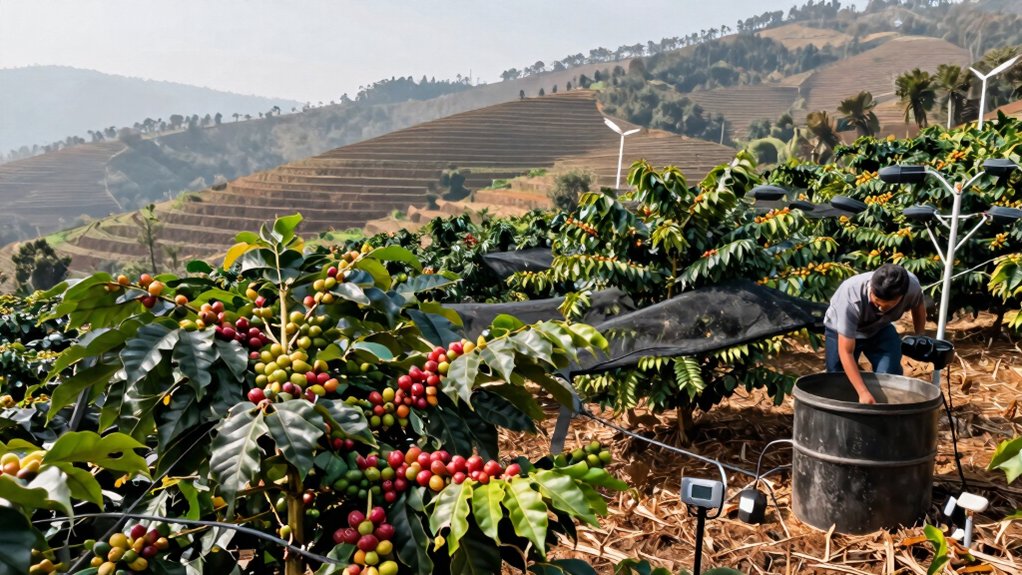
You’ll see coffee farms fighting rising temps and erratic rains by planting shade‑tree canopies that cool the microclimate, using drip‑irrigation and precise water scheduling, mulching with coffee pulp and compost, and switching to drought‑resistant, heat‑tolerant varieties. They monitor climate data with mobile apps, adopt pest‑spotting drones, and join cooperatives that provide risk‑sharing loans and insurance. Certification and blockchain traceability link these practices to market access, and if you keep going, you’ll discover even more details.
Why Coffee’s Climate Sensitivity Matters for Farmers and Consumers
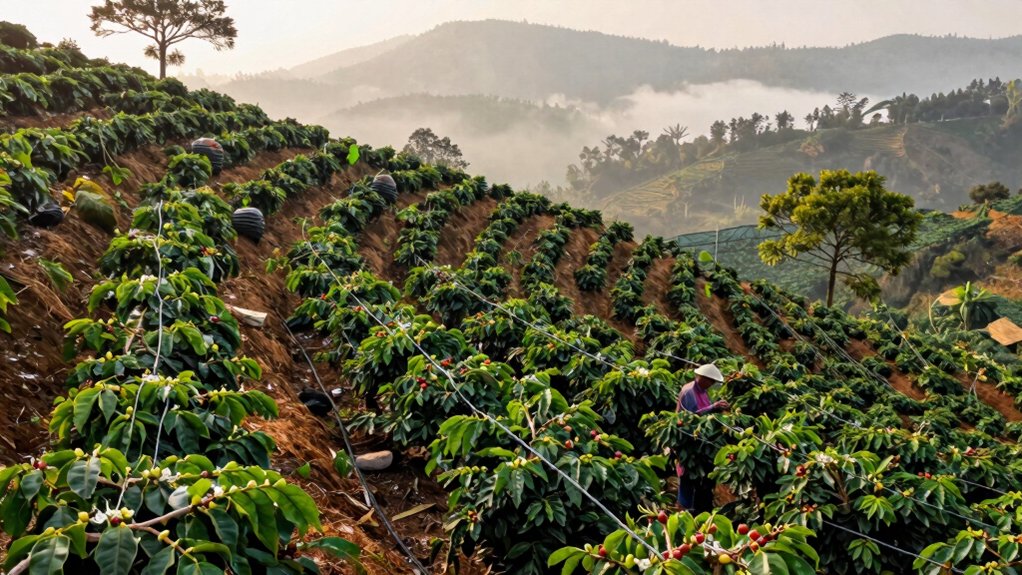
Because coffee’s climate sensitivity directly shapes what ends up in your cup, it matters to both farmers and consumers. You’ll notice Arabica yields dropping as temperatures climb, shrinking viable land by up to 50 % by 2050. Smallholders—who produce over 95 % of the world’s coffee—feel the pinch most, lacking capital for irrigation or heat‑resistant equipment. Shorter harvest windows and erratic rains raise labor costs, while hotter conditions fuel pests and diseases like coffee rust, threatening quality and price. Yet adaptation strategies can turn the tide. Shade‑grown and agroforestry systems boost climate resilience, buffering trees from heat and moisture stress. Drought‑tolerant varieties and targeted farmer training further safeguard incomes, ensuring the beans you brew stay flavorful and affordable. Removable dividers in organizational design mirror how adaptable farming practices can reorganize resources to meet changing climates.
How Shade Trees Cool Coffee Plantations
You’ll notice that choosing the right shade‑tree species lets you fine‑tune the microclimate, keeping leaf temperatures a few degrees lower than in full sun. The selection can also influence canopy structure to support evapotranspiration and soil moisture management, much like a well‑designed mug rack can optimize space and stability top‑mounted balance.
Shade Tree Species Selection
Ever wonder how a well‑chosen shade tree can turn a sweltering coffee farm into a cooler, more resilient ecosystem? You’ll pick species that balance canopy density and root depth, because shade trees with deep roots hold soil moisture and improve microclimate while supporting intercropping. Choose trees that drop abundant leaf litter; the organic matter boosts soil structure and nutrient cycling, reducing erosion. Opt for species that attract beneficial insects, shaping pest dynamics by encouraging natural enemies. Diversify your shade management by mixing fast‑growing pioneers with slower, hardwoods to maintain consistent cover year‑round. This blend creates a stable microclimate, moderates leaf temperature, and conserves water during dry spells—all while preserving yield quality and long‑term farm resilience. Additionally, selecting IP-rated refractometer features for on‑farm monitoring can help track extraction consistency and optimize post‑harvest quality under changing climate conditions.
Microclimate Temperature Regulation
How does a shade canopy turn a scorching coffee farm into a cooler, more resilient ecosystem? You’ll see that shade trees form a protective microclimate that lowers leaf and soil temperatures, easing heat‑stress on coffee farms. Their broad leaves intercept sunlight, while roots draw water that evaporates from the canopy, creating evapotranspiration cooling. This natural temperature regulation lets beans develop evenly, preserving quality even during heat spikes.
- Canopy density – denser shade reduces daytime ground temps by several degrees Celsius.
- Soil moisture – agroforestry retains water, extending drought resilience.
- Biodiversity boost – shade trees host predators, stabilizing pest pressure and overall crop health.
A recent interdisciplinary assessment highlights how these microclimates interact with local weather patterns to support sustained yields microclimate regulation.
Climate‑Smart Irrigation & Water Management
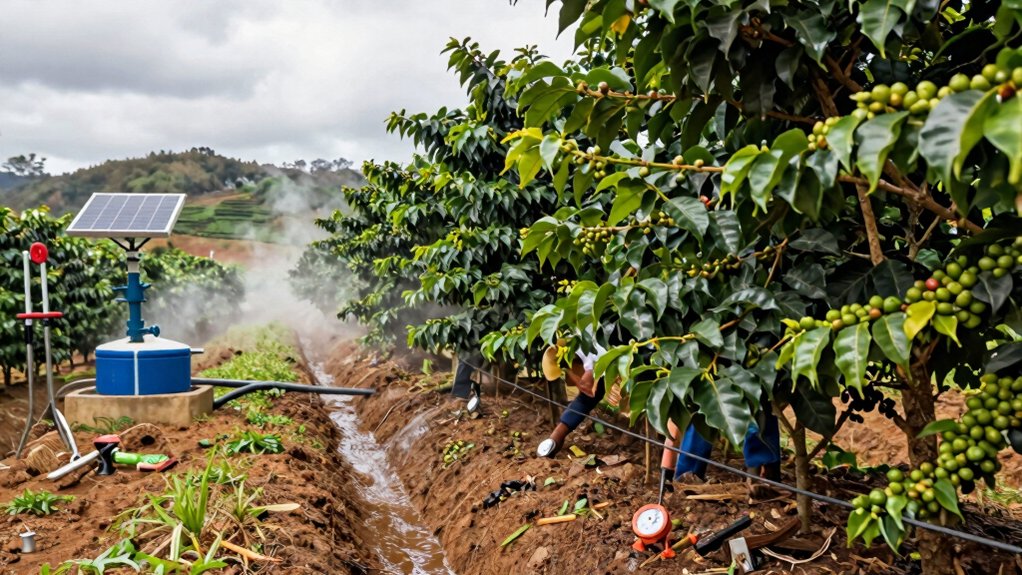
Since droughts are becoming more frequent, climate-smart irrigation on coffee farms relies on drip and sprinkler systems that deliver water exactly where and when it’s needed, cutting overall use while keeping yields stable. You’ll pair climate-smart irrigation with precise water management, using rapid soil testing to schedule each pulse of drip irrigation. This data-driven approach boosts drought tolerance, letting you apply just enough moisture at key growth stages. Stainless steel durability considerations from percolator gear emphasize the importance of robust materials in demanding field equipment to withstand outdoor conditions. Planting shade trees and integrating agroforestry further improves water retention, lowering evaporation and buffering microclimates. Meanwhile, insurance schemes tied to rainfall provide a safety net when extreme dry spells hit. Together, these tactics keep your coffee trees hydrated, healthy, and productive despite a shifting climate.
Climate‑Smart Mulching, Terracing & Soil Conservation
You’ll choose mulch materials that balance moisture retention, nutrient release, and local availability, then arrange them to protect the root zone during heat spikes. In addition, selecting sustainability‑minded decaf coffee sources can inform soil and shade management decisions, aligning farm practices with eco‑friendly supply chains Swiss Water Process.
Mulch Materials Selection
Which mulch material best balances moisture retention, nutrient supply, and erosion control on your coffee slope? You’ll find that coffee pulp, leaf litter, and compost each bring distinct benefits. Coffee pulp supplies organic carbon and boosts nutrient cycling, while leaf litter shades the soil, lowering soil temperature and enhancing drought resilience. Compost offers a stable structure that holds soil moisture and reduces runoff, fitting neatly into agroforestry systems that already protect your shade trees. Coffee pulp also supports soil microbial activity and simplifies nutrient cycling organic matter across the root zone.
Terrace Design Principles
You start by cutting level benches into the hillside, aligning each bench with the natural contour. This terracing slows runoff, captures rain, and creates a stable base for mulching.
Spread organic residues on each bench to conserve soil moisture, suppress weeds, and add organic matter. The mulch works with the terrace’s drainage channels to prevent nutrient leaching and reduce erosion. Additionally, selecting pH-stable amendments and monitoring soil pH regularly helps maintain optimal nutrient availability for coffee roots on sloped terrains buffered pH ranges.
Choosing Drought‑Resistant and Heat‑Tolerant Coffee Varieties
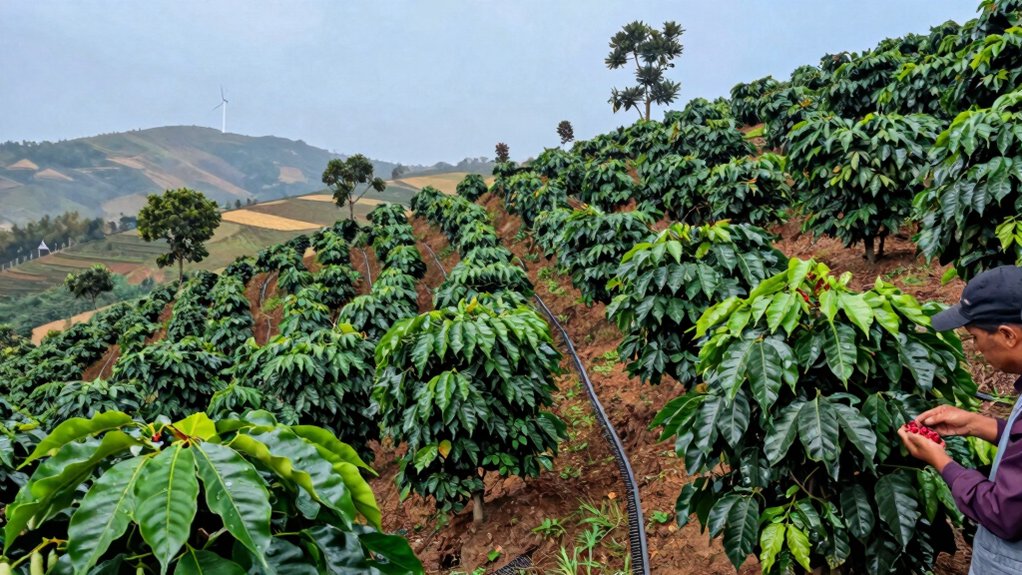
Where can you find the coffee varieties that will thrive as temperatures rise and rainfall becomes erratic? You’ll look to breeding programs that blend drought‑resistant varieties with heat‑tolerant coffee through hybridization and selective breeding. These new cultivars often pair best with shade‑grown and agroforestry systems, which cool the microclimate and cut water stress. By preserving wild germplams, researchers expand genetic diversity, giving you plants that withstand pests and disease while adapting to erratic moisture.
Breeding programs blend drought‑resistant and heat‑tolerant coffee, thriving in shade‑grown, agroforestry systems.
- Hybridized strains – cross‑bred for drought resistance and heat tolerance.
- Shade‑grown plots – trees create cooler, moister environments for seedlings.
- Agroforestry layouts – integrate coffee with timber and fruit trees to buffer temperature spikes.
These strategies let you choose resilient varieties without overhauling your whole farm.
Implementing New Varieties on Existing Farms
You’ll start by planting drought‑resistant hybrids in the spots where they’ll thrive, then weave shade‑canopy rows around them to buffer temperature swings.
While the new trees take root, you’ll boost soil health with cover crops and organic amendments, keeping nutrients in balance.
These steps let you shift smoothly without sacrificing short‑term yields.
Drought‑Resistant Hybrids
Why risk losing your harvest to scorching, when drought‑resistant hybrids can keep yields steady? You’ll plant drought‑tolerant hybrids at higher elevations, tweak shade management, and reap better water‑use efficiency and disease resistance. The payoff comes after a long‑rotation, but the resilience pays off as temperatures climb.
- Site selection – move plots to cooler, higher slopes where hybrids thrive.
- Cultivation practices – adjust shade density and soil health to match deeper root systems and improved stomatal regulation.
- Support systems – invest in farmer training, secure inputs, and partner with cooperatives or buyer programs for market stability.
Shade‑Canopy Integration
Ever wondered how a simple canopy can turn your existing coffee plot into a climate‑smart oasis? By adding a shade‑canopy through agroforestry, you create a microclimate that buffers coffee trees from temperature spikes and moisture loss, directly supporting climate change adaptation.
Pair coffee with leguminous and non‑leguminous trees, and you’ll boost soil health, fix nitrogen, and enhance biodiversity that naturally suppresses pests.
The cooler, more stable environment lets older, high‑quality varieties stay productive, stabilizing coffee yields even when rainfall varies. Track tree density, carbon sequestration, and yield consistency to gauge success, and watch how the integrated system improves resilience while preserving the ecosystem you rely on.
Soil‑Health Enhancement Strategies
How can you boost soil health while introducing new coffee varieties on an existing farm? You can protect moisture, increase soil organic carbon, and keep yields steady by pairing drought‑tolerant varieties with proven soil‑care practices.
- Plant under existing shade trees – agroforestry creates a canopy that reduces erosion, moderates temperature, and supplies leaf litter for composting.
- Apply targeted compost and mulching – spread composted coffee pulp and organic mulch around each new plant to enhance nutrient cycling, improve structure, and retain water.
- Monitor soil organic carbon – use regular soil analyses to track carbon gains, adjust compost rates, and fine‑tune irrigation for the drought‑tolerant varieties.
Agroforestry & Intercropping for Income Diversification
Can you imagine your coffee farm thriving while buffering climate shocks? By adopting agroforestry, you plant shade-grown trees that curb erosion, enrich soil, and lock carbon, boosting climate resilience. The canopy creates a stable microclimate, moderating leaf temperature and humidity, which steadies bean quality and supports biodiversity. Adding intercropping—say, bananas, beans, or cacao—creates income diversification, giving you food or fodder when coffee yields dip. These companion crops also attract pollinators and natural predators, reinforcing pest control without extra chemicals. Programs like Nespresso AAA reward you for tree planting, tracking millions of new trunks that amplify carbon sequestration and ecosystem health. Together, agroforestry and intercropping turn your farm into a resilient, multi‑source livelihood.
Climate‑Smart Integrated Pest Management
What if you could stay one step ahead of pests and disease while cutting pesticide use? Climate‑smart IPM lets you blend real‑time monitoring, forecasting, and targeted actions to protect your coffee while boosting climate resilience. You’ll use drones to spot early rust, apply Beauveria bassiana as a biological control, and switch to disease‑resistant varieties when pressure spikes. Shade‑grown systems create habitats for natural enemies, lowering pest loads and stabilizing microclimates. Training and insurance pilots give you risk‑sharing tools, so you can act preventively rather than reactively.
- Deploy drones and rapid soil tests for early detection.
- Plant shade‑grown coffee alongside agroforestry to foster predators.
- Use biological controls and disease‑resistant varieties to reduce chemical sprays.
Going Carbon‑Neutral on the Farm
Ever wondered how your coffee farm can balance profit and planet? You can aim for carbon‑neutral status by adopting shade‑grown coffee and agroforestry, which lock carbon in trees and soil. Pursue PAS 2060 certification to prove your emissions‑reducing pathway, and integrate climate‑smart farming practices like precision irrigation and optimized fertilizer use to cut on‑farm CO₂e.
Use blockchain‑enabled traceability to showcase your carbon‑neutral achievements to buyers, and tap rainfall‑based insurance payouts that protect income while encouraging low‑emission techniques. By combining these steps, you’ll lower your carbon footprint, meet market demand for sustainable beans, and safeguard your farm against climate volatility.
Community‑Based Climate Monitoring With Mobile Apps
How can you turn your coffee farm into a real‑time climate observatory? By joining a community‑based monitoring network, you’ll log temperature, rainfall, and pest sightings on a mobile app that works offline and syncs when you’re back online. Your daily entries feed into a regional dashboard that transforms raw climate data into actionable insights for shade management and irrigation. The app also triggers early warning alerts for drought, frost, or rust, letting you and neighboring farmers respond instantly.
- Install the app, train with NGO partners, and start daily weather logs.
- Upload observations to the shared dashboard for real‑time climate mapping.
- Receive automated early warnings and adjust shade or water use accordingly.
Climate‑Smart Financial Tools & Insurance
Your real‑time climate data becomes a powerful lever for financial security when you plug it into climate‑smart tools and insurance. By linking your on‑farm weather feed to climate‑smart insurance, you trigger rainfall‑based payouts the instantly after drought or excess rain, keeping cash flow steady.
Weather‑index products let you hedge against temperature spikes without needing loss assessments, simplifying risk management.
Blockchain‑verified supply‑chain data sharpens underwriting, so insurers price policies around your demonstrated climate resilience.
You can tap smallholder finance programs that bundle micro‑loans with index‑based coverage, giving you capital for inputs while protecting yields.
Together, these mechanisms turn volatile weather into predictable financial outcomes, letting you invest confidently in your coffee farm’s future.
Climate‑Smart Certification & Market Access
What if a single certification could turn climate risk into a market advantage? You’ll find that a climate‑smart certification not only validates your sustainable practices but also opens premium market access. By adopting shade agroforestry and integrated pest and disease management, you protect soils, stabilize yields, and meet buyer expectations. Farmer training equips you with data‑driven techniques, while blockchain traceability assures consumers of your coffee’s origin and resilience.
- Shade agroforestry – reduces erosion, boosts biodiversity, and satisfies certification criteria.
- Integrated pest and disease management – cuts losses, improves bean quality, and earns higher prices.
- Farmer training & traceability – builds expertise, creates transparent supply chains, and secures long‑term contracts.
These steps convert climate challenges into competitive strengths, linking sustainability to profitable market access.
Climate‑Smart Consumer Support for Resilient Coffee
Ever wondered how your coffee choices can boost farm resilience? You can drive climate‑smart consumer support by buying shade‑grown coffee that embraces agroforestry, which cuts erosion, enriches soil, and spikes carbon sequestration. Brands like Nespresso link your purchase to transparent supply chains, letting you trace each bean’s journey and confirm fair‑wage commitments via blockchain. When you choose these products, you fund cooperative finance that backs farmers with risk‑sharing loans, training, and on‑farm shade planting. Data‑driven programs already boast over 3.5 million trees planted and roughly 130,000 tons of CO₂eq removed annually. Your everyday sip therefore fuels resilient varieties, stabilizes yields, and creates a measurable climate impact.
Frequently Asked Questions
How Can Coffee Farmers Protect Biodiversity While Adopting Climate‑Smart Practices?
You protect biodiversity by planting shade trees, preserving native forest patches, rotating crops, using organic fertilizers, and creating wildlife corridors while adopting drought‑tolerant coffee varieties and water‑saving irrigation.
What Role Do Local Indigenous Knowledge Systems Play in Climate Adaptation?
You rely on indigenous knowledge to select resilient varieties, time planting with seasonal cues, and preserve shade trees, which together boost yields, protect soils, and buffer farms against climate extremes.
How Do Climate‑Smart Farms Measure and Report Their Carbon Sequestration?
You’ll use soil‑carbon sensors, remote‑sensing drones, and on‑site carbon‑footprint calculators to collect data, then upload the metrics to certification platforms that generate standardized reports for stakeholders.
What Are the Most Effective Ways to Finance Small‑Holder Climate Adaptations?
You should tap micro‑finance, blended‑finance, impact‑investor funds, and government‑backed climate grants; combine them with pay‑for‑ecosystem‑services contracts, crowd‑funding platforms, and cooperative credit unions to secure affordable, flexible capital.
How Can Consumers Verify That Their Coffee Supports Climate‑Resilient Farms?
You verify it by scanning certifications, checking QR codes, and using apps that trace beans to farms practicing shade‑growing, drought‑resistant varieties, and carbon‑sequestration methods, ensuring climate‑resilient sourcing.
In Summary
You’ve seen how coffee farms can stay resilient: shade trees cool the beans, smart irrigation saves water, and mulching protects soil. By picking drought‑tolerant varieties, using mobile climate monitors, and tapping into insurance and certification programs, farmers protect yields and livelihoods. And when you choose climate‑smart coffee, you support those efforts, helping the whole chain adapt to a warming world.


