

You make coffee carbon neutral by cutting emissions at every stage—using renewable energy on farms, optimizing roasting, employing recyclable packaging, and streamlining transport—then offsetting the remaining footprint with verified carbon credits that fund real, permanent projects. Standards like the International Gold Standard ensure the credits are measurable and independently verified. When you choose beans that follow these practices, you’re supporting lower‑impact farming, reduced fertilizer use, and methane capture at washing stations. Keep going to discover how these steps translate into real‑world brand examples and consumer benefits.
What Does “Carbon‑Neutral Coffee” Actually Mean?
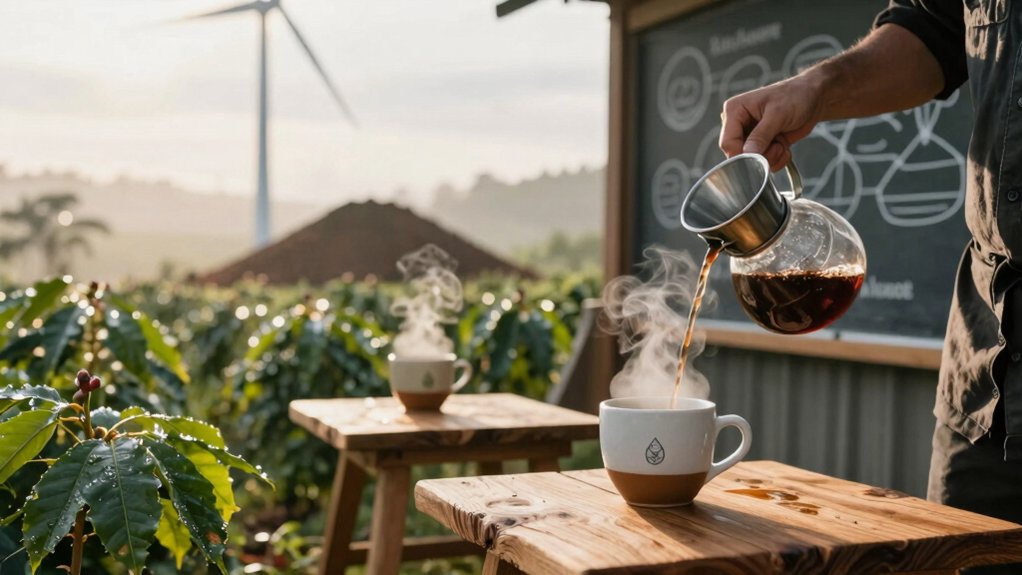
What does “carbon‑neutral coffee” actually mean? It means you sip a brew whose lifecycle emissions have been balanced to zero. You start by cutting emissions wherever you can—switching to renewable energy on the farm, optimizing roasting heat, using recyclable packaging, and streamlining transport. Then you purchase verified carbon credits to offset the remaining footprint. Those credits fund projects that are real, measurable, permanent, and independently verified, often certified by the International Gold Standard or the Clean Development Mechanism. By addressing every stage—from seed to cup—you achieve carbon neutrality. The result is a cup that doesn’t add new CO₂ to the atmosphere, letting you enjoy coffee without compromising the climate. Lifecycle emissions
Why Coffee’s Carbon Footprint Matters for the Planet and Your Cup
You probably don’t realize that most of coffee’s emissions happen before the beans even leave the farm, where land‑use change and nitrogen fertilizers dominate. Those early‑stage emissions drive climate change, which threatens yields and could shrink suitable growing land by up to 97% by 2050. If the planet suffers, your morning cup gets pricier and less sustainable, so cutting farm‑level emissions matters for both the climate and your coffee. Power outlets can support larger appliances and help keep equipment powered efficiently in some setups, which is relevant when considering how equipment and storage configurations impact energy use in coffee stations.
Climate Change Threatens Yields
If climate change keeps pushing temperatures higher, coffee yields will shrink dramatically—by 2050, up to 97 % of suitable land in key regions could disappear. You’ll see that climate change drives land use change, forcing farmers to abandon low‑altitude farms and hunt for higher ground. This slash in usable acreage slashes yields, and the front‑loaded emissions from that land use change already account for 75 %–91 % of a cup’s carbon footprint. In addition, rising pests and diseases linked to warmer climates threaten resilience and increase the need for adaptive farming practices land use change. Heavy rains or droughts further disrupt harvests, creating price spikes and volume shortfalls in Peru, Colombia, and Brazil. As temperatures climb, you’ll notice growers turning to less sustainable practices, jeopardizing biodiversity and the future of the coffee you love.
Farm‑Level Emissions Dominate
Rising temperatures threaten coffee yields, but the biggest carbon burden still comes from the farm itself. You’ll find that farm emissions account for roughly 45% of Rwanda’s green‑coffee footprint, driven largely by fertilizer use. Each kilogram of green beans carries about 1.4 kg CO₂, mostly from chemical fertilizers that also degrade soil health and leach groundwater. Over‑fertilization pushes soil pH below 5.5, cutting yields and amplifying emissions. Yet you can cut that impact: precision agriculture and region‑specific input optimization can trim unnecessary fertilizer use, shaving up to 10% off farm‑level emissions. Since 75%–91% of total emissions happen before the beans leave the farm, improving soil health and reducing fertilizer use are the most effective levers for a truly carbon‑neutral cup precision agriculture.
Carbon‑Neutral Coffee’s Biggest Emission Hotspots
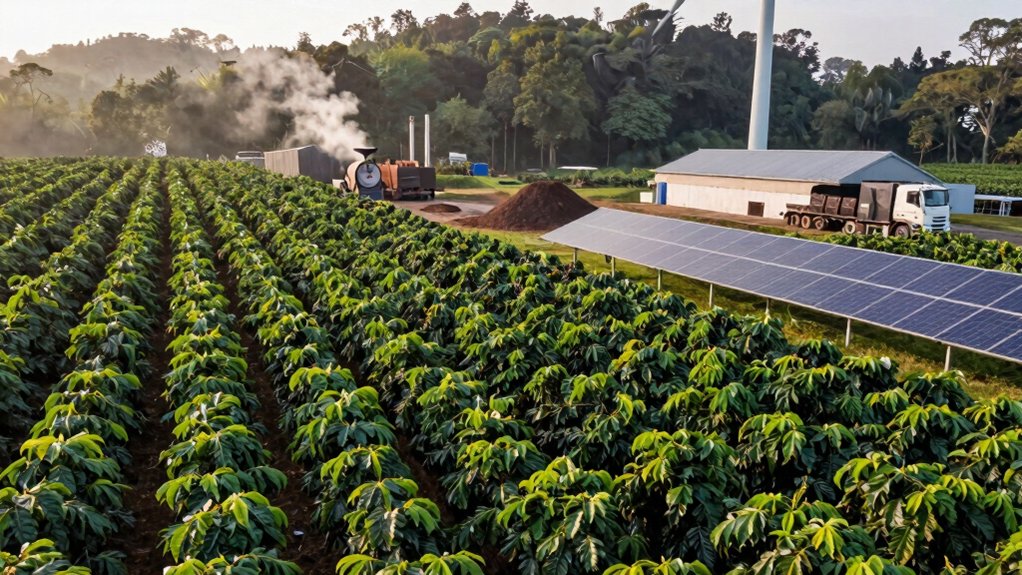
Where do the biggest emissions in carbon‑neutral coffee come from? You’ll find three hotspots: fertilizer emissions, wastewater methane, and land‑use change.
Fertilizer emissions dominate farm‑level output, especially nitrogen‑based inputs that release nitrous oxide—about 273 times more potent than CO₂.
At washing stations, wastewater methane adds another 40 % of the supply‑chain footprint, unless you capture and treat it.
Land‑use change, often from deforestation, spikes the carbon balance before beans even leave the farm.
Together, these three sources account for roughly 85 % of total emissions per kilogram of green coffee.
Targeting them—through greener fertilizer regimes, methane‑capture technology, and sustainable land management—offers the clearest path to truly carbon‑neutral coffee. Keto-friendly
Rwanda’s Farms: A Case Study in Carbon‑Neutral Coffee Emissions
You’ll notice that tighter soil fertilizer management can slash the 1.4 kg CO₂ per kilogram of green coffee that comes from chemical use.
Capturing methane from washing‑station wastewater cuts another big chunk of Rwanda’s emissions.
And the new organic fertilizer from black‑soldier‑fly waste turns pulp leftovers into a carbon‑negative input for the farms, reinforcing the value of ATC temperature stabilization in achieving consistent processing benefits.
Soil Fertilizer Management
Rwanda’s coffee farms are grappling with soil‑quality issues that push growers toward cheap chemical fertilizers, which account for most of the 1.4 kg CO₂ emitted per kilogram of green coffee at the farm gate.
You can boost soil health and slash farm emissions by reshaping fertilizer management.
Start with regular soil testing to match nutrient applications to actual needs, then shift toward organic amendments like compost and biochar that improve structure while sequestering carbon.
Finally, adopt precision‑application tools that reduce over‑use and runoff.
These steps cut reliance on synthetic inputs, lower the carbon intensity of each bean, and move Rwanda’s coffee toward true neutrality.
- Soil testing for tailored nutrient plans
- Organic amendments to enhance soil health
- Precision application to optimize fertilizer use
Wastewater Methane Capture
Ever wondered how the bubbling wastewater at coffee washing stations fuels climate change? In Rwanda, those basins release methane that accounts for roughly 45 % of farm‑level emissions. When you install methane capture systems alongside upgraded wastewater treatment, you trap a potent greenhouse gas before it escapes. The captured gas can be filtered and fed into generators, offsetting diesel use and cutting the carbon intensity of each kilogram of green coffee. By integrating these captures with Rwacof’s broader recycling and soil‑health plans, you push the entire operation toward carbon‑neutral coffee. The result is a measurable emissions drop, a cleaner production cycle, and a stronger market claim for sustainability‑focused growers. Methane capture further enhances the environmental benefits by reducing emissions at their source and supporting renewable energy integration across farming operations.
Organic Fertilizer Innovation
Capturing methane from wastewater is only half the story; the next step is turning farm waste into a clean, organic fertilizer. In Rwanda, you’ll see black‑soldier‑fly facilities transform coffee pulp into nutrient‑rich organic fertilizer, cutting reliance on synthetic chemicals. This shift boosts soil health, improves water retention, and drives emissions reduction across the farm level. By feeding maggots to livestock, farms close the loop, turning waste into animal feed while lowering carbon footprints. The result is higher yields, better cup quality, and a pathway to carbon‑neutral coffee.
- Convert pulp waste into organic fertilizer.
- Use soil‑testing guidance to optimize application rates.
- Integrate maggot‑derived feed to reduce overall emissions.
Tools & Standards for Coffee Carbon Mapping
How do you guarantee that every kilogram of coffee you trade reflects its true climate impact? You start with carbon mapping tools that track emissions from farm to export, pinpointing hotspots like Rwanda’s 3 kg CO₂e per kilogram of green coffee.
By measuring fertilizer use—1.4 kg CO₂e per kilogram—and wastewater methane at washing stations, you create a data‑driven emissions reduction roadmap.
Standards such as the Rwacof protocol let producers, traders, and mills share verified numbers, enabling sustainable sourcing decisions that respect regional variability.
Collaborative platforms integrate soil, practice, and processing data, so you can apply region‑tailored decarbonization strategies.
The result is a transparent supply chain where each coffee tonne carries a credible climate footprint, supporting genuine carbon‑neutral claims.
How Regenerative Soils Cut Farm Emissions
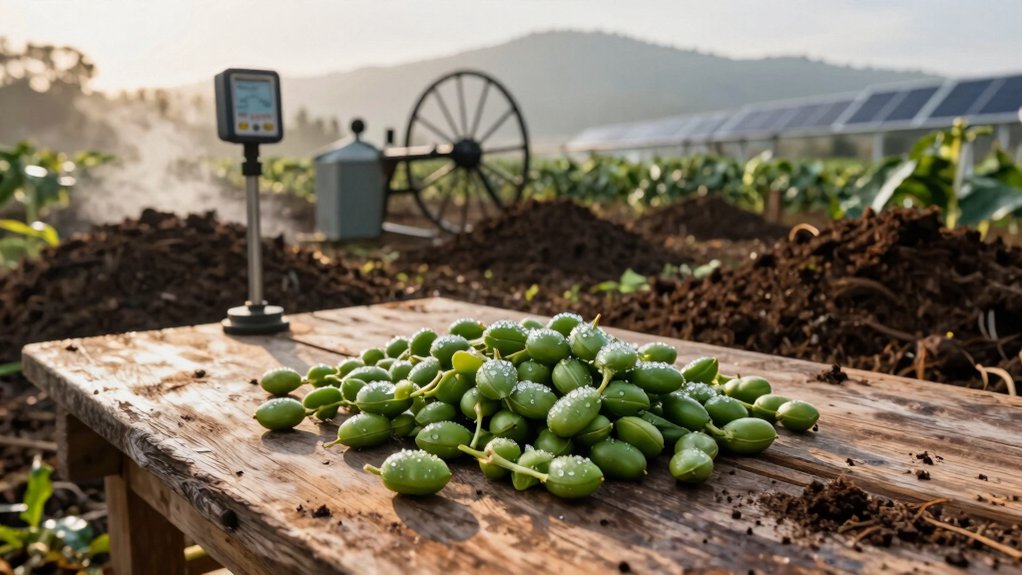
You’ll see that regenerative soils lock away carbon directly in the ground, turning farms into carbon sinks.
By boosting organic matter, they let you cut back on synthetic fertilizers, which means fewer nitrous‑oxide emissions.
The result is lower farm‑level GHGs while keeping yields strong.
Il Soil Carbon Sequestration
When you adopt regenerative practices—cover crops, reduced tillage, and compost—you boost soil organic matter, turning fields into carbon sinks that cut farm emissions.
In Rwanda’s Rwacof farms, you’ll see soil carbon sequestration rise as regenerative soils lock more carbon underground, lowering the coffee supply chain’s lifecycle footprint.
Adding biochar from coffee waste further stabilizes carbon for decades while improving nutrient retention and crop resilience.
- Cover cropping – diversifies root structures, accelerates organic matter buildup, and enhances sequestration rates.
- Reduced tillage – minimizes disturbance, preserves soil aggregates, and keeps carbon locked in the profile.
- Compost application – supplies fresh organic inputs, fuels microbial activity, and raises soil organic matter levels.
These steps shift fields from carbon sources to long‑term sinks, delivering measurable emissions cuts.
Reduced Fertilizer Dependency
Ever wondered why cutting fertilizer use can slash your coffee farm’s carbon footprint? When you adopt regenerative soil practices, you boost soil health and let natural microbes recycle nutrients, so you need less synthetic fertilizer. Precision agriculture and soil testing let you apply just enough nutrients, curbing over‑application and cutting N₂O emissions. In Rwanda, farmers who switch from cheap chemical inputs to cover crops, compost, and organic amendments see fertilizer reduction and higher carbon storage in the ground. These soil‑building strategies also improve yields and resilience, making the farm more profitable and climate‑smart. Industry programs now target origin‑level interventions, guiding you toward soil‑centered management that lowers overall emissions while preserving coffee quality.
Low‑Energy Washing Stations for Carbon‑Neutral Coffee
How can low‑energy washing stations help you achieve carbon‑neutral coffee? You’ll cut greenhouse gas emissions at the washing stage by using efficient aeration, sealed systems, and smarter wastewater management. Reducing energy demand lowers methane leaks and overall lifecycle emissions, keeping product quality while moving you toward carbon neutrality.
- Aeration upgrades – Boost oxygen transfer to break down organic waste, slashing methane output.
- Sealed processing loops – Capture and recycle water, preventing fugitive gas release and cutting energy use.
- Optimized wastewater treatment – Deploy low‑power biofilters that treat effluent with minimal electricity, further trimming emissions.
Verified Offsets for Carbon‑Neutral Coffee
Why should you trust the offsets that claim your coffee is carbon‑neutral? You need real, measurable, permanent, and additional reductions that an independent verification body confirms. Brands like Jasper Coffee rely on International Gold Standard Certification through the Clean Development Mechanism, ensuring each offset meets strict criteria. Projects range from renewable energy installations to restoring degraded Tanzanian grasslands, providing tangible carbon removal. Those offsets are paired with on‑farm emission cuts—solar panels, waste‑heat recovery, and efficient logistics—so the coffee isn’t just buying a “green” label. By demanding rigorous verification, you guarantee that the offsets truly balance the remaining emissions, delivering genuine carbon‑neutral coffee without shortcuts.
Why Carbon‑Neutral Coffee Matters to Farmers, Roasters, and You
What makes carbon‑neutral coffee matter is simple: it directly benefits the people who grow, roast, and drink it. You’ll see that carbon neutrality isn’t just a buzzword; it translates into real‑world gains for every link in the supply chain.
- Farmers gain healthier soil, lower fertilizer costs, and better market access as buyers prioritize sustainable beans.
- Roasters tap into growing consumer demand, differentiate their brand, and often command price premiums when they can prove low supply chain emissions.
- You, the consumer, enjoy a cup that supports environmental stewardship while still delivering the flavor you love.
Brands That Already Sell Carbon‑Neutral Coffee
Ever wondered which brands already deliver truly carbon‑neutral coffee? You can trust Jasper Coffee, which hit 100% carbon neutrality back in 2009 and backs any remaining emissions with offsets sourced from International Gold Standard‑verified projects. Presto Coffee cuts its supply chain emissions by up to 70% with eco‑friendly air roasting, pairs that with 100% recyclable packaging, and uses Rainforest Alliance certified beans. In East Africa, Sucafina and Rwacof join forces to improve soil health, slash fertilizer use, and recycle waste, moving their Kenya and Rwanda supply chains toward carbon neutrality. The Regenerative Agriculture Initiative in southern Peru aims for a 2026 launch, investing in multi‑stakeholder projects that lower emissions, restore grasslands in Tanzania, and secure living incomes for producers. All these brands track reductions and offsets through annual inventories, ensuring transparent progress toward a truly carbon‑neutral cup.
How You Can Support Carbon‑Neutral Coffee Today – Buy, Label, Advocate
You’ve seen which brands already offer carbon‑neutral coffee, now it’s time to turn that knowledge into action. Start by buying brews that carry verified carbon‑neutral labels, and check that they disclose emissions transparency through annual GHG inventories. Choose products backed by Rainforest Alliance, B Corp, or International Gold Standard credits, because those certifications guarantee sustainable sourcing and offset integrity. Finally, push for clearer labeling and stronger industry standards by contacting retailers, signing petitions, and sharing your expectations on social media.
Buy verified carbon‑neutral coffee, track emissions reports, and push for clearer labeling and industry standards.
- Buy certified carbon‑neutral beans and track the brand’s emissions transparency reports.
- Label your own pantry with notes on sustainability claims to keep the conversation alive.
- Advocate for mandatory carbon‑footprint disclosures and support policies that reward sustainable sourcing.
Frequently Asked Questions
What Is the 15-15-15 Rule for Coffee?
You follow the 15‑15‑15 rule by cutting emissions 15% in farming, 15% in processing, and 15% in distribution, then you offset the remaining 15% with verified, permanent carbon credits.
Why Do the USA Not Produce Coffee?
You don’t grow coffee in the U.S. because the climate’s too cold and dry, the land’s unsuitable, and water’s scarce; importing from tropical regions is far cheaper and more efficient.
What Is the Only Country in the World That Is Carbon Negative?
You’ll find Bhutan is the only carbon‑negative country, because its forests sequester more CO₂ than the nation emits, thanks to strict forest‑cover laws and abundant hydropower keeping emissions minimal.
What Are the 4 Enemies of Coffee?
You’ll face four enemies: deforestation, excessive fertilizer, climate‑driven extreme weather, and waste from processing or packaging that releases methane and other greenhouse gases.
In Summary
By choosing carbon‑neutral coffee, you’re cutting emissions, supporting sustainable farms, and nudging the whole industry toward greener practices. Every cup you buy can fund verified offsets, empower growers, and shrink the carbon footprint from field to mug. Keep an eye on labels, demand transparency, and spread the word—your daily habit can drive real change for the planet and the people who grow your brew.


