

You’ll transform your espresso routine with a bottomless portafilter by watching extraction happen in real time. You’ll spot channeling instantly when water rushes through weak spots, see uneven tamping create multiple streams, and identify grind inconsistencies that spouted portafilters hide. You’re no longer guessing why shots taste bitter or sour—you’re adjusting dose, distribution, and technique based on immediate visual feedback. This diagnostic tool turns your espresso machine into a personal quality control system. There’s plenty more to discover about mastering each variable.
What Is a Bottomless Portafilter and Why It Matters?
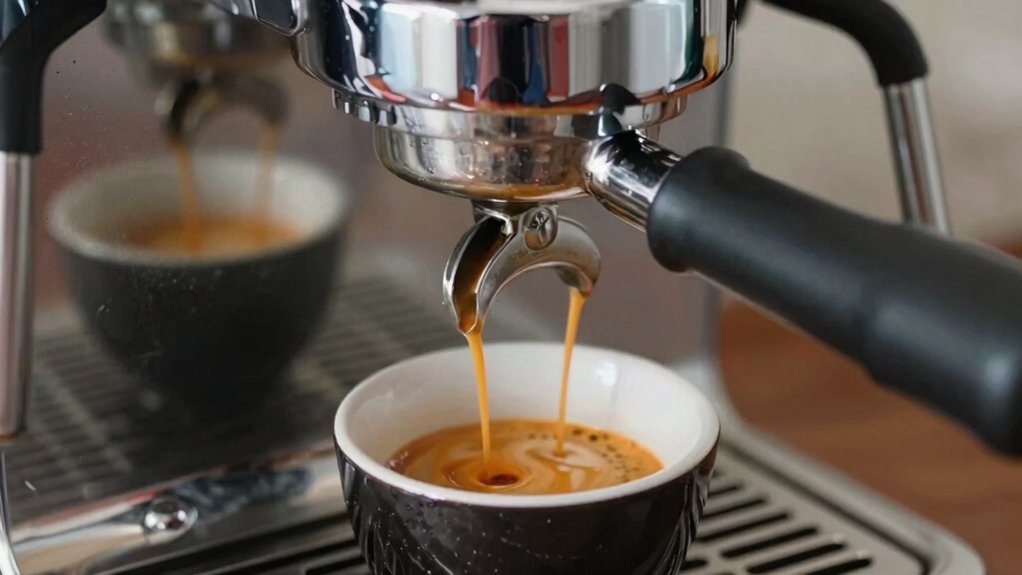
Ever wondered what’s actually happening inside your espresso puck during extraction? A bottomless portafilter eliminates the mystery by removing the basket’s bottom, exposing your coffee and creating a direct flow into your cup. This transparent design reveals exactly how water travels through your puck, making it invaluable for diagnosing issues.
You’ll immediately spot channeling, uneven tamping, and grind inconsistencies as they appear—spray patterns or multiple streams signal problems. This visual feedback guides your adjustments to grind size, dose, and distribution in real time.
When you observe a single cohesive stream with stable crema, you’ve achieved more even extraction patterns. A bottomless portafilter transforms espresso-making from guesswork into precise technique refinement, giving you concrete evidence of what your tamping technique accomplishes. Extraction visibility provides actionable insight that can accelerate your learning curve and fine-tuning.
How Do Bottomless Portafilters Reveal Extraction Problems?
Why do multiple streams pour from your portafilter when you’re expecting a single, steady flow? Your bottomless portafilter reveals extraction problems instantly through visual feedback that traditional baskets hide. When you use a bottomless portafilter, you’ll observe:
- Channeling patterns showing as irregular sprays rather than cohesive streams
- Uneven extraction indicated by sputtering or side-biased dripping
- Density imbalances exposing poor tamping or distribution techniques
- Grind size issues revealed through chaotic flow transitions
- Packing problems displayed as underfilled or densely packed areas
These visual cues guide your diagnostics directly. Spraying signals inadequate distribution, while irregular streams point to tamping inconsistencies. By observing how water flows through your coffee bed, you’ll identify exactly which variable—grind, dose, distribution, or tamping—needs adjustment, enabling you to refine your technique systematically and achieve superior extraction consistency. This practice also aligns with the broader concept of maximizing extraction efficiency by promoting even flow paths grind consistency and distribution accuracy across the bed.
Spotting Channeling With a Bottomless Portafilter

How quickly can you spot a channeling problem? With a bottomless portafilter, you’ll notice it immediately. When water finds weak spots in your puck, you’ll see multiple distinct streams or sprays instead of a single, cohesive flow. These irregular jets and splattering patterns reveal that your espresso extraction isn’t even. Over Ice temperature adjustment is a recurring feature in many iced-coffee makers that can influence extraction consistency when brewing iced beverages.
What Causes Channeling: Dose, Distribution, and Tamping
You’ll notice channeling intensifies when you underdose your coffee, as insufficient grounds create gaps where water rushes through unimpeded. Uneven tamping pressure compounds this problem by establishing density variations throughout your puck that guide water toward the weakest points. Regularly using a consistent dose and uniform tamping helps maintain stable extraction across sessions, aligning with best practices for Non-toxic alkaline formula cleaners and their role in maintaining equipment cleanliness that supports consistent flow.
Underdosing and Weak Spots
When you underdose your portafilter, you’re basically creating a looser coffee bed with larger gaps between particles. Water finds these weak spots and flows through them unevenly, causing channeling instead of cohesive extraction. A bottomless portafilter reveals this immediately—you’ll see spray patterns and irregular streams where underdosing compromises your distribution.
How underdosing sabotages extraction:
- Creates larger gaps encouraging water to bypass dense areas
- Leaves uneven density that promotes early breakthrough along edges
- Forces water to seek the path of least resistance
- Accelerates spray and uneven extraction across the puck
- Reduces contact time between water and coffee grounds
Your bottomless portafilter becomes your diagnostic tool. Watch for these telltale signs and adjust your dose upward, ensuring consistent distribution and proper tamping pressure to eliminate weak spots entirely. grind settings
Uneven Tamping Pressure Issues
Even with the right dose and proper distribution, your tamping technique can still sabotage extraction. Uneven tamping pressure creates density inconsistencies throughout your puck, establishing channeling pathways where water rushes through instead of saturating the coffee uniformly. You’ll experience spray patterns, sputtering, and multiple extraction flows rather than the smooth, honey-like stream you’re targeting. A levelheaded, consistent tamp around 30 pounds of pressure minimizes these density variations and promotes even water distribution across your entire bed. Here’s where your bottomless portafilter becomes invaluable: it reveals exactly what’s happening below. Watch for spray patterns and flow irregularities that signal tamp pressure problems. This visual feedback lets you make precise adjustments, transforming your technique and dramatically improving your extraction consistency and espresso quality No preservatives, artificial colors or flavors; 1% sales to bee research.
Master Your Tamping Technique for Consistent Shots
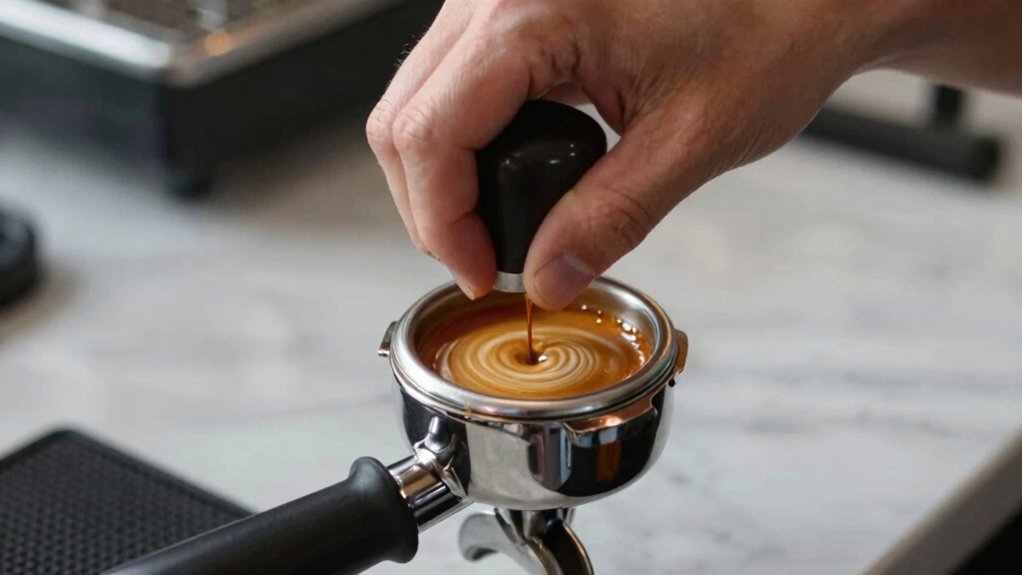
Why does tamping technique matter so much for espresso extraction? Your tamping technique directly controls water flow through the coffee bed, preventing channeling and ensuring even extraction.
Master these fundamentals with your bottomless portafilter:
- Apply consistent tamping pressure around 30 pounds for cohesive extraction
- Level your tamp to prevent preferential water paths
- Maintain uniform puck density across the entire surface
- Watch visual cues like irregular streams to identify flaws
- Pair even distribution with consistent pressure for honey-like pours
You’ll notice immediate improvements when you nail this technique. The bottomless portafilter reveals every mistake through splattering or uneven flow, giving you real-time feedback. As you refine your approach, you’ll achieve stable crema and smoother shots consistently. This precision transforms your espresso from mediocre to exceptional. Bottomless portafilter insights
Distributing Grounds Evenly: A Bottomless Portafilter Essential
How you distribute grounds in your basket determines whether you’ll see a single, consistent stream or chaotic splattering beneath your bottomless portafilter.
When you use proper distribution tools or WDT, you prevent uneven grounds that create multiple flow points and spray. Dosing evenly across the basket ensures all perforations receive similar contact, promoting one cohesive stream instead of splatter.
Well-distributed grounds transform your extraction feedback dramatically. You’ll notice the flow starts slowly, transitioning to honey-like consistency rather than abrupt bursts. This evenness reduces hidden channeling by exposing the puck’s surface to observation.
Your bottomless portafilter becomes a diagnostic tool. By achieving proper evenness, you gain immediate visibility into how technique adjustments—tamping pressure, dosing, grind size—affect extraction. This real-time extraction feedback accelerates your path to consistently superior shots.
Decoding Spray Patterns: Single Streams vs. Sputtering
When you pull a shot with your bottomless portafilter, what comes out from underneath tells you everything about your puck’s integrity.
A single, cohesive stream signals proper grind distribution and even tamping—the hallmark of balanced extraction. Conversely, sputtering or spraying reveals problems you’ll want to address immediately:
- Uneven tamping pressure creates multiple weak flow points
- Grind inconsistencies cause rapid, irregular spray patterns
- Underdosed or overdosed areas show up distinctly through spray patterns
- Channeling results in chaotic splatter instead of smooth flow
- Real-time adjustments prevent crema degradation and shot instability
Your spray patterns act as a diagnostic tool. When you observe a honey-like pour with minimal splatter, you’re witnessing extraction balance. Those early spray warnings let you refine your technique immediately, transforming your bottomless portafilter from a mere brewing device into your personal espresso quality control system.
Fine-Tune Your Grind, Dose, and Timing From What You See
You’ll quickly spot grind issues when you watch how water flows through your puck—a gushing stream signals you need to go finer, while uneven spurts point to distribution problems.
Your dosing accuracy directly impacts what you’re seeing; even a half-gram deviation can trigger channeling or uneven saturation that throws off your entire shot.
Observable Flow Reveals Grind Issues
Why does your espresso sometimes gush out in erratic spurts instead of flowing smoothly? A bottomless portafilter reveals the answer by exposing weak spots in your puck. When you observe multiple streams or uneven flow patterns, you’re seeing grind issues in real time.
Observable flow patterns tell you:
- Multiple streams signal an inconsistent grind size
- Channeling indicates weak distribution technique
- Sputtering reveals tamping pressure problems
- Early gushing suggests you’ve dosed too little coffee
- Delayed flow shows you’ve packed the puck too densely
Each flow pattern guides your adjustments. A coarser grind may fix gushing, while a finer grind combats channeling. Refining your distribution technique and tamping pressure directly addresses what you’re seeing. This visual feedback accelerates your path to consistent, balanced extraction.
Adjusting Variables Through Visual Cues
Understanding what you see in the portafilter is only half the battle—now you need to act on it. Bottomless portafilters let you translate visual feedback into concrete adjustments. When you spot channeling or spray patterns, you’ll know to modify your grind size, dose, or tamping density. If water sprays unevenly, try grinding finer or adding more coffee. Notice a sluggish pour? Coarsen your grind slightly. A honey-like flow signals you’re hitting the mark—lock in those settings. Compare shots before and after each adjustment to quantify improvements in crema and extraction speed. This real-time visual guidance transforms guesswork into systematic refinement, helping you dial in consistency shot after shot.
When Bottomless Reveals More Than Spouted: Use Cases for Diagnostic Feedback
How can you pinpoint extraction problems before they affect your shot’s taste?
A bottomless portafilter delivers extraction diagnosis that spouted filters can’t match. You’ll spot issues instantly:
- Channeling patterns reveal uneven puck preparation requiring dose or distribution adjustments
- Multiple spray streams indicate grind size problems needing immediate correction
- Crema stability shows whether your tamping pressure ensures proper puck density
- Grind distribution flaws become obvious through visual flow assessment
- Real-time feedback accelerates skill development faster than tasting alone
With a bottomless portafilter, you’ll observe whether water finds weak paths through your puck or flows cohesively. This diagnostic advantage means you’ll adjust variables—grind, dose, distribution—before pulling another mediocre shot. You’re not guessing; you’re seeing exactly what’s happening during extraction, transforming visual cues into tangible improvements.
Frequently Asked Questions
Does a Bottomless Portafilter Create Better Espresso?
You won’t automatically get better espresso with a bottomless portafilter, but you’ll gain visual feedback that helps you optimize your technique. You’ll identify extraction flaws and refine your grind, distribution, and tamping for improved consistency.
What Are the Disadvantages of Bottomless Portafilter?
You’ll face spraying and splattering during extraction, especially when you’re learning. You’ll reveal channeling flaws that complicate shots, require precise technique, and risk staining your clothes with liquid spatter.
How to Get a Faster Extraction Espresso?
You’ll achieve faster extraction by grinding finer, distributing grounds evenly, and tamping consistently. You can also increase your dose slightly while maintaining similar yield to raise pressure and speed up extraction substantially.
Do You Get More Crema With Bottomless Portafilter?
You’ll likely get richer, more stable crema with a bottomless portafilter because you can observe and correct extraction issues in real time, creating more uniform flow and minimizing disruptions to crema formation.
In Summary
You’ll find that mastering your bottomless portafilter transforms your espresso game. By watching how water flows through your puck, you’re catching extraction problems you’d otherwise miss. You’re dialing in your grind, dose, and tamping with real-time feedback. You’re eliminating channeling and perfecting distribution. This diagnostic tool doesn’t just improve your shots—it makes you a more intentional, skilled espresso maker.


