
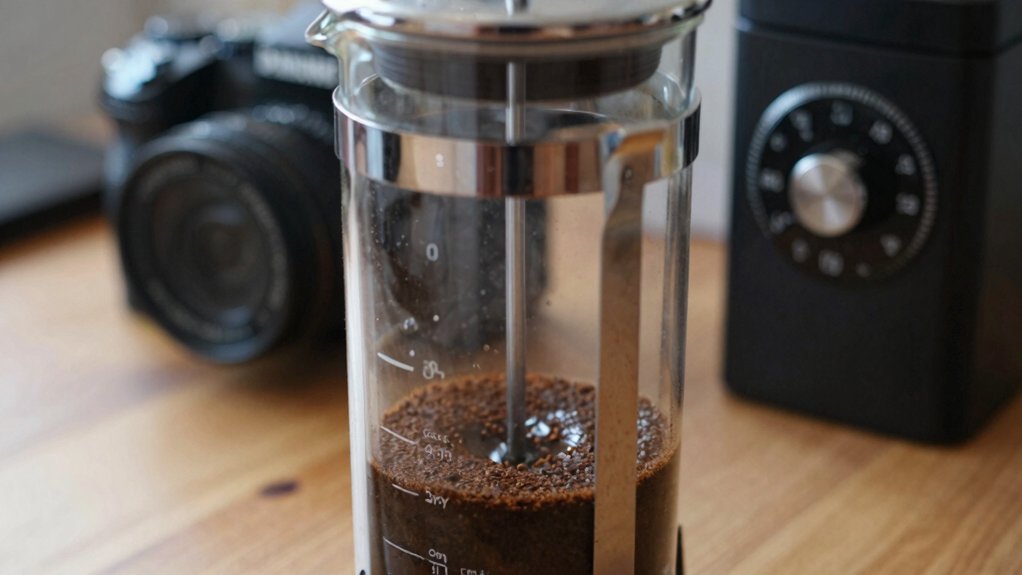
Start with a coarse, breadcrumb‑like grind and use a 1:20 coffee‑to‑water ratio, 4‑minute immersion, and water at 90–97 °C. Brew a small batch, then adjust the burr grinder one notch finer if the cup is weak or one notch coarser if you get too much sediment. Keep the dose consistent (e.g., 30 g coffee to 500 g water), log the grind setting, brew time, and taste notes, and tweak until the cup is clean, bright, and balanced. The next sections will walk you through detailed steps and logging tips.
Choose the Right French Press Grind Size
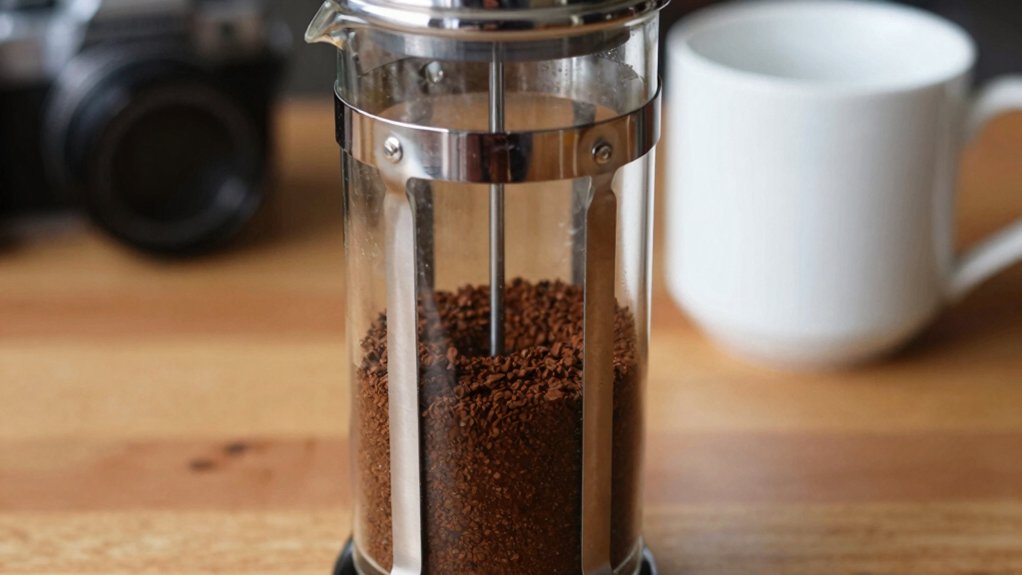
A coarse grind—think breadcrumbs or tiny oatmeal flakes—keeps the French press from clogging and limits sediment. You’ll want a grind size that feels uniform, because irregular particles cause uneven extraction and a muddy cup. Start by setting your grinder to the coarsest setting that still produces consistent particles, then adjust one notch finer or coarser until the plunger moves smoothly and the flavor hits your target. Remember to grind whole beans just before brewing for freshness, and aim for a 1:20 coffee-to-water ratio, such as 20 g coffee to 400 g water, to match the coarse grind and achieve a balanced, uniform extraction grind consistency.
Why Coarse French Press Grind Size Matters
Typically, a coarse French‑press grind keeps fine particles out of the metal filter, so you avoid sediment and a gritty mouthfeel. When you choose a coarser grind size, the water flows more freely around each particle, slowing extraction and preventing the bitter, heavy notes that finer grinds can produce. This slower extraction lets the coffee’s natural sweetness and bright acidity shine, while the larger crumbs stay suspended longer, reducing clogging and channeling. Using a burr grinder, aim for the coarsest setting that still wets the bed evenly—think breadcrumbs or small oatmeal flakes. Small adjustments guided by taste keep the brew balanced, delivering a clean body and clear flavor without unwanted sediment. Auto-off safety can help protect the kettle during longer brewing tasks while you dial in your grind.
How French Press Grind Size Uniformity Affects Extraction
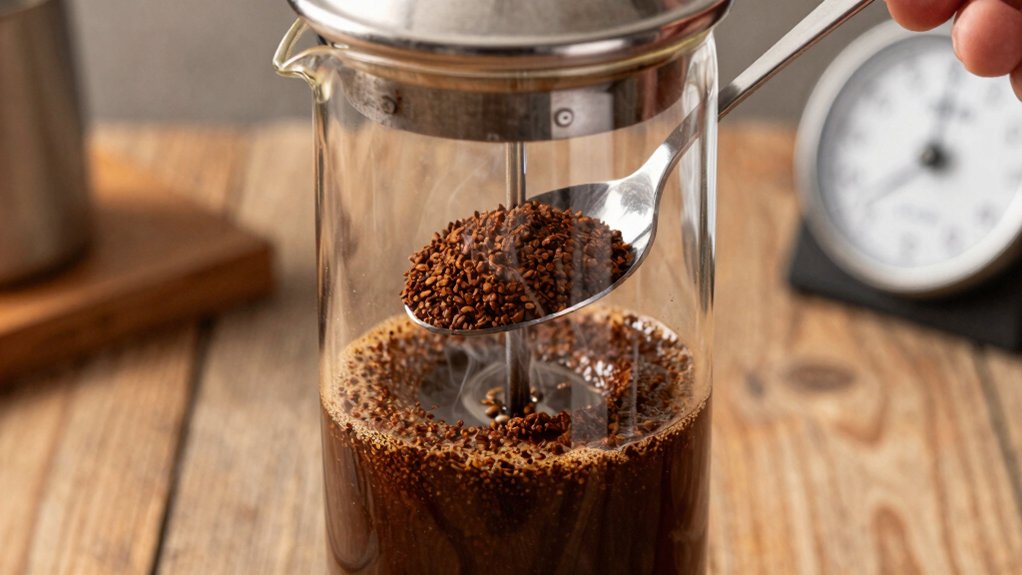
Ever wondered why some French‑press brews taste flat while others burst with balance? When your grind size uniformity is spot‑on, every particle extracts at the same rate, preventing the bitter bite of over‑extracted fines and the watery thinness of under‑extracted boulders. A consistent, coarse grind creates a smooth flow through the metal filter, so sediment stays out and flavor stays in. If particles vary, water channels through larger chunks first, leaving smaller ones under‑ Saturated and larger ones over‑saturated, which throws off aroma and body. Regularly check your burr grinder’s calibration and taste for shifts—tiny deviations can alter extraction dramatically. Subtopic 1: Veken Airtight Stainless Steel Coffee Storage Canister helps maintain freshness and aroma by limiting exposure to light and air, which supports more consistent flavor over time UV protection and can be a part of a routine that includes evaluating grind consistency for optimal extraction.
Set Burr Grinder for French Press Grind Size
Wondering how to dial in your burr grinder for a perfect French‑press? Start by selecting the coarse grind setting; it should look like breadcrumbs or tiny oatmeal flakes. Load fresh beans into the burr grinder and turn the dial a few clicks toward coarser. Grind a small batch, then brew using a 1:15–1:20 coffee‑to‑water ratio and a 4‑minute immersion. Taste the cup and glance at the bottom of the press—if you see too much sediment, turn the grinder one notch finer; if the brew is weak, go a notch coarser. Keep the particle size uniform to prevent fines slipping through the metal filter. Avoid pre‑ground coffee, as it’s usually too fine for a French press. Adjust until the French press grind size consistently yields a clean, balanced cup. Wide‑mouth ceramic canisters with airtight lids help keep your beans fresh between brews airtight seals, protecting aroma and flavor for repeated use.
Step‑by‑Step: Fine‑Tune French Press Grind Size
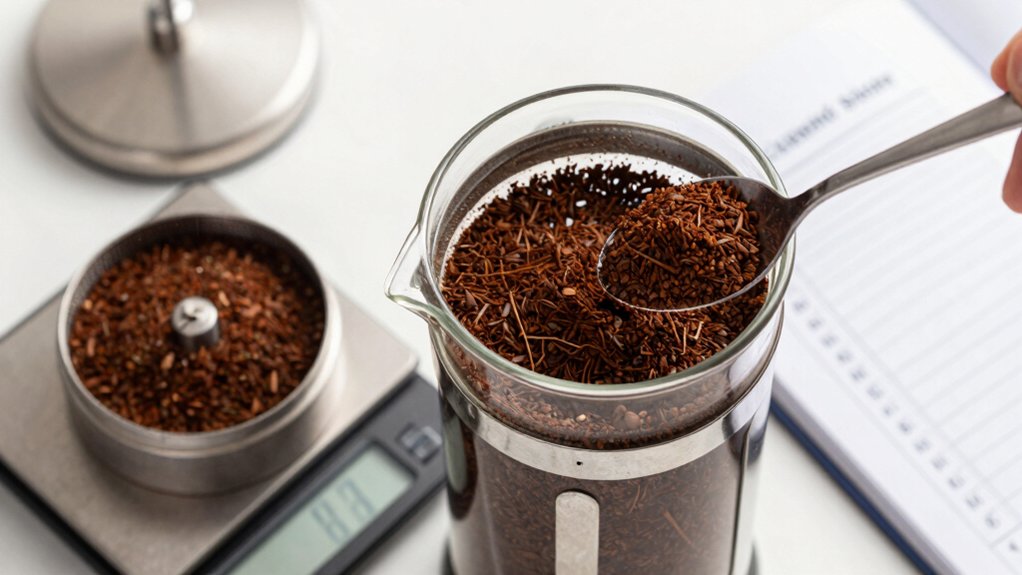
You’ll notice that consistent grinds give you a predictable extraction, so start with a uniform, breadcrumb‑like size. Aim for a particle range that lets the coffee steep for about four minutes; if it’s too fast, go a notch finer, and if it’s too slow, go coarser. Adjust in small increments and taste‑test each change to lock in the perfect balance. Add a note on choosing equipment and setup may involve considering power features and stability for your brewing area Power outlets and electrical features and ensuring your setup fits the space and workflow.
Grind Consistency Matters
Why does grind consistency matter for a French press? Because a uniform grind size ensures even extraction, preventing muddy or overly gritty cups. A burr grinder gives you the control you need; it produces particles that stay within the coarse‑to‑medium‑coarse range, so fines don’t settle as sediment. Grind just before brewing, keep the same coffee weight, and stick to a 1:15–1:20 brew ratio. If the brew tastes muddy, coarse it a touch; if it’s weak, move toward a slightly finer coarse grind. Test three settings—coarse, medium‑coarse, and a bit finer—to map flavor changes.
Coarse
Particle Size: Large crumbs
Expected Taste: Clean, light
Medium‑coarse
Particle Size: Breadcrumb‑like
Expected Taste: Balanced
Slightly finer
Particle Size: Small crumbs
Expected Taste: Fuller, richer
To extend your understanding of tool design and maintenance that helps you keep grind gear clean and effective, consider using purpose‑built espresso machine brushes for routine maintenance to protect your burrs and internal components maintenance tools.
Optimal Particle Size Range
A consistent grind is only half the battle; now you need to pinpoint the exact particle size that delivers a clean, balanced cup. For a French press, aim for a coarse‑to‑medium‑coarse grind that looks like breadcrumbs or tiny oatmeal flakes. Use a burr grinder set to the “French press” or a coarse setting so each particle is uniform. Target a particle size that slows extraction for a ~4‑minute brew while keeping fines out of the metal filter. If the cup feels murky, coarsen the grind a notch; if it’s sour or under‑extracted, tighten it slightly within the coarse range. Test by adjusting 0.1–0.2 mm between two brews, then settle on the grind size that balances body and clarity. Brewing consistency
Adjusting For Brew Time
Ever wondered how a few millimeters of grind can turn a dull French press into a balanced brew? Your brew time and grind size dance together to control extraction. Start with a coarse, breadcrumb‑like grind and a 4‑minute immersion. If the cup feels sour or thin, fine the grind a notch and watch the extraction deepen. If bitterness overwhelms, coarser the grind and shorten the brew time to keep contact in check. Keep particles uniform; uneven grounds create hot spots and extra sediment. Use a burr grinder for repeatable tweaks and taste a series of brews at 0.5–1.0 step changes to map flavor response. Aiming for consistency across multiple scales can help you dial in with precision (Precision 0.1 g) and ensure you’re measuring grind size and weight reliably as you experiment.
Identify the Perfect Grind by Tasting
Start with a coarse grind that looks like breadcrumbs or small oatmeal flakes, then taste the brew to gauge extraction. You’ll notice whether the cup feels heavy and bitter—signs of over‑extraction—or thin and sour, indicating under‑extraction. If sediment clogs the sip, coarsen the grind size a notch; if flavor is muted, move to a slightly finer coarse setting. Keep the grind size consistent across batches, jotting down flavor shifts so you can map adjustments to body and clarity. Test at least two settings, two steps apart, on the same beans. Compare the cups, and choose the one that delivers a clean, balanced taste with the right extraction. This systematic tasting will pinpoint your perfect French press grind.
Taste Signs of Under‑Extracted French Press Grind
You’ll notice a thin, watery body and a bright, sour edge that makes the coffee feel under‑cooked. The aroma will be weak and muted, lacking the rich, inviting scent of a proper brew. Sweetness is almost absent, leaving a flat, metallic tang that signals under‑extraction.
Thin Body, Weak Aroma
What’s happening when your French press cup feels watery and smells faint? You’re likely battling a thin body and weak aroma caused by under‑extraction. A grind size that’s too coarse leaves too little surface area for the water to pull out soluble compounds, so the brew ends up pale and watery. The aroma stays muted because fewer fragrant oils escape. To fix it, adjust your grind and brew parameters.
- Coarse particles floating on the surface, barely touching water
- Pale liquid that slides off the tongue without weight
- Faint scent that barely registers before you sip
- Mouthfeel that feels like thin broth rather than rich coffee
Switch to a slightly finer, consistent medium‑coarse grind, raise water temperature a few degrees, and extend brew time just enough to boost extraction and restore a full, aromatic cup.
Bright, Sour Notes
Ever notice a sharp, citrusy bite that makes your French press taste more like a lemon‑squeezed water than coffee? That bright, sourness usually means your grind size is too coarse, letting water rush through and limiting extraction. The result is a thin, acidic cup where fruit‑like notes dominate and body feels almost watery. If you shorten brew time or skip proper agitation, the coarse particles stay under‑saturated, keeping the sourness high.
To tame that, dial the grind a bit finer—just enough to slow the flow and improve extraction without slipping into bitterness. A finer setting lets more soluble compounds dissolve, softening the acidity, adding depth, and giving you a richer, more balanced brew.
Lack of Sweetness
If the grind’s too coarse, the coffee will taste thin and flat, missing the natural sweetness that should linger after each sip. You’ll notice a sharp tang, a hollow finish, and a body that feels almost watery. The large particles limit extraction, so soluble sugars stay locked in the grounds, leaving a dry, astringent aftertaste instead of caramel or chocolate notes. To bring back that lingering sweetness, you need to adjust the grind size finer, extending contact time and improving extraction.
- A bright, grassy acidity that feels like a lemon zest bite
- A mouthfeel that’s thin, like diluted broth
- An aftertaste that’s dry and astringent, lacking lingering caramel
- A muted aroma that fails to evoke roasted depth
Fine‑tuning the grind size boosts extraction, unlocking the coffee’s natural sweetness.
Taste Signs of Over‑Extracted French Press Grind
Curious why your French press leaves a bitter, astringent aftertaste? When your brew is over‑extracted, you’ll notice a heavy, drying sensation on the palate and a thick, syrupy body that clings too long. The finish lingers like chalk, resin, or even burnt‑metal, masking the coffee’s nuanced aromas. You may catch burnt or charcoal notes that eclipse the original flavor profile, leaving the cup feeling flat and dull despite its strength. A metallic aftertaste often signals that the grind size is too fine, pulling excess soluble compounds. These signs—bitter astringency, syrupy heaviness, lingering chalky finish, and burnt‑metal notes—tell you the grind is over‑extracted and needs coarser adjustment.
Scale‑Based Dose‑to‑Water Ratio for French Press Grind
Bitter, astringent notes tell you the grind is too fine, so the next step is to measure coffee and water precisely. Grab a scale, set a 500 g water target, then calculate a dose between 25 g and 33 g (1:15–1:20). Place the coffee on the scale, note the exact weight, and adjust the grind size until the brew feels balanced—coarse enough to avoid sediment, fine enough for body. Record each trial’s dose, water mass, and taste notes; this data lets you fine‑tune the grinder for repeatable results.
- 500 g water, 30 g coffee (1:16.7)
- Coarse‑to‑medium‑coarse grind setting
- Scale‑verified dose for consistency
- Taste notes tied to each grind size adjustment
Pre‑Heat Vessel for Consistent French Press Extraction
You’ll notice that pre‑heating the beaker or carafe keeps the brew temperature steady, so the extraction stays uniform.
Warm the mug (and milk, if you use it) before pouring to cut down heat loss after the press.
Using hot, not boiling, water for the pre‑heat protects the grounds and maintains the target 90–97 °C throughout the brew.
Pre‑Heat Vessel Benefits
Pre‑heating the French‑press beaker, plunger, and even the mug keeps the brew at the target 90–97 °C (195–205 °F) longer, so the grounds stay immersed in a stable temperature and extract uniformly. When you pre‑heat, you stop the sudden temperature plunge that occurs as hot water meets a cold vessel. This temperature stability protects the delicate balance of immersion brewing, letting each particle soak evenly for the full 4‑5 minute steep. The result is a smoother, richer cup without the bitter or sour notes that arise from under‑extraction.
- Warm the beaker in hot water for 30 seconds.
- Heat the plunger by rinsing it with boiling water.
- Swirl the mug in the kettle to bring it near brewing temperature.
- Dry each piece quickly before assembling to avoid excess steam.
Consistent Temperature Maintenance
Ever wonder why your French‑press sometimes tastes thin or overly bitter? You can fix that by mastering temperature control through pre‑heating. Warm the beaker, mug, and even the milk before you add coffee and water. A hot vessel slows heat loss, keeping the brew in the sweet spot of 90–97 °C for the full 4‑plus minutes.
This stable thermal environment lets the grind size work as intended, extracting balanced flavors without the bitterness that comes from a rapid temperature drop. Use a timer to start each batch at the same temperature, and you’ll see reproducible results. Consistently pre‑heated components mean every cup hits the same flavor profile, batch after batch.
Agitation & Bloom for French Press Grind Extraction
Why does agitation matter during the bloom? It spreads water evenly across the grind size, breaking the crust that forms when grounds first meet hot liquid. A gentle stir for 15–30 seconds lets every particle soak, preventing pockets of under‑extracted bitterness and over‑extracted heaviness.
- You pour water at 90–97 °C, watch the surface ripple, then stir lightly with a spoon.
- The motion lifts the crust, letting steam escape and coffee bloom like a flower.
- You feel the slurry thicken uniformly, a sign the grind size is consistent.
- After the stir, you let the mixture settle, confident the bloom has set the stage for a balanced press.
Adjust French Press Grind Size for Roast Levels
After the bloom settles, you’ll notice that the grind’s co still dictates how each roast extracts. For darker roast levels, keep the French press grind coarse but nudge it 0.5–1 notch finer to restore muted acidity and boost body, then watch extraction. If the cup feels weak, tighten another notch.
Lighter roast levels demand a coarser grind—start 1–2 steps coarser than the standard coarse—to preserve floral notes and avoid over‑extraction. Aim for breadcrumb‑like particles, minimizing fines, but a touch more uniformity can help a light roast stay balanced. When a light brew tastes under‑extracted, go one step finer or add 30–60 seconds brew time. If a dark brew is bitter, go one step coarser or trim 15–30 seconds.
Log Data to Lock In Ideal French Press Grind Size
Curious how a simple spreadsheet can turn guesswork into consistency? You’ll start by logging data for each brew: note the grind size setting, dose, water weight, and brew time. Then add extraction notes—sediment level, body, sweetness, and foam plume. Over time patterns emerge, revealing which setting yields the cleanest cup.
- Coarse‑medium grind gives a thin body, low sediment, and a bright finish.
- Medium‑coarse grind produces a balanced mouthfeel, moderate foam, and subtle sweetness.
- Fine grind shows heavy sediment, bitterness, and a dense crema.
- Adjust in 1‑2 step increments while keeping the 30 g/500 g baseline to isolate each effect.
Use this log template to lock in your ideal French Press grind size, turning intuition into repeatable excellence.
Frequently Asked Questions
How to Dial in Grind Size for French Press?
You start with a coarse, breadcrumb‑like grind, brew a cup, taste, then adjust one notch finer or coarser until the body and clarity feel right, keeping dose and time constant.
Which Coffee Roast Is Best for GERD?
You’ll find darker roasts gentler on GERD because they’re lower in acid, so choose a medium‑dark or dark bean, preferably freshly ground, and avoid pre‑ground, highly acidic light roasts.
What Is the 15-15-15 Rule for Coffee?
You follow the 15‑15‑15 rule by using one gram of coffee for every fifteen grams of water, measuring both by weight, which yields a balanced extraction and predictable brew strength.
Does French Press Raise Cholesterol?
Yes, it can raise your cholesterol because the French press doesn’t filter out cafestol and kahweol, which may increase LDL levels—especially if you drink several cups daily or are genetically sensitive.
In Summary
Now you’ve nailed the perfect French‑press grind, you’ll consistently pull a balanced, full‑bodied cup. Keep the grind coarse yet uniform, adjust for roast level, and log your settings. A pre‑heated vessel, proper bloom, and gentle agitation lock in flavor. Stick to these steps, and every brew will hit the sweet spot—no guesswork, just great coffee.


