
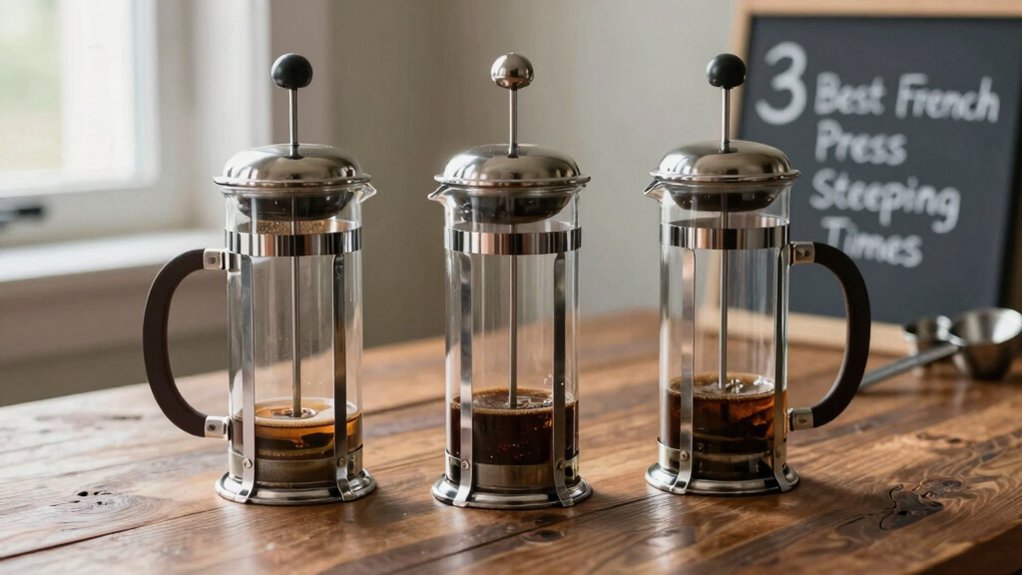
You’ll get the richest cup by using three proven steeping times—3‑4 minutes for dark roasts, 4‑5 minutes for medium roasts, and 6‑7 minutes for light roasts—each paired with the right grind size and a 1:15 coffee‑to‑water ratio. Start with a quick bloom, keep the water temperature steady, and adjust grind coarseness if you notice bitterness or weakness. These guidelines let you dial in flavor, and the next section shows how to fine‑tune the brew for any bean.
Which Steeping Time Gives Me the Flavor I Want? – Quick Answer
Want a coffee that hits just right? In a French press, your steeping time decides whether you get a bold flavor or a smooth brew.
In a French press, steeping time determines whether your brew is bold or smooth.
Aim for 4 minutes as a baseline; it balances extraction without bitterness.
If you crave intensity, stretch the steeping time to 6‑7 minutes, especially with a higher coffee‑to‑water ratio or a coarse grind.
For a milder cup, pull back to 3‑4 minutes, which works well with lighter roasts and a finer grind size.
Roast level also matters: darker beans often need shorter steeping, while lighter beans benefit from the extra time to unlock nuance.
Adjust the grind size and coffee‑to‑water ratio together, and you’ll land on the perfect flavor profile every brew. Coffee grounds quality
How to Adjust French Press Steeping Time for Roast Level and Grind Size
In a French press, the steeping time you choose should match both the roast level and the grind size to keep extraction balanced. Dark roasts need a shorter steep time to avoid bitterness, while light roasts benefit from a longer brew time to unlock sweetness. Adjusting grind size also shifts the optimal time: a coarse grind works well at 4‑5 minutes, but a medium‑coarse grind can handle a few extra seconds without over‑extracting. Keep water temperature steady and give the coffee a quick bloom before you start the timer. A dedicated coffee accessory like a compact K-Cup storage drawer or a wall‑mounted mug organizer can help keep your brewing station organized as you experiment with time and grind adjustments.
French Press Steeping Time Troubleshooting: Fix Bitter or Weak Brew
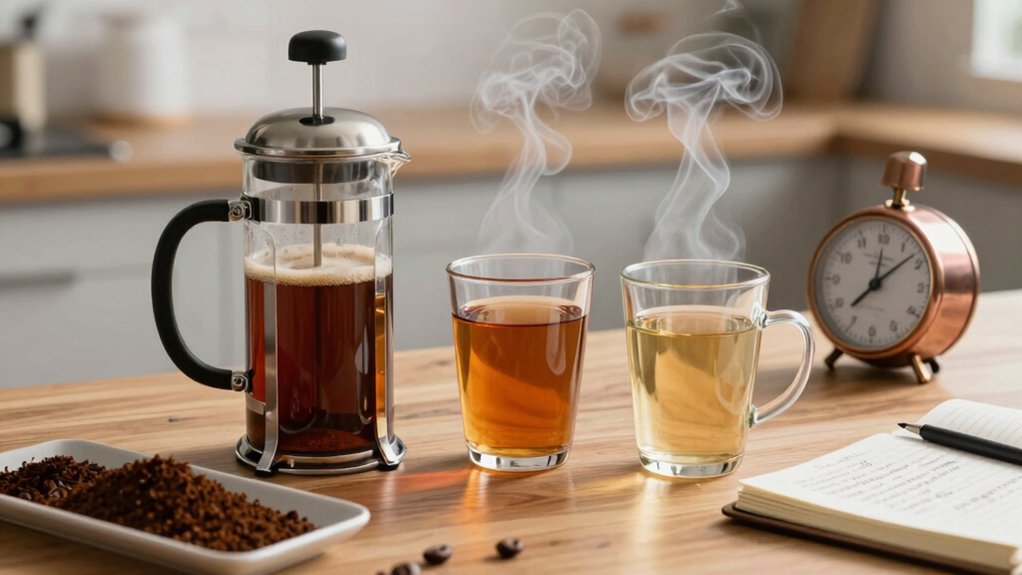
Why does your French press sometimes turn out bitter or weak? You’re likely mis‑managing extraction. If the brew tastes bitter, you’ve over‑extracted: shorten steeping time, use a coarser grind, or lower temperature.
Mis‑manage extraction: over‑extract bitter, under‑extract weak—adjust time, grind, temperature.
For a weak brew, under‑extraction is the culprit: grind finer, extend brew time, or raise temperature a few degrees.
Start with a 1‑minute bloom to release gases, then add water and steep 4–5 minutes for most beans.
Dark roasts need 3–4 minutes; light roasts can handle 6–7 minutes.
Keep the coffee‑to‑water ratio around 1:15, press slowly and evenly, and serve immediately to avoid sediment.
Adjust these variables in your coffeemaking routine, and you’ll eliminate both bitter and weak brews. Extraction control helps you tune grind, temperature, and brew time to hit your target profile.
Frequently Asked Questions
What Is the Ideal Steep Time for French Press?
You’ll hit the sweet spot at four to five minutes; start there, then tweak in thirty‑second to one‑minute steps until the brew matches your taste, roast, and strength preferences.
What Is the 15-15-15 Rule for Coffee?
You follow the 15‑15‑15 rule by using a 1:15 coffee‑to‑water weight ratio, steeping for about 15 minutes, then rinsing or pre‑wetting the filter for 15 seconds before pouring.
What Is the 80 20 Rule for Coffee?
You apply the 80/20 rule by recognizing that roughly 80 % of flavor comes from the first 20 % of extraction—so you steep a French press for about one to four minutes, then stop to avoid bitterness.
What Are Common French Press Mistakes to Avoid?
You should avoid over‑steeping, using boiling water, grinding too fine, skipping the bloom, and pouring without stirring. These errors cause bitterness, sediment, weak flavor, and uneven extraction.
In Summary
Pick the steeping time that matches your roast, grind, and taste—whether you crave a bright, light brew or a deep, robust cup. Adjust in small increments, taste, and fine‑tune until you hit the perfect balance. If it turns out bitter or weak, tweak the time, grind size, or water temperature. With a bit of experimentation, you’ll consistently pull the flavor you want from your French press.


