

You’ll get tighter grind‑size control and a more uniform particle distribution with flat burrs, which cuts channeling and yields brighter, cleaner espresso and precise pour‑overs. Their parallel‑ring design keeps the gap steady, so you avoid fines and boulders, and the larger contact area reduces heat‑induced drift. Though they need a bigger motor and better ventilation, the consistency they deliver outweighs the extra cost for specialty brewing. Keep reading to see how design, maintenance, and brew methods play into the decision.
Why Choose Flat Burrs Over Conical Burrs?
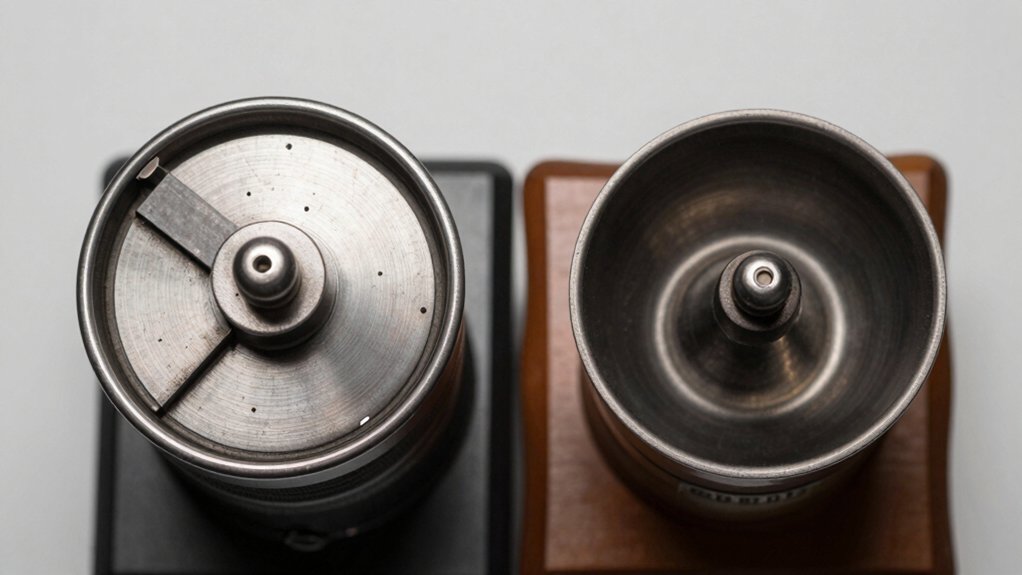
Why opt for flat burrs? You’ll notice their grind‑size precision right away; the parallel plates keep each particle consistent, giving you a cleaner, brighter cup—especially in espresso. Flat burrs also deliver more uniform extraction because the simple alignment reduces variability across the grind bed. You might pay extra for the larger, heavier build and the stronger motor they demand, but the payoff is a steadier flow and less flavor loss. Keep an eye on heat buildup; good ventilation helps maintain that precision during long sessions. Some designs trap more grounds, but modern chambers and outlets mitigate retention. In short, flat burrs give you the control and clarity you crave, even if they cost a bit more. Precision control can further enhance how evenly the grind bed delivers extraction across different brew methods.
What Makes Flat Burrs Deliver More Uniform Particle Size?
You’ll notice that precise burr alignment keeps the gap between the rings perfectly consistent, so each particle gets the same shearing force. That steady gap control translates into a uniform particle distribution across the entire grind. In conical grinders, slower grinding and gear reduction help minimize heat buildup, preserving aroma and flavor across all grind settings thermal management.
Precise Burr Alignment
Ever wondered how flat burrs keep your coffee’s particle size so consistent? You’ll notice flat burrs rely on precise alignment of the two parallel rings. When the rings stay truly parallel, the gap between them stays uniform across the entire grinding surface, so each bean slice experiences the same crush force. This alignment eliminates the wobble that concentric burrs can introduce, cutting down on outliers like fines or boulders. The chassis holds the burrs steady, and the motor’s power maintains that steady gap even under heavy load. As a result, the particle distribution tightens, delivering a smoother extraction. You benefit from a more predictable brew without having to fine‑tune the grinder constantly. Precision alignment ensures consistent results across batches and helps maintain optimal extraction profiles over time.
Consistent Gap Control
How does the flat burr’s fixed‑gap design keep every bean slice crushed the same way? You’ll notice that the two flat burr rings stay stationary while one rotates, so the gap never wavers. This parallelism forces each particle through the same shearing space, delivering grind-size homogeneity that conical burrs can’t match. The robust motor holds the gap even at high RPMs, and proper ventilation prevents thermal drift that would otherwise widen the distribution. This design also minimizes inconsistent contact time between particles, contributing to a more uniform grind across the shot. Fixed-gap flat burrs offer predictable performance under a wide range of grinding conditions, making them a reliable choice for consistency and quality.
Uniform Particle Distribution
The flat burr design also minimizes channeling, which helps maintain consistent grind particle distribution across the entire batch centered contact.
How Do Flat Burrs Reduce Grind Retention, Static Build‑up, and What Can You Do About It?
You’ll notice that flat burrs can cut retention by shaping the chamber and outlet to guide grounds out smoothly. In addition, several models in the listed lines emphasize anti-scorching technology and temperature control to preserve foam quality during grinding and extraction Strix temperature control.
Burr Design Reduces Retention
Why does a flat burr grinder keep your coffee grounds moving smoothly? Because flat burrs create a linear flow that pushes grounds straight out, cutting sideways cling that fuels retention. The parallel rings and a well‑designed outlet mouth keep particles from sticking, so static buildup stays low. Chamber geometry and ventilation also matter—proper housing, moderate motor speed, and a narrow chute all trim leftover grounds.
- Align burr rings with a straight outlet to guide particles directly.
- Use a housing that promotes airflow, preventing heat‑induced clumping.
- Add anti‑static coatings or integrated grind paths that complement flat burr architecture.
These design choices let you enjoy consistent dosing with minimal grind retention. flat burr benefits
Static‑Mitigation Techniques Explained
Flat burrs keep grounds moving in a straight line, but that same linear path can generate static charge and trap fine particles in the chamber. To combat this, you need static reduction strategies that target both the burr surface and the exit path. Choose a grinder with a plastic or whip‑out blast outlet, because non‑metallic surfaces shed charge faster than steel. Keep the chamber spotless; residual coffee dust amplifies cling. Look for models that integrate a Plasma Generator – it emits ionized particles that neutralize static as you grind, cutting retention dramatically. Low‑friction coatings or SSP‑coated burrs also lessen adhesion. Finally, ensure proper ventilation and moderate motor speed to keep heat low, which further reduces static buildup.
Why Do Flat Burrs Produce Cleaner, More Consistent Espresso Shots?
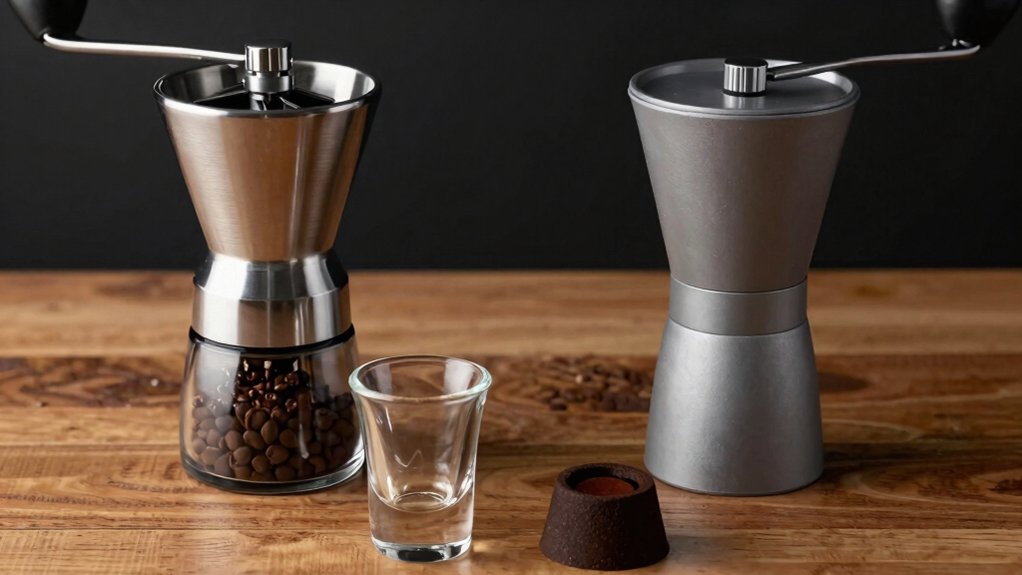
Ever wondered how a grinder can deliver espresso that tastes the same shot after shot? Flat burrs give you grind‑size homogeneity, so each particle falls within a tight range. That uniformity drives extraction consistency, eliminating the fines that over‑extract and the boulders that under‑extract. When the rings stay parallel, the contact area stays large and the spacing stays fixed, so you get repeatable doses and stable temperature throughout the grind.
- Parallel rings keep particle size variation low.
- Fixed spacing locks in the exact grind you set.
- Large contact area reduces boulders and fines, smoothing extraction.
These factors combine to give you cleaner, more consistent espresso shots every time.
How Motor Power & RPM Influence Flat Burr Consistency & Noise?
The consistency you just saw from flat burrs hinges on the motor that spins them, and the speed at which it does so. You need a robust motor that can sustain higher RPM without stalling; that power pushes the parallel burr surfaces through the beans quickly, delivering uniform particle size.
However, those same RPM levels generate static cling, causing grounds to linger on the burrs and in the chamber, which can affect consistency if the grinder overheats. Good ventilation and a moderate RPM setting keep temperature in check, preserving grind stability over long sessions.
Stronger motors let you fine‑tune RPM for tighter tolerances, but expect louder operation as a trade‑off. Balancing power, RPM, and airflow gives you the most reliable flat burr performance.
Flat Burr Noise vs. Conical Noise: What to Expect in a Home Espresso Setup?
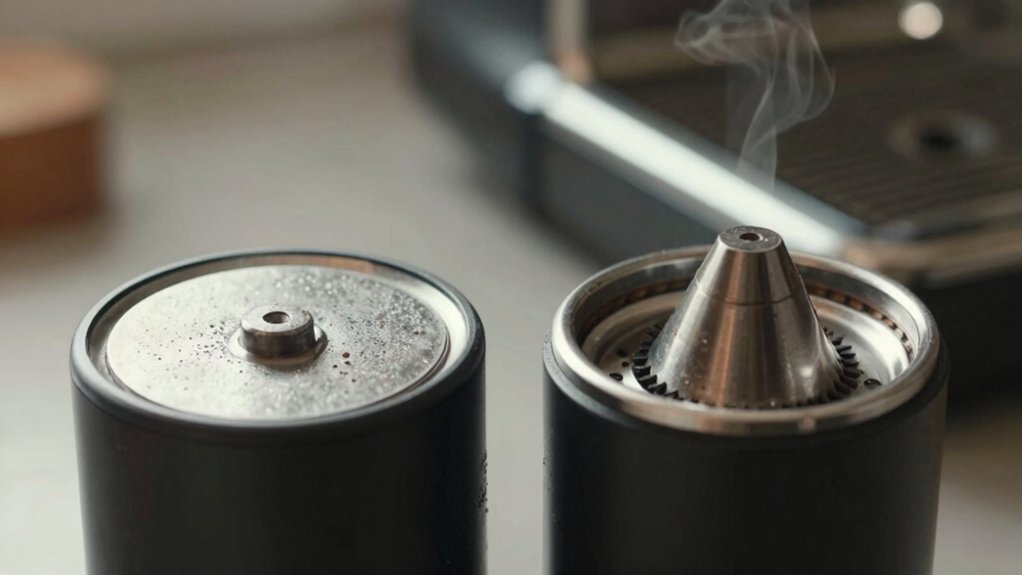
Curious how loud your espresso ritual will be? Flat burrs usually need bigger, faster motors, so you’ll hear a higher‑pitched, louder hum than with conical burrs, which spin slower and let gravity feed beans quietly. The noise isn’t just about burr shape; motor design, chamber ventilation, and outlet geometry play big roles. Some modern flat‑burr models add static‑reduction tech, like plasma generators, to curb grind retention and tame the roar. Still, expect a noticeable difference in a home kitchen, especially if you’re sensitive to background sounds.
Flat burrs demand larger, faster motors, producing a higher‑pitched, louder hum than quieter, slower‑spinning conical burrs.
- Motor size and RPM drive the primary noise gap.
- Chamber airflow and venting can amplify or dampen sound.
- Advanced static‑reduction features help flat burrs stay quieter.
Which Brew Methods Benefit Most From Flat Burr Consistency?
Flat burrs’ tight grind‑size tolerance shines brightest in methods that demand precise extraction control, especially espresso and pour‑over. You’ll notice that the grind‑size consistency they deliver eliminates channeling, giving espresso a cleaner, brighter cup and a repeatable shot profile. For pour‑over, the uniform particles promote even water flow, so you extract the full spectrum of flavors without bitter or sour patches. Single‑dose setups also benefit; the defined grind lets you dial in dose and timing with confidence. If you brew French press or cold‑,, the impact is less pronounced because those methods tolerate broader particle ranges. Focus on espresso and pour‑over, and the flat burr’s stability will keep your brew predictable and delicious.
Material Choices for Flat Burrs: Steel, Ceramic, and Coatings Explained
Ever wonder why some grinders feel smoother and last longer? You’re probably looking at the material of the flat burrs. Steel offers reliable durability, especially when it’s SSP‑coated; the coating hardens the surface, cuts wear, and preserves flavor clarity. Ceramic burrs stay cool, reducing heat transfer that can skew extraction, but they’re brittle and pricier. Coatings like SSP or ceramic layers boost hardness and longevity, letting you grind consistently without frequent replacements.
- Steel – sturdy, affordable, works well with SSP coatings.
- Ceramic – heat‑resistant, precise, but fragile and costly.
- Coatings – add hardness, lower wear, and improve grind uniformity.
Choosing the right combo lets you balance durability, heat management, and flavor fidelity.
Maintenance Tips to Keep Flat Burrs Performing at Their Best
You should start a daily burr cleaning routine to prevent grind buildup and static clumping. Then, check the burr alignment regularly, making sure the rings stay perfectly parallel. These simple habits keep your flat burrs delivering consistent grind size and peak performance.
Burr Cleaning Routine
Keeping your grinder spotless is essential for flat burrs to stay consistent and efficient. A solid cleaning routine prevents grounds from clogging the chamber and preserves grind uniformity. After each brew, brush the burrs and grinding chamber to sweep away loose particles. Every 1–3 months, disassemble the unit, give the flat burrs a thorough brush‑out, then run a cleaning pellet or a handful of dry beans to flush residual oils. Finally, wipe the outfeed chute and retention path to curb grind buildup, which flat burr designs especially attract.
- Brush after every use – removes loose grounds instantly.
- Deep clean quarterly – disassemble, brush, run cleaning beans.
- Clear chute and path – prevents retention and maintains flow.
Burr Alignment Checks
Why bother with alignment checks? You keep flat burrs delivering consistent grind size and extraction.
First, verify that the two burr rings sit perfectly parallel; any tilt spikes variability. Look at the grinding‑chamber outlet and feed path for buildup or misfeed, which signals clearance issues. After every few hundred kilos ground, measure wear to ensure teeth stay sharp and parallelism hasn’t drifted. Spin the burrs by hand—smooth rotation means bearings and mounts are solid, while wobble or resistance points to mounting problems. Perform these alignment checks regularly, and you’ll maintain the homogeneity that flat burrs are known for, preventing grind‑size drift and ensuring reliable dosing.
When Do Flat Burrs Give Better Value Than Conicals?
When does a flat‑burr grinder actually outshine a conical one? You’ll see its edge when you demand grind‑size homogeneity and grind consistency for espresso or precise pour‑overs. The larger, more powerful flat burrs keep particle size tight, delivering a brighter cup and stable extraction. Though they cost more and can heat up, their precision pays off in high‑volume or specialty brewing where every nuance matters.
- Espresso focus – Flat burrs maintain uniform particle distribution, boosting espresso clarity and acidity.
- High‑volume brewing – Their robust motors handle long sessions without sacrificing grind consistency.
- Cost‑justified precision – When you value superior grind‑size stability over price, the flat burr’s performance outweighs its larger footprint.
Frequently Asked Questions
Are Flat Burrs or Conical Burrs Better?
You’ll find flat burrs better for consistent grind size and uniform extraction, while conical burrs excel in quieter, cooler operation and lower cost—choose based on your priority between precision and affordability.
Why Is Costco Getting Rid of Its Coffee Grinders?
You’re hearing Costco’s grinder pull‑out because sales lag, supplier contracts expire, and the retailer wants to cut inventory costs, replace underperforming models, and focus on higher‑margin kitchen appliances.
Why Are Flat Burrs More Expensive?
You pay more because flat burrs need larger, high‑precision motors and tighter tolerances, which demand complex engineering, premium materials, and meticulous assembly to keep the burrs perfectly parallel and guarantee consistent grind uniformity.
Do Conical Grinders Make Thicker Rdpresso?
No, conical grinders don’t inherently produce thicker espresso. They can affect grind uniformity and retention, but brew strength depends on dosage, pressure, and extraction time, not solely on burr shape.
In Summary
In the end, flat burrs give you tighter particle control, less retention, and a cleaner espresso shot—especially when you pair them with a powerful, low‑noise motor. They shine in high‑precision brewing methods, and their steel or ceramic builds stay consistent longer with proper care. If you value uniformity, reduced static, and a smoother grind experience, flat burrs often outshine conicals, delivering better value for serious coffee enthusiasts.


