
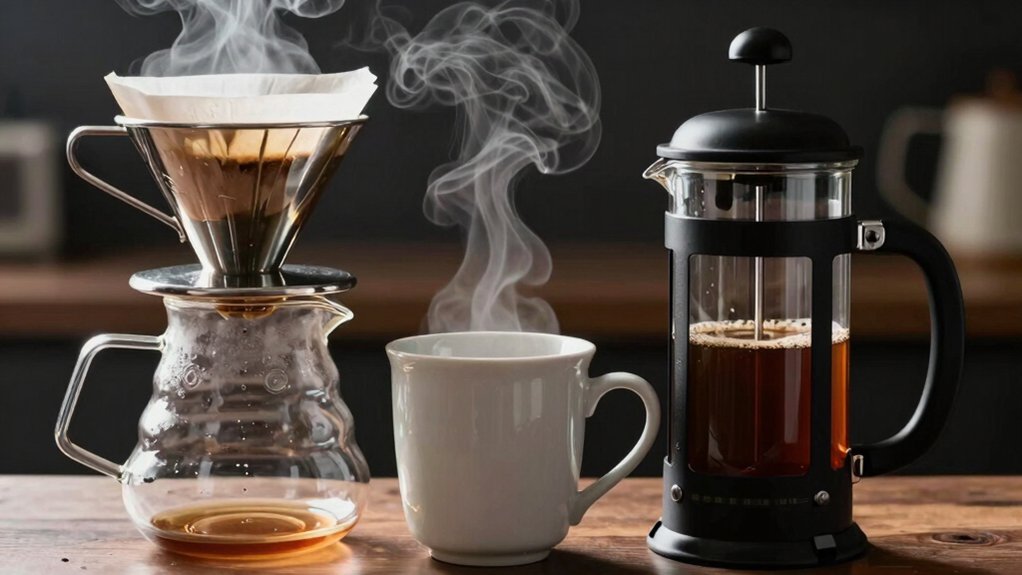
You’ll notice pour‑over uses a medium grind, a paper filter and a 1:16 coffee‑to‑water ratio, giving a bright, clean cup with light acidity and a short 2‑4‑minute brew. French press works with a coarse grind, a metal mesh, a 1:12 ratio and a 4‑5‑minute immersion, producing a fuller, oil‑rich body and velvety mouthfeel. The filter type controls sediment and oil transfer, so your flavor and cleanup differ. Keep going to discover which method fits your taste and routine best.
Pour‑Over vs French Press: How Brewing Mechanics Affect Flavor and Body
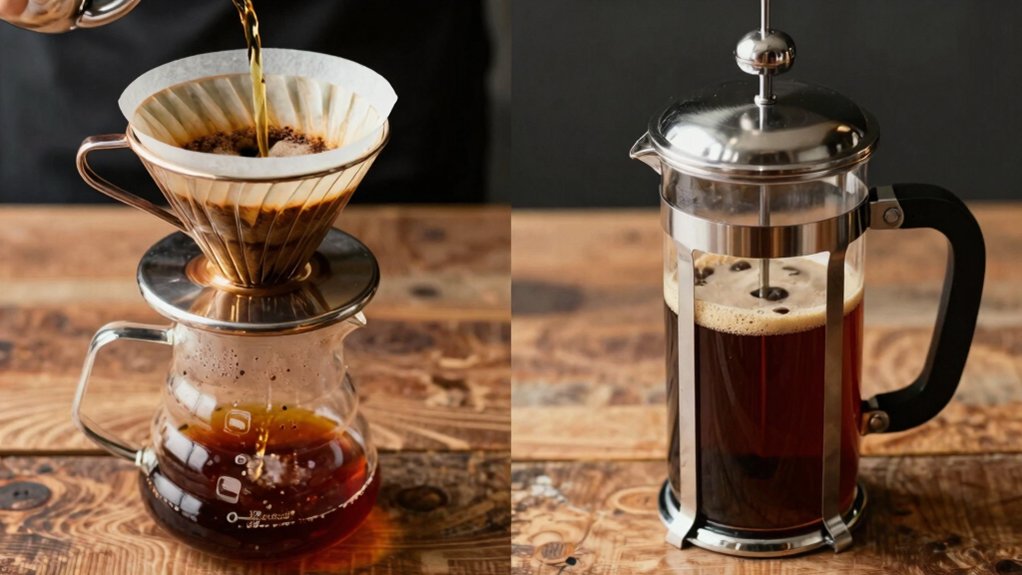
Pour‑over and French press each shape coffee’s flavor and body through distinct brewing mechanics. With pour‑over you control water flow using a gooseneck kettle, letting water seep through a paper filter that traps sediment and oils. That filter type yields a cleaner cup, bright acidity, and a light mouthfeel. The process also benefits from precise grind size and temperature control to optimize extraction temperature range and usage. French press relies on immersion and a plunging metal filter, which retains oil and allows fine particles to stay in the brew. The coarse grind size prevents excessive sediment, yet the metal filter’s oil retention creates a richer, fuller body and a velvety mouthfeel. By adjusting grind size and filter type, you directly influence flavor clarity, body depth, and the overall sensory experience.
Pour‑Over vs French Press: Ideal Grind, Ratio & Timing for Each Method
A solid grind, proper coffee‑to‑water ratio, and timing are the three pillars that separate pour‑over from French press.
- Grind size – Use a medium grind for pour‑over and a coarse grind for French press; the former works with a paper filter type, the latter with a metal mesh.
- Ratio – Aim for 1:16 (16 g / 240 ml) in pour‑over and 1:12 (30 g / 360 ml) in French press to balance extraction and body.
- Timing – Bloom for 30 s, then pour steadily from a gooseneck kettle for 2–4 min in pour‑over; let French press steep 4–5 min in full immersion before plunging.
Adjusting grind size, ratio, and timing lets you control extraction, brightness, and oil‑richness for each method. Pour-Over Technique
Pour‑Over Vs French Press: How to Eliminate Grit From Your Cup
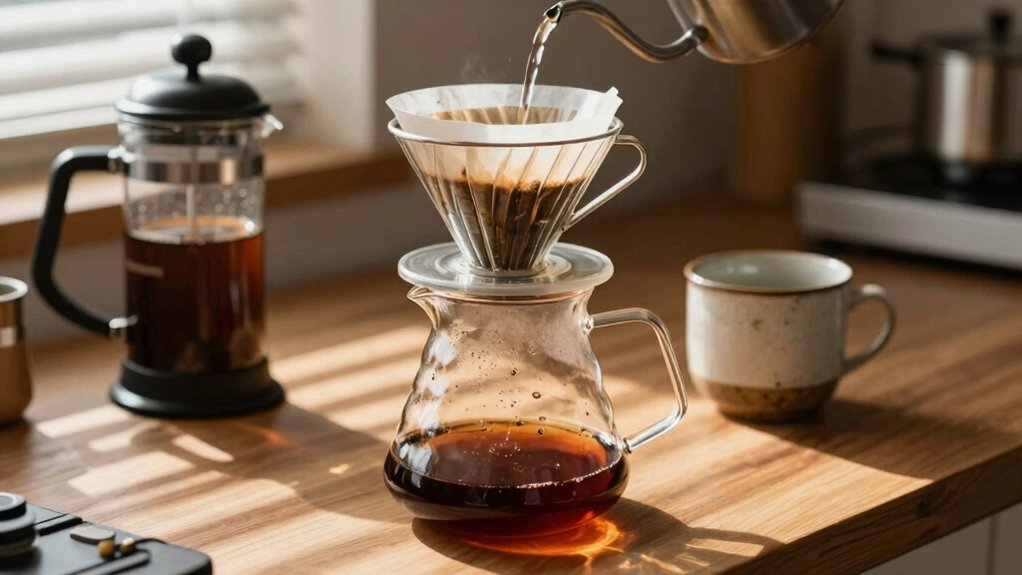
Ever wonder why your French press sometimes ends up with gritty sips while a pour‑over stays silky smooth? You can banish grit by mastering grind size, settling, and double filtration. Use coarse ground size for the French press and medium‑coarse for pour‑over; the metal mesh lets fewer fines slip through, while the paper filter catches sediment outright. After plunging, let the coffee settle, then pour slowly to avoid the last ounces that still hold grounds. For extra clarity, add a second metal strainer on the mug. Quick cleanup matters—rinse the French press carafe right after pouring, and simply discard the paper filter for pour‑over.
| Method | Filtration Technique | |
|---|---|---|
| French press | Coarse grind → metal mesh → optional second strainer | |
| Pour‑over | Medium‑coarse grind → paper filter (single step) | |
| Cleanup | Rinse carafe promptly (French press) | Discard filter, rinse carafe (pour‑over) |
| Sediment control | Settling + careful pour (French press) | Paper barrier (pour‑over) + extraction/DS Focus |
Pour‑Over vs French Press: Choosing the Right Tool for Your Flavor Preference and Lifestyle
Which method matches your taste and routine? You’ll choose based on flavor preference, lifestyle, and how much effort you want to spend. Pour‑over delivers a clean, lighter cup that highlights subtle notes in a light roast, while French press gives a full‑bodied, oil‑rich brew that suits bold, dark roasts. Consider grind size, brew time, and cleanup when deciding.
- Flavor focus – Pour‑over with a medium grind and paper filter for bright, nuanced flavors; French press with a coarse grind for robust, gritty‑free richness.
- Control vs. convenience – Use a gooseneck kettle and precise pour rate for pour‑over; rely on immersion brewing and a set brew time for French press.
- Lifestyle fit – Pour‑over offers quick cleanup and minimal sediment; French press scales easily for multiple cups and tolerates a more relaxed routine.
Frequently Asked Questions
Which Method Uses Less Electricity per Brew?
You’ll use less electricity with a French press because it needs only hot water, while a pour‑over often requires a heated kettle or electric dripper, consuming extra power per brew.
Can I Use a Reusable Metal Filter for Pour‑Over?
Yes, you can use a reusable metal filter for pour‑over. It lets you brew without paper, saves waste, and still produces a clean cup—just ensure the filter fits your dripper and rinse it after each use.
How Does Water Hardness Affect Each Brewing Style?
You’ll notice that hard water can over‑extract the pour‑over, making it bitter, while in a French press it may leave mineral deposits that dull flavor and cause a heavier, muddier body.
Is One Method Better for Cold Brew Preparation?
You’ll find the French press works better for cold brew because its steeping allows full extraction, while a pour‑over’s quick flow won’t develop the smooth, low‑acid profile you want.
What Impact Does Altitude Have on Extraction Time?
At higher altitude, boiling point drops, so water’s temperature is lower; you’ll need longer extraction times to achieve the same flavor intensity, especially with methods like pour‑over or French press.
In Summary
You’ve seen how pour‑over’s clean, bright extraction contrasts with the French press’s rich, full‑bodied brew. If you crave clarity and control, stick with the pour‑over; if you prefer depth and a bit of texture, the French press delivers. Pick the method that matches your taste, schedule, and equipment, and you’ll consistently enjoy coffee that fits your style.


