
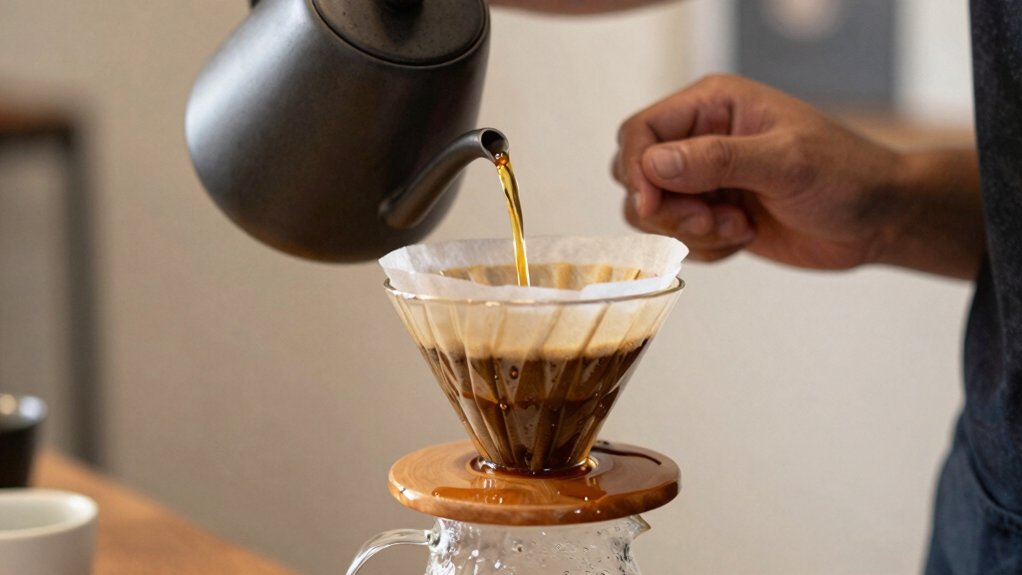
Master the gooseneck spiral by holding the kettle just below the surface splash point and pouring in a steady, even swirl to keep the bed saturated from center to edge. Keep your grind uniform and sized for a 3‑4‑minute brew, avoiding channeling and over‑extraction. Finally, dial in a 1:17 brew‑ratio and water at 195‑205°F, adjusting temperature for bean acidity. These steps will boost extraction efficiency and flavor balance, and the next section shows how to fine‑tune each variable.
Pour‑Over Extraction Flow: Mastering the Gooseneck Spiral
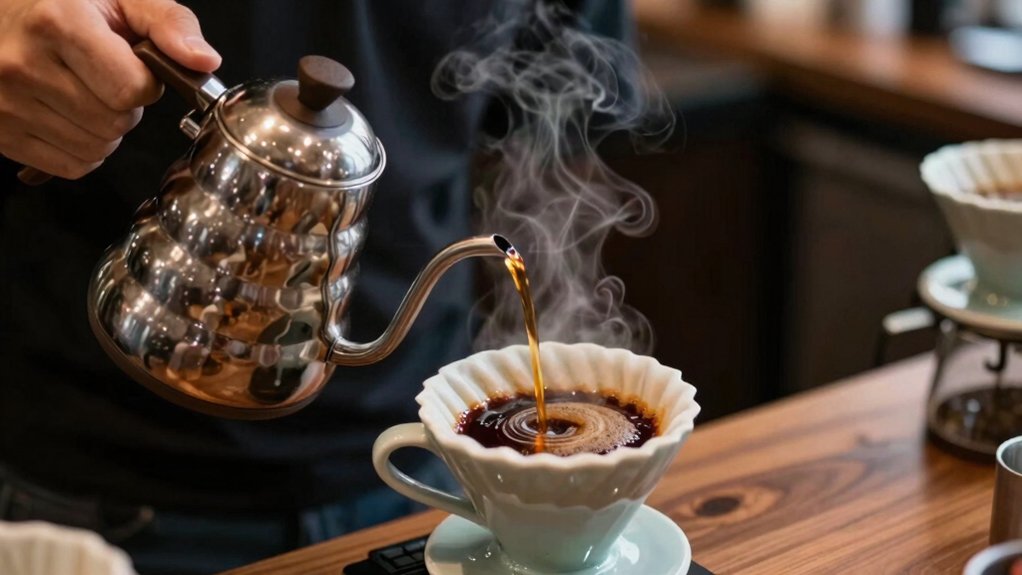
The gooseneck spiral is the heartbeat of a perfect pour‑over, and you’ll start by holding the kettle just below the surface splash point to launch a controlled swirl that drives turbulence deep into the coffee bed. Using a gooseneck kettle, keep the spiral pour quick yet steady on an even plane, preventing splashes and preserving bed integrity. Begin with a gentle water flow rate that targets the slurry, ensuring the stream permeates the grounds instead of pooling. Adjust the pour height: higher heights boost controlled turbulence and penetration, while lower heights protect the bed. Maintain a steady spiral pattern to achieve uniform saturation from center to edge, fostering a consistent bloom and optimal extraction均. This pouring technique maximizes pour‑over extraction efficiency. Grind setting versatility
Grind‑Size & Bed Uniformity: Achieving Consistent Soluble Extraction
Why does grind size matter so much? It dictates how quickly soluble compounds dissolve and how evenly water reaches every particle. A uniform grind size creates bed uniformity, preventing channeling that would otherwise rush water through low‑resistance paths and leave portions under‑extracted. In a pour‑over, aim for grind consistency that yields a 3–4‑minute brew time; this window supports the ideal extraction balance of 18–22 % solubles. If the grind is too fine, extraction accelerates, risking bitterness; if too coarse, solubility drops and the brew turns sour. Adjust the grind until the bed appears even, then watch the pour‑over flow. Maintaining this harmony ensures each sip reflects the full spectrum of flavors without over‑ or under‑extraction. To monitor progress, consider how the chosen refractometer model can track TDS readings during experimentation and guide adjustments data tracking.
Pour‑Over Brew‑Ratio & Temperature: Fine‑Tuning Strength and Flavor
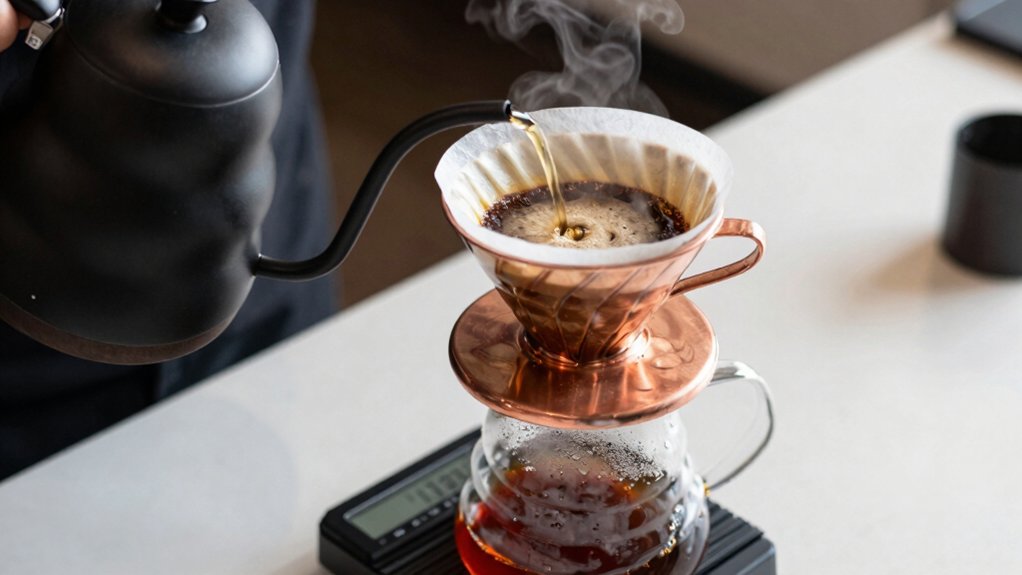
When you dial in the water-to-coffee ratio between 1:14 and 1:20—starting around 1:17 for most flat-bottom or conical brewers—you directly control the cup’s strength and extraction. A tighter ratio (1:14) yields a richer, more robust brew, while a looser ratio (1:20) produces a lighter, more delicate pour over. Pair the ratio with a consistent grind size; finer grounds slow the drip, extending brew time, coarser grounds speed it up. Begin with water temperature around 195–205°F (90–96°C) and adjust down for floral beans to tame acidity. Aim for a 3–4‑minute brew time, allowing the bloom to fully saturate coffee grounds before the steady drip, and you’ll achieve balanced extraction and clear flavor. Extraction science guides how these variables interact to shape aroma and body.
Frequently Asked Questions
How to Increase Extraction in Pour Over?
You boost extraction by grinding finer, extending brew time a few seconds, increasing pour speed, and ensuring the water fully saturates the grounds with steady, circular pours that keep the bed evenly wet.
What Is the 15-15-15 Rule for Coffee?
You use 15 g of coffee, pour 15 g of water to pre‑wet, let it bloom for 15 seconds, then continue the pour. This short bloom reduces acidity and preserves delicate aromas.
What Is the 80 20 Rule for Coffee?
You get about 80% of flavor clarity by tweaking just 20% of variables—mainly grind size, brew ratio, and pour technique—so focus on those few adjustments for biggest improvements.
What Are Common Mistakes in Pour Over Coffee?
You often under‑agitate, use the wrong grind, skip or mistime the bloom, pour unevenly, and mis‑measure water‑to‑coffee ratios or pick an unsuitable filter, leading to channeling and off‑balance flavors.
In Summary
Master these three steps, and you’ll consistently pull a clean, balanced cup. Keep the spiral steady, grind uniform, and dial in the right ratio and temperature. The result? A pour‑over that’s bright, smooth, and full‑bodied—every time.


