
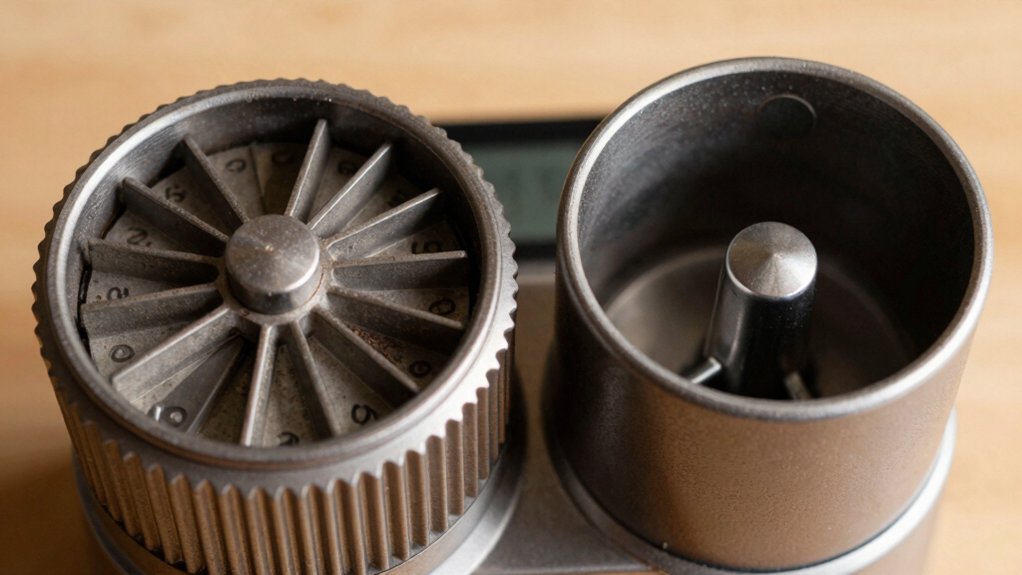
You’ll find that a stepped grinder gives you click‑by‑click size changes, perfect for everyday brewing and quick method swaps, while a stepless grinder lets you turn the burrs continuously for micrometric, espresso‑level precision. Stepped units are reliable, affordable, and beginner‑friendly, but their fixed intervals can limit granularity. Stepless models offer infinite adjustment and flavor tuning, yet they require careful logging and regular cleaning to stay repeatable. If you keep going, you’ll discover how burr quality, alignment, and hybrid designs affect your choice.
What Determines the Right Grinder for Your Brew? (Stepped vs Stepless)
Stepped grinders lock you into preset notches, so you can recall a grind size for espresso, pour-over, or French press with minimal fiddling. They’re fast and consistent, ideal if you value repeatability over fine‑tuning.
Stepless grinders give you a continuous, micrometric range, letting you dial in the tiniest adjustments that can swing espresso crema and balance dramatically. If you love experimenting and want ultimate flavor control, the endless spectrum of a stepless unit pays off.
Conversely, if you prefer speed and simplicity, a stepped model’s fixed stops keep you from over‑adjusting. Choose the style that matches your brewing rhythm and desired precision. In practice, aligning grinder precision with your brew goals can influence how you approach calibration and recipe stability, especially when aiming for consistent TDS or extraction targets across methods. grinding precision
What Is a Stepped Grinder and How Does It Work?
Since you’ve weighed the pros and cons of stepless versus stepped designs, let’s focus on how a stepped grinder actually works. A stepped grinder features a notched collar that locks the burr distance into one of several preset grind settings. Each notch corresponds to a fixed burr distance, so you can dial the grinder from espresso to pour-over to French press with a simple turn. Because the collar snaps into place, the setting stays stable, preventing mid‑brew shifts and ensuring repeatability batch shots. Models like the Baratza Encore ESP, Mahlkönig Guatemala, and Fellow Opus use this mechanism, offering beginners quick, reliable adjustments. Larger step gaps give broader ranges but may sacrifice espresso precision, while finer steps provide tighter control for delicate brews. The preset steps are designed to maintain consistency across grinding sessions and allow quick jumps between brew styles without recalibrating. stepwise adjustment helps users understand how discrete increments translate to measurable grind sizes for different coffees.
What Is a Stepless Grinder and Why Is It Infinite?
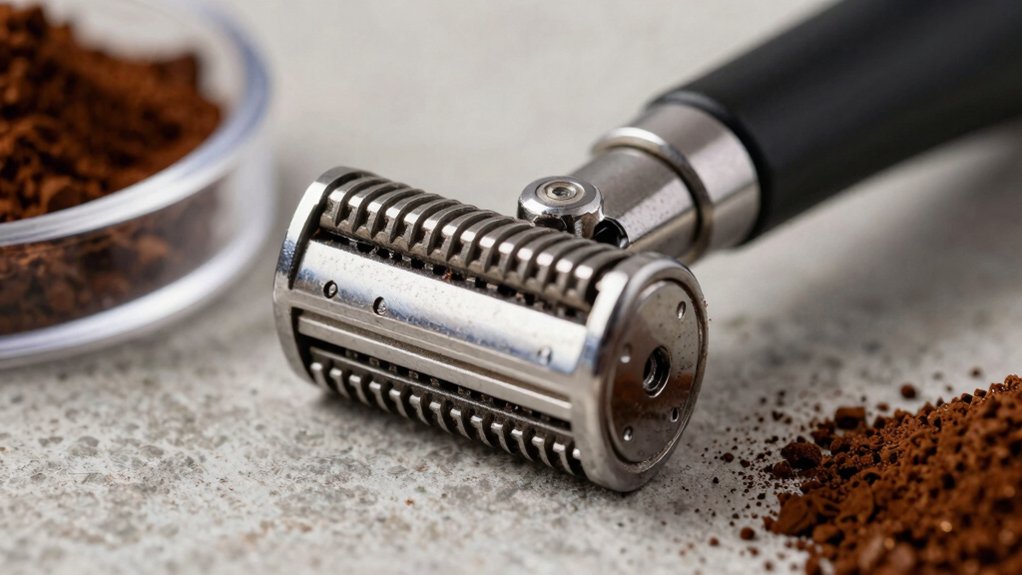
You’ll notice the burrs move continuously as you turn the collar, giving you micrometric control over grind size. Because there’s no preset stop, you can fine‑tune the texture endlessly, adjusting by the smallest fraction each time. This approach aligns with how USB-C rechargeable models emphasize portability without sacrificing precision in grind consistency stepless precision.
Continuous Burr Positioning
Ever wondered how a stepless grinder can dial in a grind size with seemingly endless precision? You’ll notice the burrs slide smoothly because the collar threading lets you make a stepless adjustment. The continuous burr moves in tiny increments, so your grind positioning feels almost infinite, yet you still need to note the setting to repeat it later.
- Direct collar turning – you rotate the collar, and the fine threading shifts the burr without any clicks.
- Gear‑linked indirect adjustment – a gear or linkage translates a small rotation into an even finer burr movement.
- Reference marking – because there are no notches, you write down the collar position or use a marker to capture the exact setting.
These mechanisms give you micrometric control, but they also demand careful handling to avoid accidental shifts. Foam quality levels
Micrometric Adjustment Mechanism
What makes a stepless grinder “infinite” is its micrometric adjustment mechanism, which translates the tiny rotation of a knob or collar into a proportional movement of the burrs. You’ll feel the knob turn a fraction of a degree, yet the threaded collar or worm‑gear advances the burrs by microns, giving you a seamless spectrum of grind sizes. The mechanism can be direct—turn the collar and move the burrs—or indirect—use a gear linkage that multiplies the rotation for even finer control. Because there are no preset stops, you can dial in any setting between the minimum and maximum gap, making the grinder truly continuous. Consistent reference marks or a memory log help you repeat a favorite setting despite the endless range. The design often emphasizes a compact footprint and a simple control interface to support a smooth, repeatable workflow. micrometric adjustment
Unlimited Grind Fine‑Tuning
How does a stepless grinder achieve “infinite” fine‑tuning? You turn a continuous collar or worm gear, and the grind size slides smoothly without fixed stops. This design lets you make micro‑adjustments that feel limitless, but you must record each setting to reproduce it later. The lack of labeled positions means precision depends on your own markings and diligent cleaning, yet the payoff is espresso extraction that hits the sweet spot every time.
- Mark the dial – use stickers or a reference dial to capture your favorite grind size.
- Track beans – note the exact micro‑adjustment for each roast to maintain flavor consistency.
- Clean regularly – keep the clutch mechanism tight so micro‑adjustments stay accurate.
How Do Burr Quality and Alignment Influence Precision in Stepped vs Stepless Grinders?
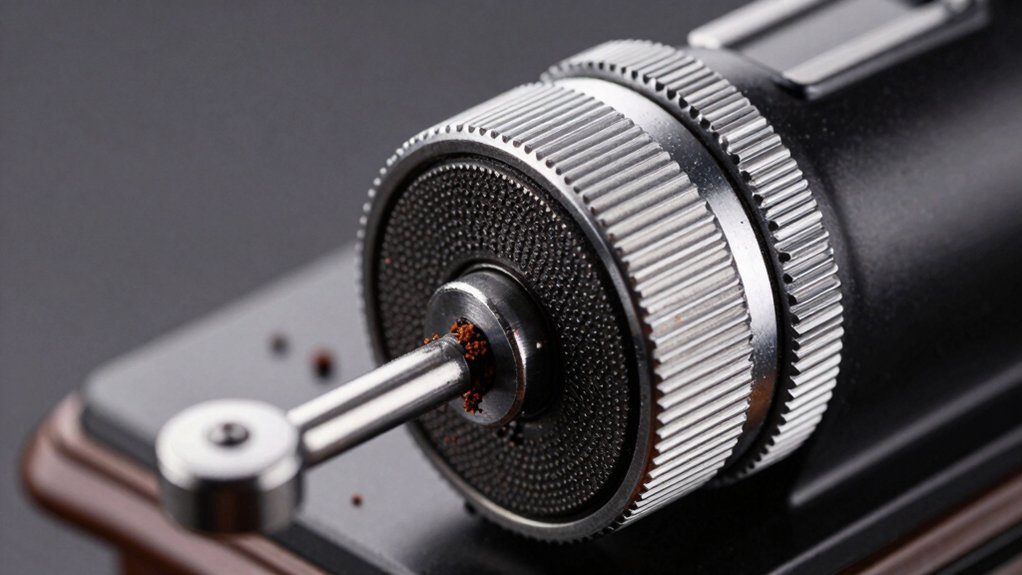
Why does burr quality matter so much for precision? Because finer, uniform burrs give you tighter particle size distribution, reducing extraction variance in both stepped and stepless grinders. When burr alignment is spot‑on, each click or micro‑adjustment reproduces the same grind precision. Misalignment introduces uneven cuts, causing sudden shifts between steps or micro‑adjustments, and it amplifies burr wear over time.
In stepless models, that wear or tilt can throw off the delicate tolerance needed for exact micro‑tuning, making repeatability harder. Regular maintenance—cleaning oil and residue, inspecting burr wear, and checking alignment—keeps the grind consistent. Documenting calibration references whenever you rotate or replace burrs further safeguards the precision you rely on. AeroPress
How Do You Pick the Right Step Size or Thread Pitch for Perfect Espresso?
Choosing the right step size or thread pitch for espresso hinges on matching the grinder’s micro‑adjustment range to the bean’s extraction window. You’ll want a step size that lets you dial in the shot without hunting. Smaller gaps—around 0.2–0.3 on the dial—give you fine espresso dialing, while larger steps force you to tweak dose or tamp pressure to compensate. Remember that step size precision depends on burr alignment; any mis‑tolerance will ruin repeatability even on a high‑end machine. To support consistent results, consider using a dedicated cleaning regimen for grinders to maintain stable dosing and avoid flavor transfer from residual oils standalone coffee grinders. 1. Test a single bean roast, record the step that hits 25‑30 s extraction.
2. Verify repeatability by pulling three shots, adjusting only the dial.
3. If results vary, check burr alignment and consider a finer thread pitch.
What Are the Pros of Stepped Grinders for Everyday Brewing?
Ever wondered how a stepped grinder can streamline your daily coffee routine? With stepped grinds you get quick adjustments that lock into pre‑marked notches, so you can shift from drip to pour‑over without hunting for the perfect setting. Those notches give you consistency across beans and roasts, because you always return to the same burr distance. Fewer moving parts mean the machine stays reliable and easy to clean, boosting affordability compared with complex stepless units. You’ll appreciate the repeatable feel—just turn the dial, hear the click, and you’re set. For beginners or anyone who values speed and dependable results, stepped grinders deliver the practical control you need for everyday brewing.
What Are the Cons of Stepped Grinders for Espresso Dialing?
While stepped grinders shine for everyday brewing, they fall short when you need the fine‑tuned precision that espresso demands. The fixed intervals limit adjustment granularity, so you often end up with a grind that’s either too coarse or too fine for your espresso dialing target. Over time, consistency wear can shift those steps, making repeatable shots harder to achieve.
- Coarse step size – The jumps between settings are too large, causing under‑ or over‑extraction when the ideal size lies between steps.
- Inconsistent results – Different grinders or wear on a single unit produce varying gaps, breaking the repeatability you need for espresso.
- More trial‑and‑error – You’ll spend extra time tweaking recipes for each bean, reducing the speed and efficiency of dialing in your espresso.
What Are the Pros of Stepless Grinders for Flavor Tuning?
Why settle for a one‑size‑fits‑all grind when you can fine‑tune every espresso shot? With stepless grind adjustments you get infinite granularity, letting you dial in the exact particle size that brings out your preferred acidity, sweetness, and body. Micrometric adjustments let you tweak the dose by tenths of a millimeter, achieving flavor tuning that’s impossible on stepped machines.
The continuous threading mechanism provides precision control, eliminating the gaps that cause under‑ or over‑extraction. You’ll notice a smoother crema, more consistent extraction, and the ability to experiment across methods without swapping burrs.
While you must log each setting to reproduce results, the payoff is a bespoke cup that reflects your palate, shot after shot.
What Are the Cons of Stepless Grinders for Routine Use?
Can you keep a stepless grinder dialed in day after day? You’ll find that the freedom of infinite adjustments comes with hidden costs. Without fixed references, a tiny bump can shift the grind, so maintaining consistency demands diligent note‑taking. The finer threads and continuous movement attract oil and residue, so maintenance becomes a regular chore. Precision can drift over time, and the learning curve for micro‑adjustments can lengthen your dialing‑in routine.
- Inconsistent repeatability – No preset steps mean you must record exact positions to hit the same grind again.
- Higher upkeep – Frequent cleaning is required to preserve precision and avoid flavor contamination.
- Cost and time – Premium stepless models are pricey, and mastering them eats into your daily brewing schedule.
How Can You Record and Recall Settings on a Stepless Grinder?
Ever wonder how to lock in that perfect grind without a click‑stop? You can build a simple reference system by adding collar markings with a permanent marker or small stickers. Write the bean type, roast level, and brew method next to each mark, and note the grinder model and burr condition in your maintenance notes.
For finer control, keep a digital log or a dedicated reference dial that records the exact collar position for each recipe. After every cleaning or burr change, re‑check the markings, because wear or oil buildup can shift grind adjustments.
When Is a Hybrid Grinder the Optimal Choice?
When you juggle multiple brewing methods and still demand espresso‑level precision, a hybrid grinder shines. You’ll love how it merges stepped presets with a micrometric, stepless range, letting you switch from Aeropress to espresso in a single turn while still fine‑tuning for espresso dialing. The recallable grind settings keep your favorite profiles at hand, and the extra adjustment layer lets you chase the perfect extraction without sacrificing consistency.
- Quick method swaps via preset steps.
- Micrometric tweaks for espresso dialing.
- Recallable grind settings that lock in your favorite profiles.
This blend of speed, precision, and flexibility makes a hybrid grinder the optimal choice when you need both repeatability and the ability to fine‑tune each cup.
Which Grinder Type Offers the Best Value for Home Baristas vs. Commercial Cafés?
Which grinder gives you the most bang for your buck depends on your setting.
As a home barista, you’ll likely favor stepped grinders because they offer fixed, easy‑to‑select increments, lower upfront cost, and minimal maintenance. Those steps let you switch between French press, drip, or espresso without endless trial‑and‑error, delivering reliable value for a small kitchen.
In a commercial café, stepless grinders become the smarter investment. Their micrometric, continuous adjustments let seasoned baristas dial in espresso grind size and crema balance with pinpoint precision, supporting consistency at scale. While stepless models cost more and demand skill, the payoff in extraction control and brand reputation outweighs the expense for high‑volume operations. Some units even toggle between stepped and stepless, letting you grow from simple value to advanced precision.
Frequently Asked Questions
What Is the Difference Between Stepless and Stepped Coffee Grinders?
You’ll find stepless grinders let you turn a dial continuously for infinite, micrometer‑level settings, while stepped grinders snap into fixed, repeatable clicks, offering quick, easy adjustments but coarser precision.
What Is Stepless Grind Adjustment?
You get a grinder where the dial moves continuously, letting you tweak particle size in tiny increments instead of fixed steps, so you can fine‑tune extraction for each bean, though you’ll need notes to repeat settings.
What Is the 15-15-15 Rule for Coffee?
You follow the 15‑15‑15 rule by using 15 g of coffee, 15 g of water per minute of brew time, aiming for roughly 15 % extraction, which yields a balanced espresso shot.
What Is the 80 20 Rule for Coffee?
You’ll find that roughly 80 % of a brew’s flavor comes from 20 % of the variables—grind size, bean freshness, water quality, and ratio—so prioritize those over minor technique tweaks.
In Summary
By now you’ve seen that stepped grinders give you repeatable, easy‑to‑remember settings, while stepless models let you fine‑tune endlessly for ultimate control. Choose a stepped grinder if you value consistency and quick adjustments, especially in a busy café. Opt for a stepless grinder when you crave precision and enjoy experimenting with each brew. If you need both worlds, a hybrid can bridge the gap, delivering flexibility without sacrificing reliability.


