
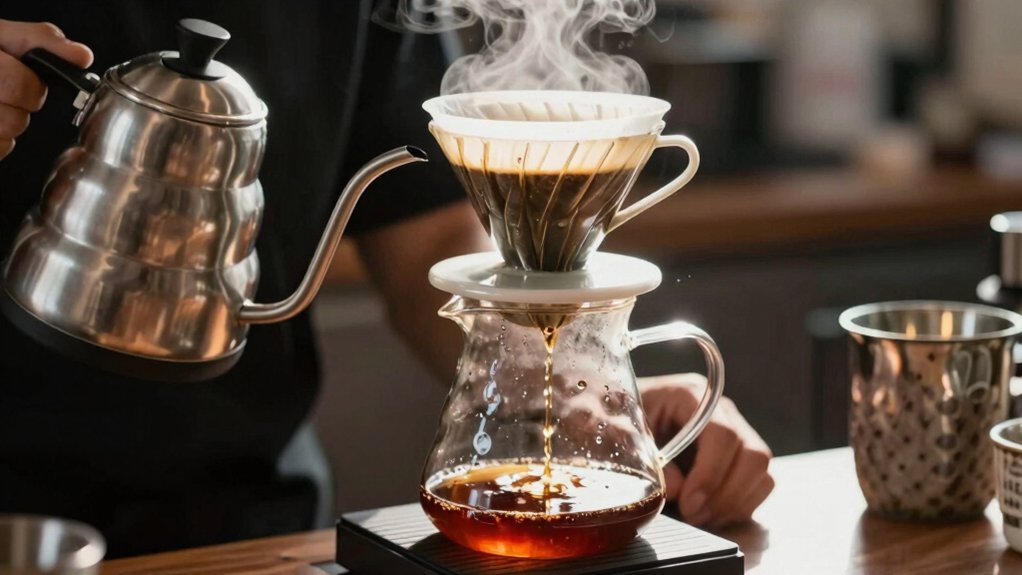
You’ll nail a perfect manual brew by dialing in grind size, water temperature, and coffee‑to‑water ratio, then applying a consistent bloom and a steady, circular pour. Use a medium‑fine grind for V60, a coarse grind for French press, and keep water at 200‑205 °F (93‑96 °C). Aim for a 1:15‑1:17 ratio, bloom for 30‑45 seconds, and pour in two phases over 3‑6 minutes. Mastering these steps sets the stage for deeper insights.
What Makes a Perfect Manual Brew?
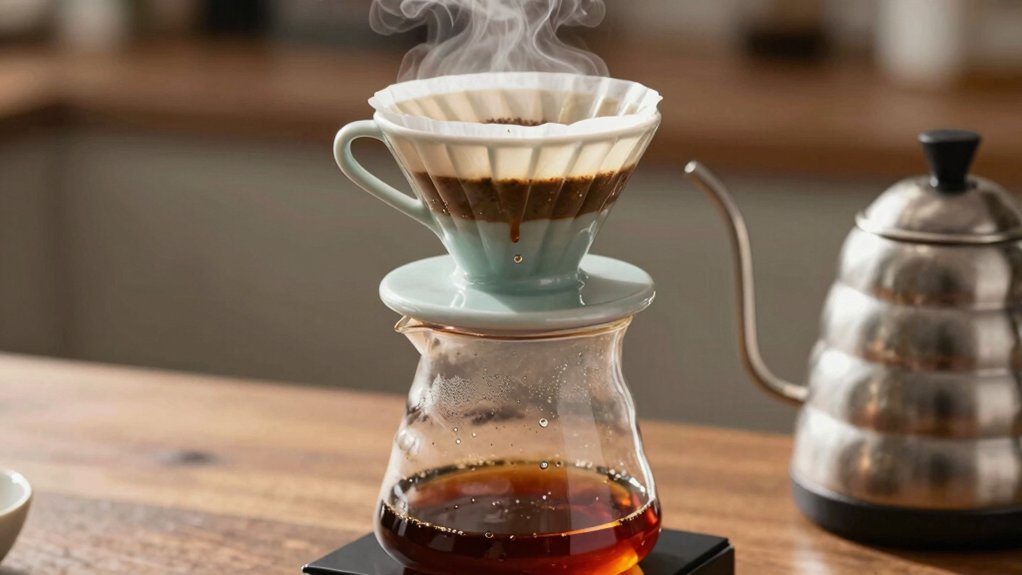
Ever wonder why some manual brews hit the sweet spot while others fall flat? You’ll find the secret in a balanced grind size and precise water temperature. Aim for a medium‑fine grind that lets water flow evenly, preventing channeling and over‑extraction.
Heat your water to 200–205 °F; this range extracts sugars and acids without scorching the grounds. Use a gooseneck kettle to pour steadily, allowing the bloom to release trapped CO₂ before the main pour.
Keep the brew ratio around 1:16–1:17, say 15 g coffee to 250 g water, and maintain a total brew time of 3–6 minutes. Fresh, high‑quality beans and the right filter—paper for clarity, metal for body—complete the equation, delivering a cup that’s bright, balanced, and full of character. Water temperature control helps ensure consistent extractions across batches.
Master the Core Variables of Manual Brewing
You’ll start by setting a consistent brew ratio—about 1 part coffee to 16-17 parts water—to keep strength predictable.
Then adjust the grind size, because a finer grind extracts more quickly, so you’ll need to tweak your pour rate and timing accordingly.
Finally, hit the target water temperature of 200-205°F, letting the kettle rest briefly after boiling to lock in optimal extraction.
Additionally, maintain stable heat control during the process by monitoring temperature and insulating the brewing setup to minimize heat loss and ensure consistent extraction. temperature control
Control Brew Ratio
Precision is the foundation of manual brewing, and mastering the brew ratio lets you dial in strength and flavor every time. Aim for a 1:16–1:17 ratio, measured as coffee mass to water mass; 15 g coffee with 250 g water hits 1:16.7. We your dose in grams and your water input in grams, then weigh both on a digital scale that reads to 0.1 g. Keep the grind size consistent while you tweak the ratio—finer grinds pull more solids, so a slightly coarser setting can balance a higher ratio. Date tracker on lid can help you track freshness across batches, ensuring consistency in flavor over time while you adjust the bloom volume and timing to fine‑tune extraction, but never stray from the measured ratio. Consistency across batches guarantees the same bright acidity, body, and nuanced notes you crave.
Grind Size Control
How does grind size shape your brew? You control extraction by choosing a grind size that matches your method and timing. A finer grind gives more surface area, speeding extraction and risking bitterness if you’re over‑extracted.
A coarser grind slows the flow, yielding a lighter, under‑extracted cup. For a V60, aim for a medium‑fine grind to balance bloom and pour rate, promoting even extraction. Consistency matters—use a burr grinder, not a blade, to avoid channeling and keep particles uniform.
If the cup tastes weak, coarsen slightly; if it’s claggy or bitter, go finer. Freshly ground beans preserve particle integrity, preventing uneven extraction and flavor loss. Adjust grind size alongside brew ratio and total brew time for optimal results.
Water Temperature Precision
Ever wondered why a few degrees can make or break a cup? You’ll notice that temperature accuracy drives extraction balance, so aim for water temperature between 200 °F and 205 °F. When you boil a stove kettle, let it rest 30–45 seconds off boil to hit that sweet spot, then pour steadily. A consistent bloom—using water at the same temperature and a volume equal to your coffee dose—suspends grounds and kick‑starts flavor. Finer grinds demand tighter control; you may drop a degree or slow the pour to avoid bitterness. Coarser grinds tolerate a touch more heat. Choose a high‑conductivity kettle, like copper, to keep the brew temperature stable from first drip to final sip. This precision keeps each batch predictable and delicious. The use of a refractometer or TDS measurement can help optimize extraction targets for repeatable results TDS measurement across batches.
Choose the Manual Brewing Device That Fits Your Taste
Looking for a brew that matches your flavor preferences? Choose a device that aligns with the cup you crave. If you love a cleaner, brighter profile, go for a pour‑over like the V60, Chemex, or Kalita. The V60’s single bottom hole and spiral ribs let you tweak contact time by adjusting pour speed, while Chemex’s thick paper filters strip body for crisp clarity. Kalita’s three small holes slow the flow, delivering a balanced extraction. For a richer, fuller‑bodied cup, the French press immerses grounds, yielding depth and texture. Consider material too: copper V60s boost thermal conductivity, whereas ceramic or glass keep flavors neutral. Brewing device selection can influence foam compatibility and temperature handling, which in turn affect extraction and aroma. Match the tool to your taste, and you’ll consistently hit the desired profile.
Optimize Water Quality and Temperature for Consistent Extraction
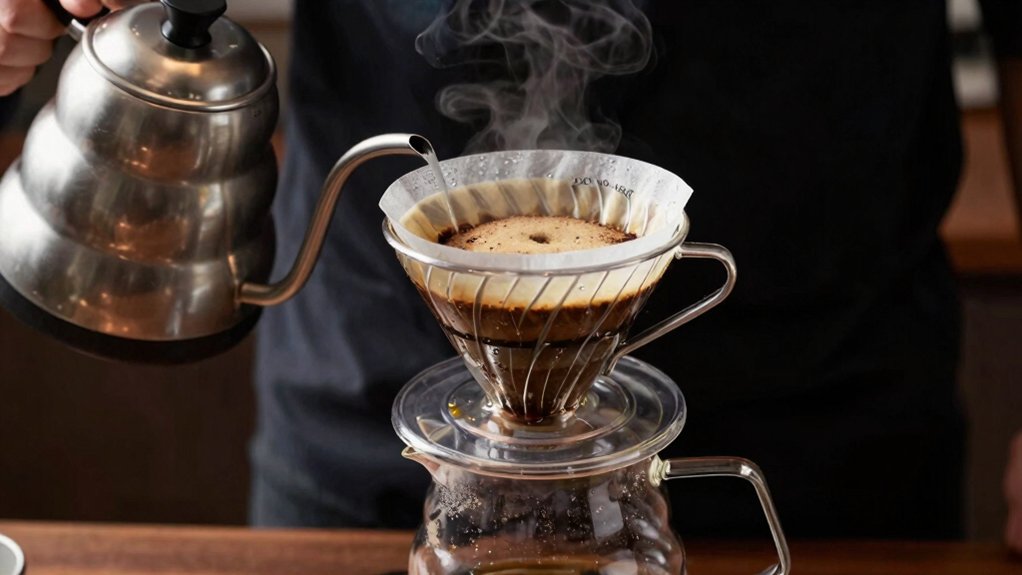
Why settle for inconsistent flavor when water quality and temperature can be dialed in for reliable extraction? You’ll notice that hard water dulls even premium beans, while pure RO water can leave the cup thin and under‑extracted. Choose a soft bottled water that supplies enough minerals for body and sweetness without overwhelming the brew. Additionally, consider using a double-sided chalkboard approach to test and display different brew ratios and temperatures for quick staff reference readability and display.
Heat your kettle to a rolling boil, then let it sit 30–45 seconds to hit the ideal brewing temperature of 200‑205°F (93‑96°C).
Adjust this temperature together with grind size and pour speed to keep total brew time between three and six minutes.
Perfect the Bloom: Why It Matters and How to Do It Right
How does a perfect bloom set the stage for a flawless cup? You start by pouring water equal to or double your coffee dose, letting it soak for 30–45 seconds. This bloom releases CO₂, preventing a soggy bed and ensuring every particle wets evenly. Keep the water at 200‑205 °F so aromatics awaken without extracting bitterness. Use a consistent grind size; a uniform particle distribution stops channeling and promotes steady extraction later. Aim for a gentle, circular pour that saturates the grounds without over‑wetting delicate particles. A longer bloom can boost aroma and sweetness, but watch the timing to avoid over‑extraction. Mastering these steps guarantees a balanced, vibrant cup before you move on to the next phase. Filter design considerations from AeroPress options can further fine‑tune taste and clarity as you proceed.
Control Pour Flow and Timing for Even Extraction
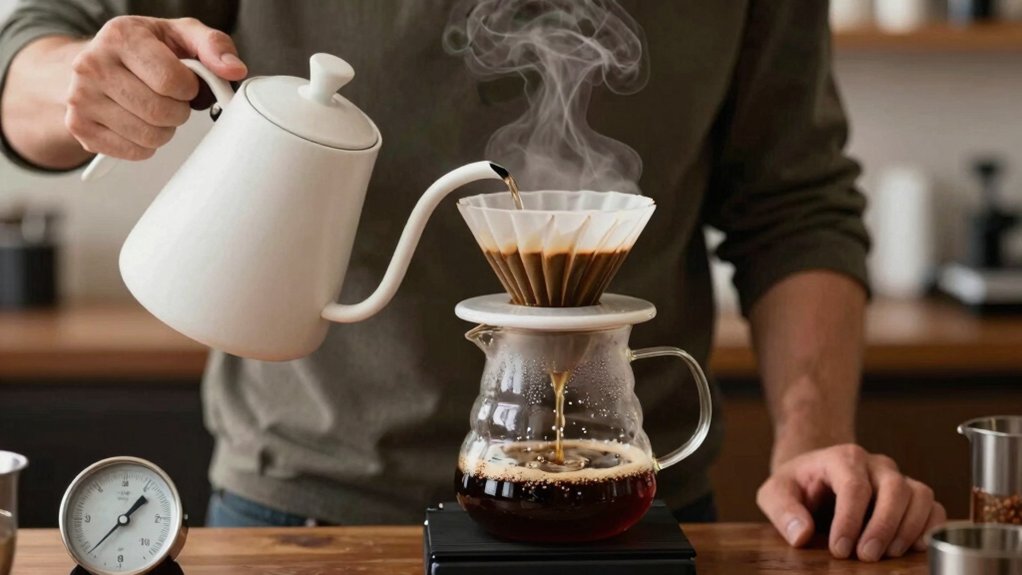
Ever wondered why a steady, circular pour makes such a difference? In a pour‑over you’ll notice the V60’s single bottom hole and cone shape channel water to the center, giving grounds a longer, uniform contact. Use a gooseneck kettle to control flow, keeping the stream slow and circular. Start with a bloom—add water equal to twice the coffee dose, wait 30–45 seconds—then pour in two phases, aiming for a 1:16–1:17 brew ratio and a total brew time of 3–6 minutes. The spiral ribs help air escape, preventing suction and channeling, so each particle extracts evenly.
| Phase | Flow Rate | Approx. Time |
|---|---|---|
| Bloom | Slow, gentle | 30–45 s |
| First pour | Moderate, circular | 45 s |
| Second pour | Steady, slower | 1 min |
| Finish | Drip to complete | 30 s |
Mind your grind size; too fine will choke flow, too coarse will rush it, compromising extraction.
Fine‑Tune Grind Size and Dose for Each Brewing Method
You’ll match grind size to each method, tweak the dose ratio, and make method‑specific adjustments to hit your target flavor. Start with a 1:15 ratio—15 g coffee to 225 g water—and then fine‑tune the grind: coarse for French press, medium‑fine for V60, a touch finer for Chemex, and consistent medium for Kalita Wave. Waffle weave and microfiber barista towels can keep your workstation clean and help you maintain precise measurements between batches, especially when you’re switching gear or trying new roasts. hanging design
Grind Size Matching
Why does matching grind size to your brew matter? Because grind size directly controls brew time and extraction balance. A fine grind slows flow, extending contact and risking bitterness; a coarse grind speeds it up, yielding a thin cup. By aligning grind size with the method, you keep extraction in the sweet spot and preserve aroma.
- Espresso – Use a fine grind (≈ 0.3 mm) to achieve a 25‑30 s brew time and rich body.
- Pour‑over – Choose medium‑fine (≈ 0.5 mm) for a 2‑3 min brew, balancing clarity and sweetness.
- French press – Go coarse (≈ 0.9 mm) to keep brew time around 4 min and avoid over‑extraction.
- Calibration – Start with the recommended setting, then tweak one or two grind steps per cycle until brew time and taste match your target.
Dose Ratio Optimization
When you dial in the dose‑to‑water ratio, you set the foundation for consistent extraction, so start with the classic 1:16–1:17 range and then tweak grind size and coffee weight to fine‑tune each method. Use a digital scale to hit 15 g coffee and 240–255 g water, then adjust dose within 12–18 g for a single cup while preserving the brew ratio. If the cup feels weak, nudge the grind size finer; if it’s bitter, go coarser.
For immersion brews, a slightly finer grind can offset a smaller dose, but avoid over‑extraction. Keep a timer handy, record changes, and repeat the process with different beans. This systematic approach locks in extraction consistency across all manual brewing techniques.
Method‑Specific Adjustments
Fine‑tuning grind size and dose for each brewing method lets you extract the sweet spot of flavor while respecting the method’s unique flow dynamics.
You’ll notice that a medium‑fine grind in a V60 paired with a 1:15‑1:17 brew ratio yields bright clarity, while a coarse grind in a French Press at 1:12‑1:15 builds body without bitterness.
A Moka Pot thrives on a fine‑to‑medium grind and a richer 1:7‑1:9 ratio, pushing espresso‑like intensity through its small chamber.
The Chemex benefits from a medium grind and the same 1:15‑1:17 ratio to balance its thick filter’s slower flow, and the AeroPress shines with a medium‑fine grind and a flexible 1:8‑1:13 ratio for a smooth, jam‑free cup.
- V60 – medium‑fine, 1:15‑1:17
- French Press – coarse, 1:12‑1:15
- Moka Pot – fine‑to‑medium, 1:7‑1:9
- AeroPress – medium‑fine, 1:8‑1:13
Troubleshoot Common Manual Brewing Issues
Ever wonder why your manual brew sometimes tastes off? Check your grind size first: uneven particles cause channeling and over‑ or under‑extraction, so switch to a burr grinder and aim for uniformity. Next, verify water temperature; 200‑205 °F (93‑96 °C) yields balanced flavor, while hotter water extracts bitterness. During the bloom, gently pour to saturate all grounds and stir lightly to release trapped CO₂ and prevent dry spots. Use the right filter for your method—thick Chemex paper for clarity or a Kalita three‑hole bottom for even flow—to avoid dull body or excess sediment. Finally, measure coffee and water by weight, keep a brew ratio around 1:16‑1:17, and time each pour with a timer to eliminate weak or astringent cups.
Clean and Maintain Your Manual Brewing Gear for Consistent Flavor
Disassemble and hand‑wash each component after every brew to stop oil buildup, which can impart off‑flavors and leave carrier residue. You’ll notice that clean water flowing through a spotless brewing device yields a sharper, more reliable cup. A quick routine prevents rust, mold, and mineral deposits, keeping pressure steady and extraction even.
Clean water through a spotless brewer yields sharper, more reliable cups while preventing rust, mold, and off‑flavors.
- Use a soft brush on filter baskets, spouts, and carafe interiors to lift particles without scratching.
- Rinse paper filters thoroughly, then air‑dry them to avoid mold and aroma transfer.
- Inspect seals, gaskets, and O‑rings; replace any that show wear to maintain consistent pressure.
- After rinsing, detangle and fully dry every piece, then periodically soak the whole assembly in a mild, cup‑safe solution per manufacturer guidance.
These steps preserve flavor integrity and extend the life of your gear.
Practice the Rhythm of Manual Brewing for Better Sensory Feedback
A steady brewing rhythm turns each pour into a sensory cue, letting you hear the bloom, feel the flow, and taste the shift in acidity as you move from one phase to the next. Use a timer and count the bloom, then pour in thirds over 3–6 minutes, keeping grind size and pour rate in sync. A digital scale locks the 1:16–1:17 ratio, so tiny adjustments reveal changes in sweetness, body, and acidity. Record grind size, bloom duration, temperature, and flavor notes in a journal; repeat with identical beans to isolate variables. Over time the loop sharpens your palate and makes each brew a repeatable experiment.
| Variable | Effect |
|---|---|
| Grind size | Alters contact time, shaping acidity and body |
| Bloom duration | Controls CO₂ release, influencing aroma |
| Pour rate | Modulates extraction speed, affecting sweetness |
Frequently Asked Questions
How Does Altitude Affect Manual Brewing Temperature?
You’ll notice water boils at lower temperatures up high, so you must start your brew a few degrees hotter to compensate. Adjust your kettle to about 2‑3 °C above sea‑level recommendations for consistent extraction.
Can I Use a Reusable Metal Filter for French Press?
Yes, you can use a reusable metal filter in a French press, but expect a slightly coarser brew and more sediment. Clean it thoroughly after each use to avoid flavor buildup.
What Impact Does Water Hardness Have on Coffee Acidity?
Water hardness softens coffee’s perceived acidity; calcium and magnesium bind to acids, reducing sharpness. If you use hard water, expect smoother, milder acidity, while soft water keeps the brew bright and more acidic.
Should I Pre-Wet the Coffee Grounds Before Blooming?
Yes, pre‑wet the grounds. You’ll release trapped CO₂, create even saturation, and prevent channeling. Pour just enough water to soak them, wait 30‑45 seconds, then continue your brew.
How Does Cup Material Influence Perceived Coffee Temperature?
You’ll feel coffee hotter in metal or ceramic mugs because they conduct heat, while glass or insulated cups keep warmth longer but feel cooler initially, so the material directly shapes your temperature perception.
In Summary
By mastering the core variables—water, temperature, grind, dose, and timing—you’ll consistently extract the flavors you love. Choose a device that matches your style, perfect the bloom, and keep your gear clean. With practice, the rhythm becomes second nature, letting you tweak each brew on the fly. Stay attentive, adjust as needed, and every cup will reflect your own perfect manual‑brewing craft.


