
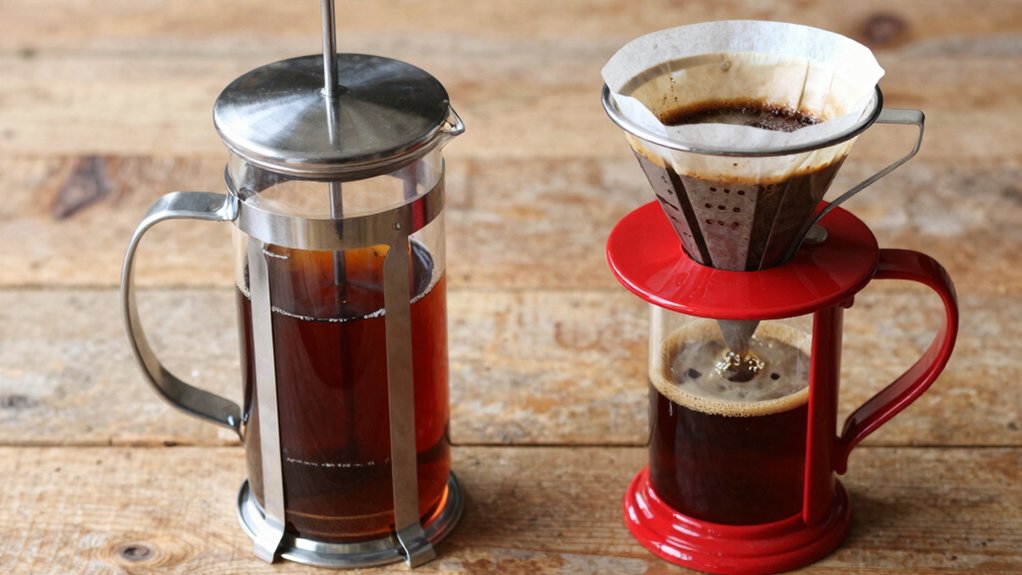
You get a richer, silkier cup from a French Press because its metal mesh lets oils and fine particles stay in the brew, giving body and a lingering smoothness. An AeroPress, especially with a paper filter, traps most of those oils and sediments, producing a cleaner, brighter cup with sharper acidity. The grind size, steep time, and temperature also differ—coarse grind and longer immersion for French Press, finer grind and shorter, press‑assisted extraction for AeroPress—so the flavor profiles diverge noticeably. Keep reading to see how each factor shapes the taste you prefer.
Decision Framework: How to Choose Between French Press and AeroPress?
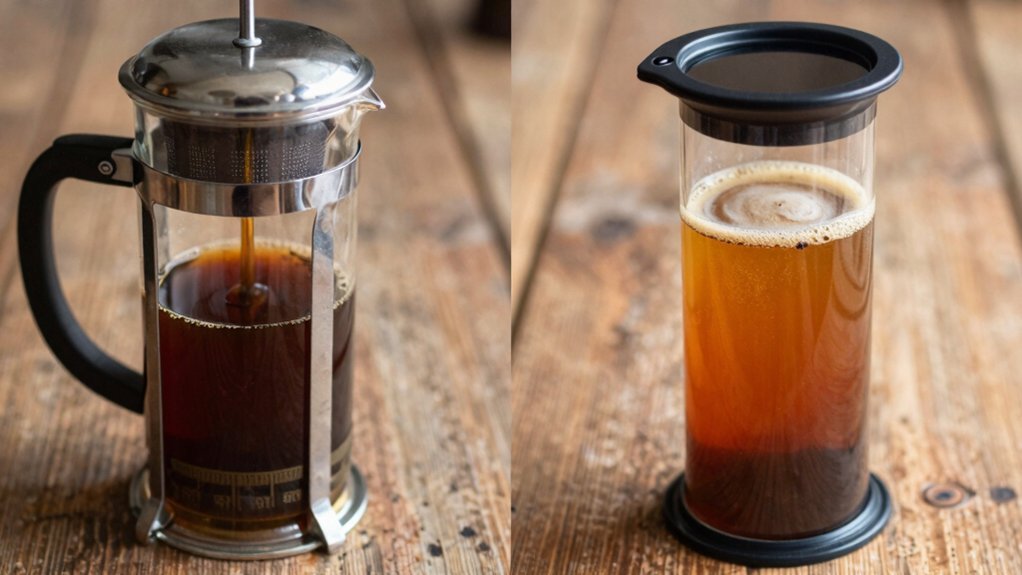
Where do you prioritize body over clarity? If you crave a full‑bodied, oil‑rich cup, lean toward the French Press; its coarse grind size and long steep let oils stay, shaping a robust flavor profile.
Prioritize body over clarity: choose French Press for full‑bodied, oil‑rich coffee.
Choose the AeroPress when you want a cleaner, brighter taste—its medium‑fine grind and short, adjustable steep time, combined with paper filtration, strip most oils and fine sediment.
Think about batch size: the French Press handles eight‑plus cups, while the AeroPress excels at single servings or concentrates you can dilute.
Portability matters too; the AeroPress is lightweight and travel‑ready.
Match these practical factors to your taste goals, and you’ll pick the method that fits each scenario perfectly.
How Metal Mesh Filtration Shapes French Press vs AeroPress Flavor?
The metal mesh in a French Press lets coffee oils and fine particles flow straight into your cup, giving the brew a rich, heavy body and a textured mouthfeel. When you use a French Press, the metal filter’s loose weave lets micro‑sediments stay, so you taste deeper flavor textural notes and a lingering silkiness.
In contrast, an AeroPress typically employs a paper filter that strips most oils and sediment, delivering a cleaner, brighter cup with sharper acidity. If you swap to a metal filter on the AeroPress, the filtration loosens, allowing more oils to pass and nudging the flavor profile toward the French Press’s fullness.
Understanding how each filtration choice shapes mouthfeel helps you decide which brew matches your palate. Additionally, the filter material significantly influences extraction speed, flavor clarity, and cleanliness of your brew.
Why Paper Filters Give AeroPress vs French Press Clarity?
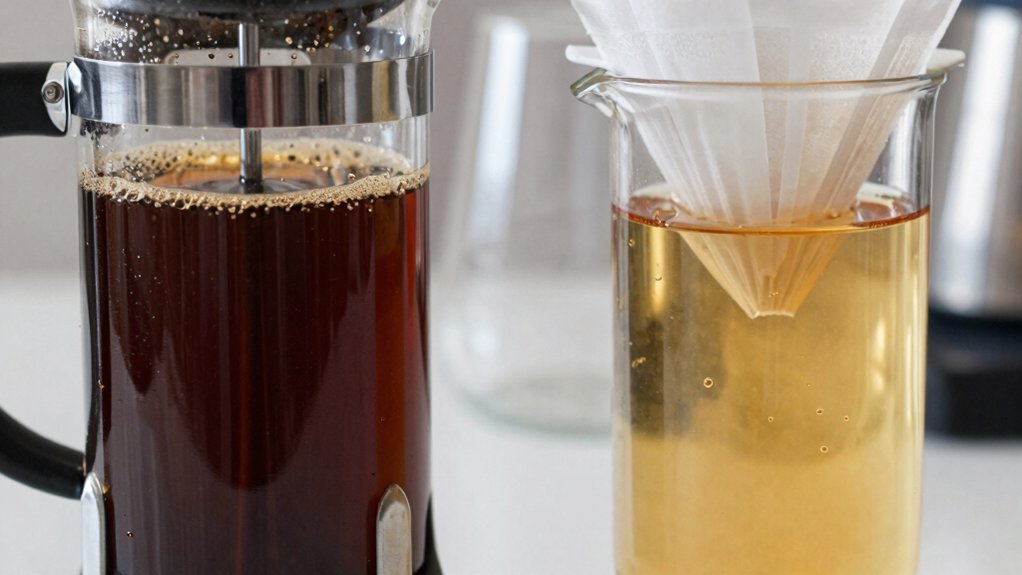
When you brew with a paper filter, it traps fine sediment and most of the coffee oils, so the cup comes through bright and clean. The French Press’s metal mesh lets those oils and particles stay, giving you a richer body but a hazier appearance. That’s why the AeroPress feels crisper while the French Press feels heavier. Using filter type carefully influences the flavor clarity and overall sensory experience of your brew.
Paper Filtration Removes Fine Sediment
Ever wondered why an AeroPress cup looks clearer than a French Press brew? The paper filtration in an AeroPress captures fine sediment that a metal mesh would let slip through. You’ll notice a crisper acidity and a clean finish because the paper filter blocks micro‑grounds and most oils, while the French Press retains them, adding body and a heavier mouthfeel. Additionally, the filtration performance of the paper filter plays a key role in controlling the extraction and clarity of each brew.
Oil Retention Alters Mouthfeel
Some of the biggest differences you’ll taste come from how much oil stays in the cup. With a French Press, the metal mesh lets oils and fine particles slip through, coating the surface and thickening the mouthfeel. Those oils give the brew a fuller body but can mute bright notes and blur origin flavors. In contrast, AeroPress paper filtration traps most oils and sediments, leaving a cleaner, crisper cup where each flavor shines.
If you swap the paper for a metal filter, the AeroPress will retain more oils and mimic the French Press’s viscous texture. So, the amount of oil that passes through the filtration stage directly shapes the mouthfeel—lighter and clearer with paper, richer and smoother with metal.
What Grind Size Should You Use for French Press vs AeroPress?
You’ll notice that a coarse grind (around 7 on Handground) works best for a French Press, letting the metal filter pass oils and fines without clogging. For an AeroPress you want a medium‑fine grind (about 2 on Handground) to keep the paper filter clean and control extraction speed. Adjusting the grind finer or coarser will shift the brew’s brightness, body, and clarity. Using the appropriate grind size is crucial for optimizing extraction and flavor, especially when utilizing different brewing methods like filter compatibility, which varies among Chemex models.
Grind Size Differences
How big should the grind be for each brew? You’ll use a coarse grind for French Press to limit sediment and a medium‑fine grind for AeroPress to let pressure and paper filtration work together. Coarser particles slow extraction, keeping the brew from becoming bitter over a four‑minute steep, while finer particles let AeroPress pull flavor quickly without excess sludge. Uniformity matters: an even grind prevents channeling and ensures consistent taste.
- French Press – coarse (≈7 on Handground) to reduce sludge through the metal mesh.
- AeroPress – medium‑fine (≈2 on Handground) for clean cup via paper filter and pressure.
- Both methods demand uniform grind to avoid uneven extraction and flavor spikes.
Impact on Extraction Speed
Uniform grind size is the key factor that dictates how fast each method extracts flavor. In a French press you’ll use a coarse grind, letting the grounds sit in full immersion for about four minutes. The metal filter lets oils and fine particles through, slowing extraction speed but building a heavy body. With an AeroPress you switch to a medium‑fine grind, shorten immersion time to one‑to‑three minutes, and apply pressure. That pressure accelerates extraction, yielding a cleaner, brighter cup even when you swap to a paper filter. Using a conical burr grinder helps achieve the precise, consistent grind sizes necessary for optimal extraction and flavor clarity.
How Long Should Coffee Steep in a French Press vs AeroPress?
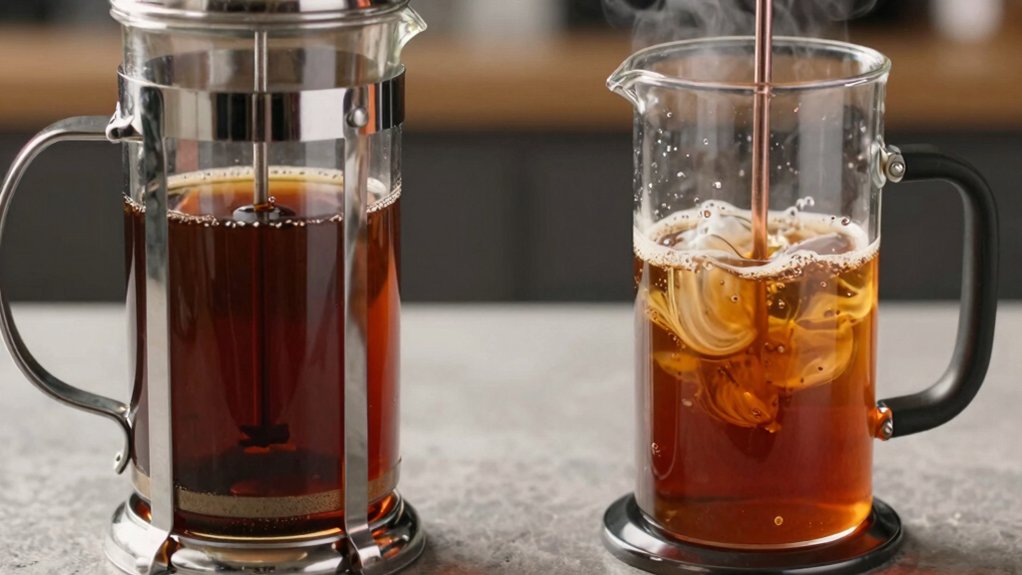
Wondering how long to let your coffee sit before pulling the plunger or pressing the cap? You’ll find that a French Press benefits from a 4‑minute steep time, letting coarse grounds release oils and fines through the metal filter for a full‑bodied extraction. In contrast, an AeroPress works best with a 1‑ to 3‑minute immersion before you apply pressure, producing a cleaner cup with brighter notes. Stirring during either immersion boosts contact, fine‑tuning flavor without extending the time. Additionally, the choice of filter material can influence the clarity and flavor profile of your brew, with paper filters providing a brighter taste and metal filters offering more oils and richness.
How Temperature Affects French Press vs AeroPress Body and Acidity?
You’ll notice that hotter water in a French Press pulls more oils, giving the cup a fuller body and smoother mouthfeel.
With an AeroPress, the same temperature combined with paper filtration keeps the brew lighter, letting acidity shine through.
Even a few degrees difference can tip the flavor balance toward richer chocolate notes in the French Press or brighter fruit tones in the AeroPress.
Additionally, double-wall insulation in some cups helps maintain the optimal brewing temperature, ensuring consistent extraction and flavor.
Temperature Influences Body
Higher brewing temperatures boost body in both French Press and AeroPress, but the French Press’s hotter, longer steep (around 196‑200 °F) amplifies mouthfeel more than the AeroPress’s typical 200 °F brew through its paper filter. When you raise the temperature, the French Press retains more oils and fines, thickening the cup, while the AeroPress’s filtration still strips much of those compounds, keeping the body lighter. Cooler water softens both, yet the French Press still feels richer because its immersion extracts more soluble solids.
- Hot water + French Press = fuller, silkier body.
- Hot water + AeroPress = lighter body due to paper filtration.
- Cooler water = smoother, less viscous body for both.
Temperature Shapes Acidity
How does temperature steer the acidity you taste in a French Press versus an AeroPress? When you raise temperature, extraction intensifies, so both methods deliver brighter acidity. The AeroPress typically brews at about 200 °F (93 °C), and its paper filtration strips oils and fines, letting crisp, sharp acidity shine through. In a French Press, you hover around 196–200 °F (91–93 °C); the metal filter lets more particles stay, softening acidity and adding body. A finer AeroPress grind at that temperature yields brisk, pronounced acidity, while a coarser French Press grind preserves richness and tempers sharpness. Even a 5–8 °F shift can noticeably alter perceived acidity, but the AeroPress’s sharper filtration makes those temperature‑driven changes more immediate in aroma and clarity.
Pressure Mechanics: Gentle Push in French Press vs Full Immersion in AeroPress?
Ever wondered why the French Press feels like a gentle push while the AeroPress operates like a full‑immersion squeeze? In a French Press, you let the grounds sit, then slowly depress the plunger, applying modest pressure that merely separates the mesh filter from the liquid. The AeroPress, by contrast, forces water through grounds and filter with a firm, rapid press, creating a high‑pressure burst that extracts quickly. This pressure difference shapes flavor: the gentle push retains more oils and body, while the full‑immersion squeeze yields a cleaner, brighter cup.
Gentle French Press push retains oils; AeroPress’s rapid squeeze yields a bright, clean cup.
- Pressure level – French Press uses low, steady pressure; AeroPress uses high, quick pressure.
- Immersion time – French Press steeps 4 minutes; AeroPress brews 1–3 minutes.
- Filtration effect – Metal mesh lets oils through; paper filter removes most oils.
Oil Retention & Resulting Mouthfeel in French Press vs AeroPress?
Why does the French Press feel richer and the AeroPress smoother? In a French Press, the metal mesh filter lets oil retention pass straight into your cup, creating a heavy, creamy mouthfeel that feels almost slurry‑like. Those natural coffee oils coat your palate, adding depth and a velvety texture.
Conversely, an AeroPress usually employs a paper filter, which captures most oils and fine particles during filtration. The result is a cleaner, glassy mouthfeel with brighter acidity and sharper origin notes.
If you swap to a metal AeroPress filter, you’ll retain more oil, but the standard paper option still delivers a smoother cup.
Understanding how oil retention shapes mouthfeel helps you choose the brew that matches your texture preference.
Sediment Levels: What You’Ll See in Your Cup With Each Brewer?
What you’ll actually see at the bottom of your cup depends on the filter each brewer uses. A French Press sediment settles as a faint brown layer, and you’ll notice a silky film of oils clinging to the surface. Aeropress filtration, by contrast, traps most particles, so the cup looks clear and the only residue is a thin, almost invisible film. The difference in clarity isn’t just visual; it shapes the flavor you experience.
- Metal mesh lets fine grounds and oils through → richer mouthfeel, less defined origin notes.
- Paper filter blocks sediments and oils → brighter, cleaner cup.
- Sediment amount directly impacts clarity → heavy sediment dulls flavors, while filtered coffee highlights brightness.
How Brewing Ratios Influence Strength and Balance in French Press vs AeroPress?
The sediment you saw in the French Press cup tells you why the same 1:16 coffee‑to‑water ratio feels stronger there than in an AeroPress. In a French Press, the metal filter lets oils and fine particles stay, so a 1:16 ratio yields a fuller body and richer strength.
With an AeroPress, the paper filter strips most oils, making that identical ratio taste cleaner and lighter, even though the grind is finer. If you raise the coffee dose or cut water, the French Press amplifies body and depth, while the AeroPress relies more on grind size and steep time to shift strength.
Adjusting brewing ratios lets you balance intensity and clarity: the French Press leans toward robust, oil‑laden richness, whereas the AeroPress favors bright, acidic balance.
Practical Clean‑up: Sediment vs. Filter Disposal for Each Device?
Ever wondered how cleanup differs between a French Press and an AeroPress? With a French Press, the metal French lets sediment settle, so you’ll scrape the grounds out of the pot, rinse the mesh, and deal with a gritty residue that clings to the sides.
The AeroPress, using a paper filter, produces a clean puck that pops out, leaving only a thin paper wrapper to toss. Both devices need a quick rinse, but the AeroPress’s plastic body and disposable paper filter make the whole process faster and less messy.
- French filter: scrape, soak, and scrub to remove sediment.
- Paper filter: pop out, discard, and give a brief rinse.
- Disposal: metal filter stays, paper filter goes straight to the bin.
Which Brew Delivers the Flavor Profile You Prefer?
Cleaning up is quick, but choosing the brew that matches your palate takes a bit more thought. If you crave bright, clean aromas and a crisp finish, the AeroPress with its paper filter lets you dial in grind size and a short extraction time, delivering lighter acidity and distinct origin notes. The metal mesh filter of a French Press holds oils and fines, giving you a fuller body and richer texture, especially when you let the coffee steep about four minutes. Think about whether you prefer the clear, precise flavors that come from controlled pressure and shorter brew time, or the deep, robust mouthfeel that full‑immersion extraction and longer steeping provide. Your favorite profile will guide the choice.
Fast Decision Matrix: AeroPress vs French Press for Your Daily Brew?
Looking for a quick way to decide which brewer fits your daily routine? Compare speed, flavor, and convenience in a simple matrix.
- Speed & brewing method – AeroPress delivers a cup in 1–3 minutes with pressure, while French Press needs a 4‑minute steep and manual plunge.
- Flavor & filter impact – Paper‑filtered AeroPress yields a clean, bright cup with reduced oil and sediment, highlighting acidity. French Press’s metal mesh keeps oils and fines, giving a full‑bodied, richer flavor.
- Portability & serving size – AeroPress is compact, perfect for single servings on the go; French Press shines in larger, shared pots with a robust mouthfeel.
Use this matrix to match your schedule and taste preference, then pick the brewer that aligns with your daily coffee ritual.
Frequently Asked Questions
Does Aeropress Coffee Taste Different From French Press?
Yes, you’ll notice a difference: the Aeropress yields a cleaner, brighter cup with less sediment, while the French Press gives a richer, oil‑laden body and deeper, bolder flavors.
What Is the Criticism of Aeropress?
You criticize the AeroPress for its limited batch size, reliance on precise timing and pressure, potential BPA‑containing plastics, and a paper filter that strips oils, yielding a thinner, less robust flavor.
Is Aeropress or French Press Easier?
You’ll find the Aeropress easier—it brews faster, cleans up quickly, and needs less effort to control variables, while the French Press is simpler to use but messier and more time‑consuming to clean.
Is It Unhealthy to Drink Coffee From a French Press?
You might worry about health, but drinking French‑press coffee isn’t inherently unhealthy; the main concern is higher oil and diterpene intake, which some studies link to cholesterol, though moderation keeps risks low.
In Summary
You’ll pick the French press if you love a full‑bodied cup with rich oils and a bit of sediment, and you don’t mind a longer steep and a metal mesh that lets everything through. Choose the AeroPress when you crave a cleaner, brighter brew with precise control over grind, time, and pressure, plus quick cleanup. Your taste, routine, and how much effort you want to spend will decide which device wins your morning.


