
You’ll notice that dark roasts flatten the espresso’s acidity, burn off the natural sugars, and flood the cup with uniform smoky, bitter notes that drown out the bean’s origin‑specific flavors. The high heat breaks down acids, proteins, and delicate aromatics, while caramelization and Maillard reactions create bitter polymers and oily residues that mask the bright, floral, and fruity cues you love. If you keep going, you’ll discover how to balance boldness with terroir and preserve those hidden nuances.
How Do Dark Roasts Mask Espresso Bean Flavors?
Dark roasts also tend to homogenize the perception of mouthfeel, making body and texture feel more uniform across different beans extraction yields.
What Taste Changes Occur as Roast Depth Increases in Dark Roast Espresso?
Ever notice how a deeper roast turns once‑bright espresso into a uniform, smoky brew? As the roast deepens, acidity drops, so the cup loses its lively snap and feels flatter.
Sweetness fades because caramelization burns off sugars, while bitter compounds rise, giving a harsher edge.
Roast‑derived flavors like smoke, char, and toasted nuts dominate, masking the bean’s original terroir.
The high heat also breaks down acids, proteins, and sugars, erasing subtle green‑bean notes and leaving a more monotone profile.
You’ll find that beans from different regions start to taste alike, their unique fruit or floral hints buried beneath the heavy, bitter, and bitter‑laden backbone of a dark roast espresso.
What Chemical Reactions Drive Caramelization and Oil Migration in Dark Roast Espresso?
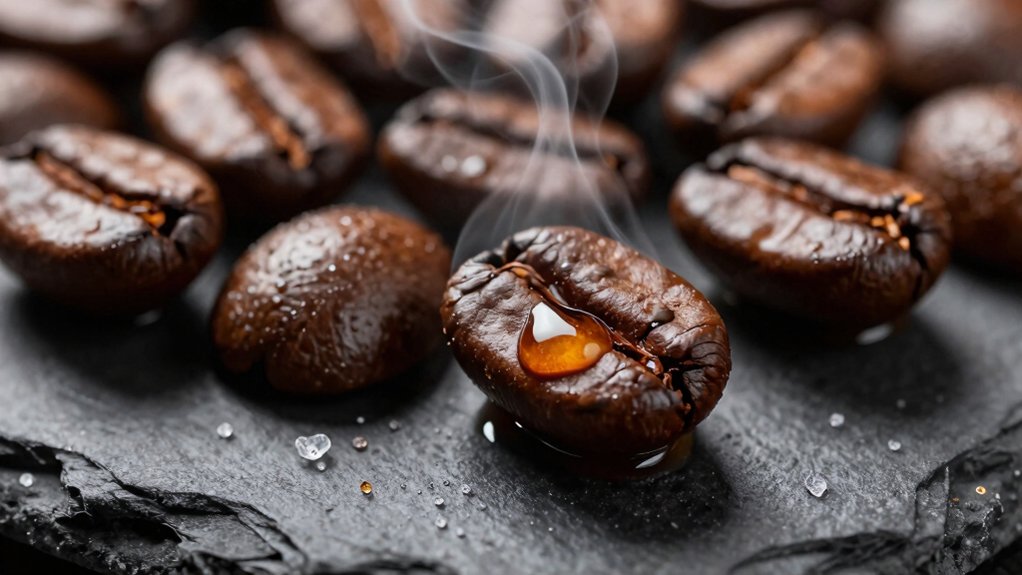
Why do dark roasts turn sugars into bitter, oily messes? When you push beans past the first crack, intense heat triggers caramelization. The sugars break down, forming brown‑black polymers and bitter compounds while losing their natural acidity.
Simultaneously, Maillard reactions intensify, creating melanoidins that thicken the bean matrix. As temperature climbs, cell walls rupture, and oil migration carries lipid‑rich oils to the surface. Those oils coat the grounds, delivering smoky, burnt notes that mask the bean’s origin.
Prolonged exposure also drives polymerization and char formation, reducing solubility and flattening nuanced aromatics. The result is a brew dominated by bitter, oily flavors, with the delicate sweetness and acidity you once enjoyed now largely gone.
Why Does the Second Crack Erase Floral and Fruity Notes?
When the beans hit the second crack, the intense heat accelerates roast development, overwhelming the delicate floral and fruity compounds that once defined the bean’s character. You’ll notice the volatile aromatics evaporate, while smoky, bitter, and char‑like molecules dominate. The prolonged exposure breaks down acids and sugars that give brightness, flattening the profile. Solubility shifts make the remaining floral/fruity notes harder to extract, so espresso tastes more like roasted chocolate than the original orchard. Additionally, precision vacuum sealing and nano-ceramic coatings highlighted in 2026 models underscore how advanced insulation can preserve aroma compounds in mugs during extraction, making it clear that even small environmental controls influence perceived flavor temperature retention.
Which Terroir‑Derived Flavors Fade With Longer Dark Roasting Espresso?
What you lose as the roast deepens are the terroir‑derived notes that make each origin unique. At a higher roast level, bright citrus acidity fades, and the delicate fruitiness that once sparked a berry‑like zing disappears. Floral aromas—lilac, jasmine, and subtle honeysuckle—are masked by caramelized sugars and bitter undertones. Nuanced cocoa, nutty, and wine‑like nuances, hallmarks of specific soils and microclimates, become indistinct as Maillard reactions dominate. The processing‑derived fruit sweetness, once vivid, flattens into a uniform roast profile. In short, the longer you push the beans into darkness, the more you erase the terroir cues that give espresso its origin character, leaving only bitterness, heaviness, and a generic roasted flavor. Reproducible flavor profile
Which Bean Origins Resist Flavor Loss in Dark Roast Espresso?
Ever wondered which beans still shine after a deep roast? You’ll find that origins with naturally bold, chocolatey or nutty profiles tend to retain more character when the roast turns dark. Ethiopian Yirgacheffe, despite its bright floral notes, often loses its delicate fruit under heavy heat, while Brazilian Santos, with its earthy, cocoa‑driven terroir, holds up better. Likewise, Colombian Supremo’s balanced acidity can survive a medium‑dark roast, but its nuanced citrus fades quickly. Look for beans that already emphasize robust, roasted‑friendly flavors—Sumatra Mandheling’s earthy, full‑bodied terroir and Mexican Altura’s deep, caramel notes are good candidates. These origins resist flavor loss longer, letting you enjoy a darker espresso without completely masking the bean’s inherent personality. link text example
When Does a Roast Become Roast‑Dominant Rather Than Bean‑Dominant?
You’ll notice the bean‑dominant threshold slips once the roast’s bitterness overtakes its sweetness, and the aroma shifts to caramelized, burnt notes. When those roast‑dominant indicators appear—muted acidity, flattened varietal nuances, and a uniform, heavy body—you’ve crossed into a roast‑driven profile. Balancing flavor preservation then means dialing back temperature or time to let the bean’s original character shine through. Temperature control can help you fine‑tune extraction to preserve nuanced flavors rather than accentuate roast over varietal notes.
Bean‑Dominant Threshold
When does a roast cross the line from showcasing the bean’s terroir to drowning it in char? You’ll notice the shift once the roast moves past medium‑dark, where acidity fades and bitterness climbs. At this bean‑dominant threshold, the bean’s intrinsic acids, sugars, and proteins have been largely degraded, leaving only the roast’s smoke‑like aromas. The longer the heat, the more the flavors converge across origins, masking the nuanced terroir you love.
| Roast Level | Flavor Profile |
|---|---|
| Light‑to‑Medium | Bright, bean‑dominant |
| Medium‑Dark | Balanced, hint of roast‑dominant |
| Dark | Roast‑dominant, bean‑dominant lost |
Recognizing this threshold helps you decide whether to preserve terroir or embrace bold, repeatable roast‑dominant notes.
Roast‑Dominant Indicators
How can you tell a roast has crossed from bean‑dominant to roast‑dominant? You’ll notice a surge of smoky, bitter, and caramel‑burn notes that drown out the subtle acidity and fruitiness that once hinted at terroir. Sweetness fades, and bitterness climbs, signaling that chemical reactions have overtaken the bean’s natural compounds. Extraction becomes more uniform; the coffee tastes the same across origins because roast‑derived flavors dominate. Processing cues—like fermentation tang—might still appear, but they’re now masked by the overwhelming roast‑dominant profile. As a result, terroir visibility drops sharply, making it hard to pinpoint the coffee’s geographic roots. In short, when the palate registers heavy, uniform roast notes and the delicate origin nuances disappear, the roast has become roast‑dominant. Roast Character becomes a more reliable descriptor than origin when evaluating how a roast affects flavor.
Balancing Flavor Preservation
Ever wondered where the line between bean‑dominant and roast‑dominant truly lies? When you push roast depth past the point where acidity and subtle sweetness survive, the bean’s terroir starts to vanish. The heat degrades acids, proteins, and sugars, turning bright notes into bitter, smoky tones. If you notice the cup losing its origin‑specific brightness and becoming uniformly roasty, you’ve crossed into roast‑dominant territory. To preserve terroir, stop the roast before the bitterness spikes and the sweetness fades. Aim for a medium‑dark range where the bean’s natural flavors still peek through, and monitor the balance constantly. This way you keep the espresso lively, not just a burnt canvas. Alcohol-free and sugar-free roasts can help maintain clearer flavor profiles while still delivering depth.
How Can You Balance Boldness With Terroir Preservation in Dark Roast Espresso?
If you want a dark‑roast espresso that still whispers its origin, focus on preserving solubility and acidity while dialing back the heat. Aim for a roast that stops just before the beans turn matte, letting the Maillard reaction build body without erasing terroir cues. Use a shorter development time and lower peak temperature; this keeps acids and sugars intact, boosting brightness and flavor nuance. Select beans with strong origin signatures and blend them with a slightly lighter roast to reinforce those notes. Adjust your grind to a fine, even size so extraction extracts the retained solubility without over‑extraction. The result is a bold, smoky cup that still carries the distinct terroir of its source.
How to Keep Bitterness in Check While Achieving a Dark Profile?
Balancing bitterness while pushing a roast darker means managing heat and time so the bean’s natural sugars and acids aren’t stripped away. You control roast depth by adjusting the drum temperature and shortening the end‑time, letting the bean develop a rich, dark hue without lingering in the “burn” zone.
Monitor the crack stages closely; once the second crack appears, pull the batch quickly to halt the formation of bitter‑tasting molecules.
Use a slower ramp at the start to preserve solubility, then accelerate just enough to achieve the desired roast depth.
Finally, cool the beans rapidly to lock in flavor and prevent over‑development.
This disciplined heat‑transfer strategy keeps bitterness in check while delivering a satisfying, dark espresso profile.
Which Roaster Design Elements Preserve Flavor in Dark Roast Espresso?
You’ll notice that a roaster’s stirrer‑bean contact control can keep the beans from scorching against hot walls, preserving their nuanced flavors.
A well‑designed cooling tray that manages heat efficiently prevents post‑roast bitterness and locks in soluble compounds.
Together, these design elements let you achieve a dark roast espresso without sacrificing the bean’s original character.
Stirrer‑Bean Contact Control
When the stirrer blades scrape against beans, they can leave micro‑scratches that unevenly conduct heat, leading to inconsistent development of the dark‑roast flavor profile. You should treat stirrer contact as a critical variable; even slight surface damage can cause hot spots that over‑caramelize some beans while leaving others under‑developed. Check clearance between the vanes and chamber walls—tight gaps increase the chance of beans getting caught and scraped. Opt for smooth‑finished, rounded stirrers and ensure they rotate freely without wobble. Regularly inspect beans after each batch for marks; a clean, unblemished surface signals even heat transfer. By minimizing stirrer‑induced surface damage, you preserve the nuanced bitterness and caramel notes essential to a balanced dark‑roast espresso.
Cooling Tray Heat Management
Scraping beans with a rough stirrer can leave micro‑scratches that create hot spots, so the next step—cooling—must keep those spots from heating up again. Your cooling tray should act as a heat‑management buffer, not a heat source. Insulated or ventilated trays keep the surface cool, letting beans lose residual heat uniformly without reigniting Maillard reactions. Check geometry regularly: maintain clear gaps, smooth surfaces, and avoid sharp edges that trap beans against hot zones. Airflow must stay unobstructed, so beans don’t cling to warm walls and develop burnt notes. By minimizing direct contact with hot metal and ensuring rapid, even cooling, you preserve the dark‑roast’s nuanced flavor profile and prevent over‑development that would otherwise dominate your espresso cup.
How to Taste for Terroir Clues in Dark‑Roast Espresso Shots?
Even though dark roasts veil a bean’s native character, you can still tease out terroir hints by focusing on the subtle undercurrents that survive the roast.
Start by letting the espresso cool a few seconds; the initial bitterness softens, letting faint mineral notes surface.
Swirl the shot, then sniff for a whisper of earth or dried fruit—these are the lingering terroir signals that survived the roast depth.
Take a small sip, hold it, and notice the texture: a thin, dry mouthfeel often masks acidity, but a lingering sweetness can betray the bean’s origin.
Compare two shots side‑by‑side, noting any difference in lingering spice or nutty undertones; those nuances point back to the coffee’s soil and climate.
Why Do Some Espresso Drinkers Prefer Low‑Acidity Dark Roasts?
You probably love the way a dark roast tames acidity, giving you a smoother, less tangy espresso that still feels bold. The consistent, roast‑driven flavor lets you enjoy a heavy mouthfeel and a creamy crema without the bright, variable notes of lighter beans.
Plus, the lower acid content can be gentler on your stomach, making those long coffee sessions more comfortable.
Acidity Reduction Preference
Why do many espresso lovers gravitate toward low‑acidity dark roasts? You crave acidity reduction because the deep roast degrades the beans’ natural acids and caramelizes sugars, muting tartness. Darker roasts also layer smoky, caramel notes that mask any remaining sharpness from terroir, giving a smoother mouthfeel. When you sip, the bitterness replaces bright acidity, aligning with a palate that prefers a velvety, less a cup. This profile feels more drinkable, especially after meals or when you’re sensitive to sour notes. You also appreciate the consistency—each pull delivers the same muted acidity, so you can enjoy espresso without the jittery edge that lighter roasts sometimes provoke. The result is a comforting, low‑acidity experience that fits your taste..
Bold Flavor Consistency
What drives many espresso drinkers to favor low‑acidity dark roasts is the promise of bold, consistent flavor that sidelines origin‑specific quirks. You appreciate how a dark roast strips away bright acids, leaving a uniform backbone of smoke, char, and gentle bitterness. That backbone delivers flavor consistency shot after shot, so you never have to guess whether today’s brew will taste like a tropical orchard or a chocolate bar. You also enjoy the simplicity of a profile that doesn’t demand nuanced palate training, letting you focus on the robust body rather than subtle terroir notes.
- Reduced acidity smooths out flavor swings
- Roast‑derived bitterness dominates, masking origin differences
- Sweetness and fruit fade, creating repeatable taste
- Consistent boldness supports routine brewing habits
Digestive Comfort Appeal
Ever notice how a dark‑roasted espresso feels gentler on your stomach? You’re probably tasting the result of dark roasting, which breaks down acids and proteins, leaving a smoother, less tart cup. That reduction in acidity can ease digestive discomfort for those sensitive to acid‑related symptoms. The process also amplifies bitterness, dulling sweetness and creating a fuller body that lingers longer in the gut. While roast‑derived flavors mask subtle origin notes, many drinkers accept the loss of complexity for the comfort of a gentler brew. In short, the trade‑off of lower acidity aligns with your digestive comfort goals, even if the terroir becomes harder to detect.
What Decision Framework Guides Roast‑Level Selection for Market Demand?
How do you decide which roast level will satisfy market demand while preserving a bean’s character? You weigh market trends against terroir impact, then map consumer segmentation to flavor goals. Start by profiling the target audience: bold‑profile seekers prefer lower acidity and stronger roast notes, while terroir‑curious drinkers want origin‑specific nuances. Next, assess bean quality; lower‑grade beans can survive darker roasts without masking too much flavor. Finally, test solubility and sweetness to ensure drinkability. By aligning these data points, you choose a roast level that meets demand without erasing the bean’s identity.
- Identify consumer segment (bold vs. terroir‑focused)
- Evaluate bean grade relative to intended roast intensity
- Measure acidity, sweetness, and solubility at trial roasts
- Balance roast‑derived flavor dominance against terroir impact
Frequently Asked Questions
Is Dark Roast Okay for Espresso?
You can use dark roast for espresso, but it’ll mask the bean’s origin flavors, boost bitterness, and flatten acidity, so you lose the nuanced, terroir‑driven profile you’d get from lighter roasts.
Why Do Coffee Snobs Not Like Dark Roast?
You don’t like dark roast because it masks the bean’s terroir, flattens acidity, and overwhelms subtle flavors with bitterness and smoke, erasing the nuanced sweetness and brightness you cherish.
What Are the Disadvantages of Dark Roast Coffee?
You lose bright acidity, subtle origin notes, and natural sweetness; bitterness dominates, body becomes heavy, and the coffee’s nuanced flavors flatten, making it harder to distinguish individual beans or roasts.
What Is the 15-15-15 Coffee Rule?
You follow the 15‑15‑15 rule by targeting roughly fifteen minutes total roast time, with about fifteen minutes from first crack to the end of development, aiming to balance acidity, sweetness, and body.
In Summary
You’ve seen how deep roasting shrouds the bean’s native terroir, turning bright, floral notes into uniform bitterness and burnt sugar. The chemistry—caramelization, oil migration, and the second crack—overwrites delicate acidity and fruit, leaving a heavy, low‑acid profile that many espresso drinkers love. Ultimately, choosing roast level is a trade‑off: preserve nuanced origin flavors or deliver a bold, consistent cup that meets market expectations.


