

You can’t pull a consistently delicious espresso shot without mastering how grind size, dose, time, and water quality work together. Each variable directly affects the others—finer grinds slow flow, higher doses increase resistance, and ideal extraction happens in a tight 25–30 second window. When you understand these interconnections, you’ll diagnose problems faster, adjust with confidence, and dial in shots that taste balanced and sweet. There’s much more to discover about dialing your perfect shot.
The 1:2 Extraction Ratio as Your Foundation
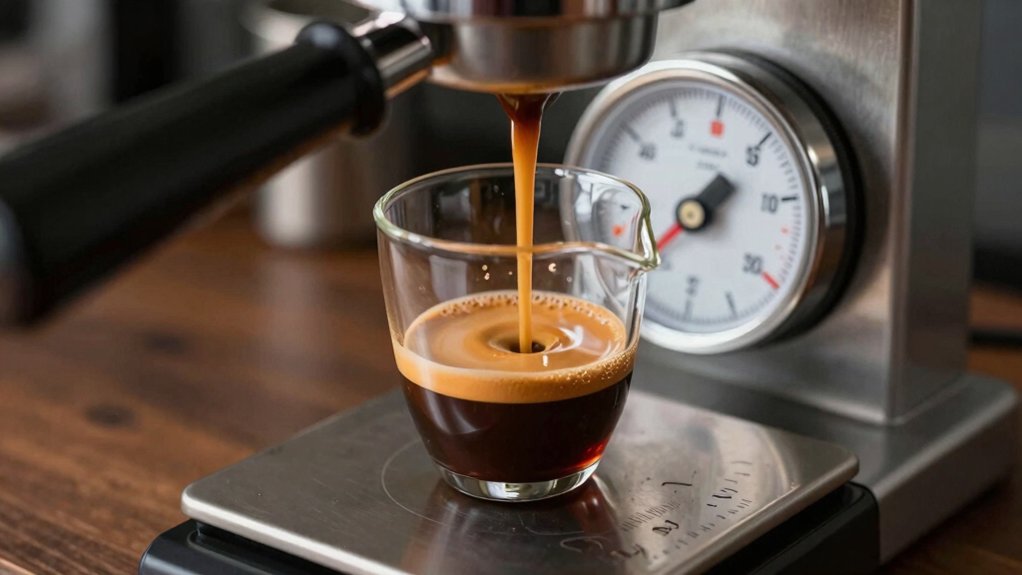
The 1:2 extraction ratio—16–18 g of coffee yielding 32–36 g of espresso—serves as your baseline for balanced strength and flavor. This foundational framework connects your dose, grind size, and extraction time into a cohesive system that you can adjust without losing equilibrium. When you maintain the 1:2 ratio, you’re preserving the crema, body, and sweetness that define a well-pulled shot. However, understand that larger doses can increase extraction even at the same 1:2 target, so you’ll need to compensate by adjusting your grind size or extraction time accordingly. Your typical 25–30 second extraction window works within this framework, balancing acidity against bitterness. By anchoring yourself to the 1:2 ratio, you gain a reliable reference point from which you can confidently dial in any coffee. ATC temperature compensation plays a crucial role in maintaining accuracy across different brewing environments, ensuring consistent results.
Why Grind Size Controls Shot Speed?
You control shot speed primarily through grind size, which directly affects how water moves through your puck by altering particle density and surface area. When you adjust grind fineness, you’re essentially tuning puck resistance to hit your target shot duration—finer grinds slow water’s passage and extend extraction time, while coarser grinds accelerate flow and shorten it. Understanding how particle size influences both resistance and extraction efficiency lets you dial in the balance between achieving proper extraction and maintaining your ideal 25–30 second pull. The choice of grind size also interacts with the equipment you use, including the type of filtration and brew method to achieve consistent results Stainless steel spoons and durable tools that support steady practice.
Puck Resistance And Flow
Espresso’s flow rate isn’t random—it’s determined by the resistance your coffee puck creates against the pump’s pressure. You control this dynamic through grind size, which directly influences extraction time and shot quality.
Here’s how puck resistance governs your shots:
- Finer grinds increase surface area and density, slowing water penetration and lengthening extraction time
- Coarser grinds reduce resistance, allowing faster flow and shorter shot times
- Optimal resistance keeps shots within the 25–30 second window for balanced extraction
- Uneven distribution or clumping bypasses puck resistance entirely, creating channeling and under-extraction
Your grinder-machine pairing determines how sensitive flow rate becomes to grind adjustments. Small changes yield noticeable differences in timing and flavor payoff, making precise grind calibration essential for consistent espresso. Puck Resistance
Adjusting For Shot Duration
Once you’ve dialed in your grind size, the real test comes during the pull—watching how fast or slow water travels through your puck tells you whether you’re hitting that 25–30 second sweet spot. If your shot rushes through in 15 seconds, you’re under-extracting; dialing finer increases surface area and slows flow, boosting your extraction rate toward balance.
Conversely, a sluggish 40-second pull signals over-extraction—grinding coarser reduces resistance and accelerates water flow. Remember that grind size interacts with tamping consistency and dose, so minor adjustments amplify effects on shot duration. You’ll recognize proper extraction when blonding occurs around 25–30 seconds, indicating you’ve maximized flavor without bitterness or sourness.
Particle Size And Extraction
The foundation of shot speed lies in particle size—grind finer, and you’re multiplying the surface area water contacts, which naturally slows its passage through the puck and extends extraction time. You’re working within a narrow window where contact time directly determines what gets dissolved.
Finer particles increase resistance, forcing water to spend more time navigating the bed. Coarser particles accelerate flow, reducing contact time and extraction intensity. Espresso’s 25–30 second requirement demands precision—too coarse and you’ll under-extract; too fine and you’ll choke the shot. Your grind size adjustments must account for roast level and equipment variables, since puck temperature and channeling shift how the same grind performs. Silicone gaskets and seals in the group head play a role in maintaining consistent pressure and preventing leaks that could alter extraction dynamics. You’re essentially controlling extraction by controlling the speed water moves through your grounds.
How Temperature and Pressure Shape Extraction
How do you balance bitterness against brightness in your cup? Temperature and pressure work together to shape extraction kinetics in ways that directly affect your final flavor profile. The right setup can also influence how consistently you achieve that balance across different beans and grinds, helping you maintain your preferred profile with repeatable results. temperature control and pressure stability together set the stage for reliable extractions.
Dose Adjustments and Their Cascading Effects
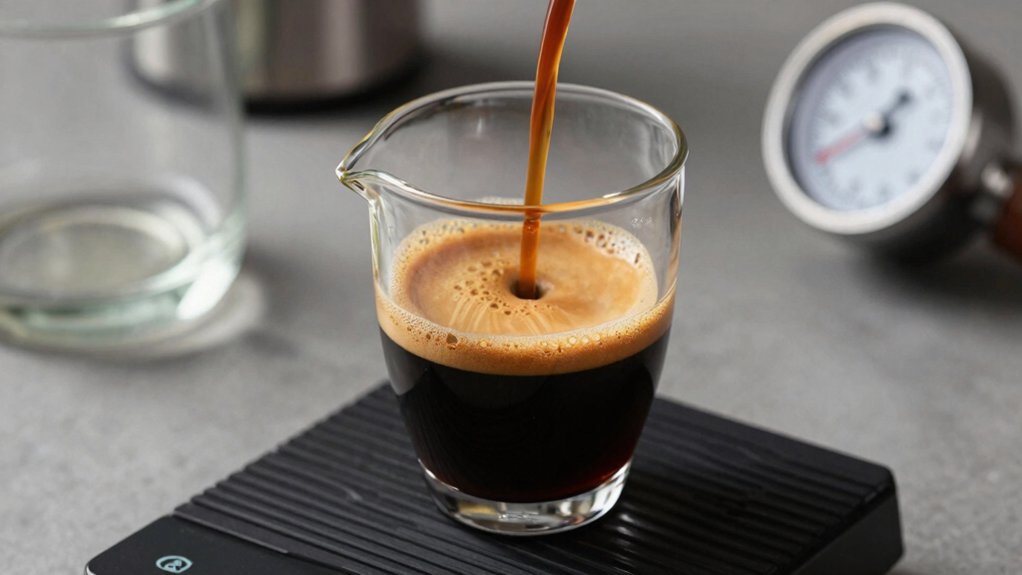
Why does adjusting your dose from 16g to 20g feel like it transforms your entire shot? You’re not imagining it—you’re triggering a cascade of changes that reshape your entire brew.
When you increase dose, you’re fundamentally altering how water interacts with coffee grounds:
- Puck resistance rises, slowing water flow and extending extraction time naturally
- Total dissolved solids (TDS) increase, producing a stronger body in your cup
- Grind size consistency becomes critical, since a denser bed amplifies any inconsistencies
- Tamping precision matters more, as small deviations compound through the thicker coffee bed
Even maintaining your 1:2 ratio, a higher dose shifts your effective extraction window. Your machine’s basket design interacts with this new density differently, demanding adjustments to grind size and tamping technique to stay dialed in. Grinder design
Diagnosing Extraction Problems: Fast, Slow, or Balanced
Once you’ve dialed in your dose, the next critical skill is reading what your shot’s telling you. Your extraction time acts as your primary diagnostic tool. A fast shot—finishing in 15–20 seconds—signals coarse grind, insufficient dose, or weak tamping, resulting in sour, underdeveloped flavors.
Conversely, slow extractions exceeding 40 seconds stem from fine grind, excessive dose, or over-tamping, producing ashy bitterness.
You’re aiming for that sweet spot: 25–30 seconds yielding golden crema and harmonious sweetness. This balanced window indicates your grind size, dose, and tamping are working together properly. Pay attention to your palate—sourness confirms under-extraction, while burnt notes reveal over-extraction. By correlating taste with timing, you’ll quickly identify which variable needs adjustment. Additionally, selecting from the broad range of customizable options offered by modern machines—such as the 100,000+ drink combinations and precision milk frothing on Terra Kaffe TK-02—can help fine-tune flavor balance across different profiles and milks. Extraction control
Your First Dial-In: Grind, Time, and Dose in Order
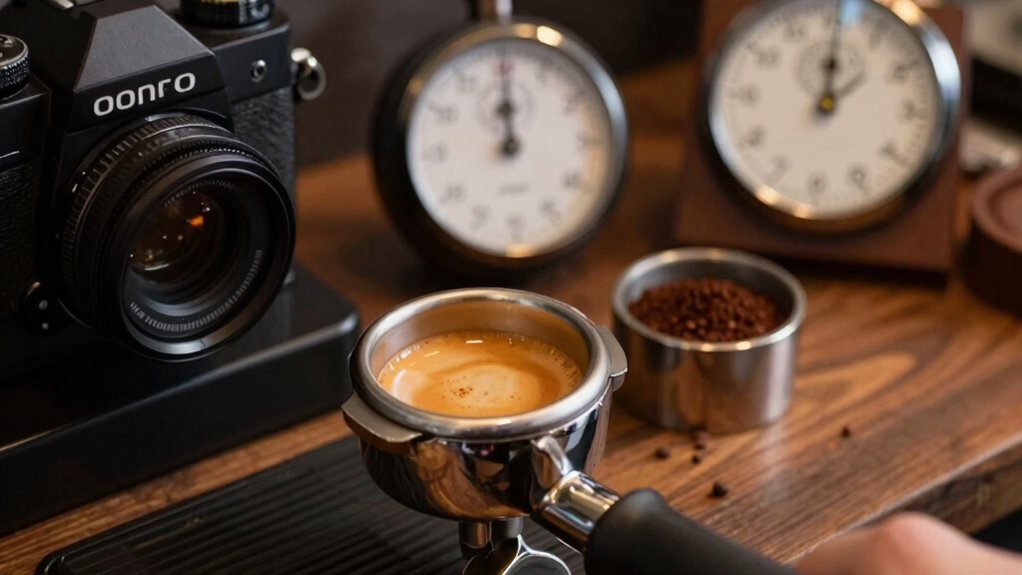
Now that you’ve learned to diagnose extraction problems, it’s time to put those skills into practice with your first dial-in session. You’ll adjust three variables systematically to achieve balanced extraction within your 25–30 second target window.
- Start with grind: Use this as your primary control—finer grinds slow flow and increase extraction, while coarser grinds speed it up.
- Monitor time: Pull shots and note their duration; if you’re running fast (15 seconds), grind finer; if slow (40 seconds), grind coarser.
- Lock in dose: Begin with 16–18 g for your 1:2 ratio, yielding 32–36 g output.
- Fine-tune together: Grind adjustments affect time and dose interaction, so evaluate all three variables as an interconnected system rather than isolation.
Water Quality’s Impact on Extraction Flavor
You’ve dialed in your grind, time, and dose—but there’s another variable that quietly shapes every shot you pull: water quality. The minerals in your water directly influence extraction speed, crema stability, and flavor complexity. Aim for 40–125 ppm total dissolved solids to balance sweetness with clarity.
| Water Type | TDS Level | Effect on Extraction |
|---|---|---|
| Too soft | <40 ppm | Under-extraction, muted complexity |
| Optimal | 40–125 ppm | Balanced sweetness, clean flavor |
| Moderately hard | 125–200 ppm | Slower extraction, potential astringency |
| Very hard | >200 ppm | Scale buildup, bitter notes |
| Filtered tap | Variable | Removes sediments, improves clarity |
Hard water slows extraction and dulls your espresso’s brightness, while soft water fails to convey the mineral sweetness you’re after. Regular descaling and filtered ground coffee water maintain consistent flavor profiles and protect your machine’s longevity.
Pre-Infusion and Tamping for Consistent Extraction
Pre-infusion and tamping form the foundation of repeatable espresso shots. You’ll achieve consistent extraction by mastering these two variables.
Here’s how to optimize your technique:
- Apply pre-infusion for 3–10 seconds at low pressure to wet grounds evenly before full extraction
- Tamp with steady, level force to prevent channeling and irregular flow through your puck
- Use spring tampers or self-leveling tools to improve shot repeatability and reduce grind adjustments
- Adjust grind or tamp pressure when shots run fast—pre-infusion alone won’t fix flow resistance issues
Beginners should disable pre-infusion initially until your workflow improves. Once you’ve developed tamping consistency, you’ll notice extraction becomes more uniform. Factory presets help, but your technique matters most. Combine proper tamping with measured pre-infusion, and you’ll eliminate variables that cause inconsistent shots.
Putting It Together: Your Weekly Dialing Checklist
You’ll establish daily consistency by tracking your grind, dose, and tamp adjustments on a weekly checklist that logs baseline parameters against actual results.
Your routine practice window—just 30 minutes weekly—standardizes tamping pressure and distribution, cutting down the variability that creeps into shots when you’re working without structure.
Each session’s flavor notes and planned dial moves become your roadmap, turning random adjustments into deliberate refinements that compound over time.
Daily Consistency And Routine
How do you know if your espresso routine actually works? You establish daily consistency through deliberate repetition and measurement.
- Standardize your workflow – Use identical procedures for dose, grind size, distribution, and tamping each session to isolate what actually changes your shot.
- Lock down your baseline – Dial in with 9 bars of pressure, a 1:2 dose ratio, 92–93°C water, and 25–30 seconds extraction time as your reference point.
- Track minimal variables – Reduce grind size, dose, and tamping force fluctuations so consistency builds naturally over weeks, not days.
- Log everything – Record shot time, crema color, and taste notes to spot patterns and recognize when adjustments improve your espresso rather than merely changing it.
Grind, Dose, And Tamp Adjustments
Once you’ve locked in your baseline routine, the real work begins: adjusting grind, dose, and tamp in concert to dial in shots that taste balanced rather than sharp or flat.
You’ll find that grind size and dose interact directly—a finer grind with your fixed dose increases puck resistance, lengthening extraction time, while a coarser grind speeds it up. Aim for roughly 27 seconds. Your tamp consistency matters equally; level, even pressure slows water flow uniformly across the puck, reducing channeling and ensuring balanced extraction.
Change one variable at a time. Adjust grind incrementally, monitor your extraction time, then tweak dose to fine-tune resistance. This methodical approach reveals how each adjustment affects flavor, helping you build shots that eliminate acidity and bitterness simultaneously.
Frequently Asked Questions
What Are the Variables for Espresso Extraction?
You’ll control dose, grind size, water temperature, brew time, and pressure to shape your espresso’s extraction yield and flavor balance. You’ll adjust these core variables to reach your desired taste profile.
What Are the Factors That Affect Espresso Extraction?
You’ll control extraction through dose, grind size, brew time, roast level, water temperature, pressure, and beverage weight. You’re adjusting how quickly flavors dissolve and how balanced your shot tastes.
What Is the 15-15-15 Rule for Coffee?
You’re aiming for roughly 15 seconds of pre-infusion, 15 seconds of contact time, and 15 seconds of post-infusion. You’ll adjust your grind, dose, and tamp to achieve consistent extraction flow and balanced flavor development.
What Are the Three Factors That Can Affect the Extraction Time?
You’ll find that grind size, dose, and puck resistance are the three factors that most directly affect your extraction time. You can manipulate each to shorten or lengthen how long water contacts your coffee grounds.
In Summary
You’ll find that mastering extraction variables transforms your espresso from mediocre to exceptional. By controlling grind size, temperature, and dose, you’re crafting consistent shots that highlight your beans’ best flavors. You don’t need perfection—you need understanding. Start with the 1:2 ratio, dial in your grind, then adjust from there. You’ll quickly develop the intuition to troubleshoot any extraction problem that comes your way.


