

You’ll master espresso shot volume and strength by controlling three variables: dose (ground coffee weight), yield (liquid espresso weight), and brew ratio (their relationship). The 1:2 ratio—where yield doubles your dose—creates balanced, repeatable shots within a 25–30 second extraction window. Grind size is your primary lever for adjusting extraction speed and flavor intensity. Combine this foundation with stable temperature and pressure settings, then dial in taste by making isolated adjustments. Understanding how these elements interact reveals the precision required for consistently excellent espresso.
Understanding Brew Ratio: Why It Shapes Your Shot
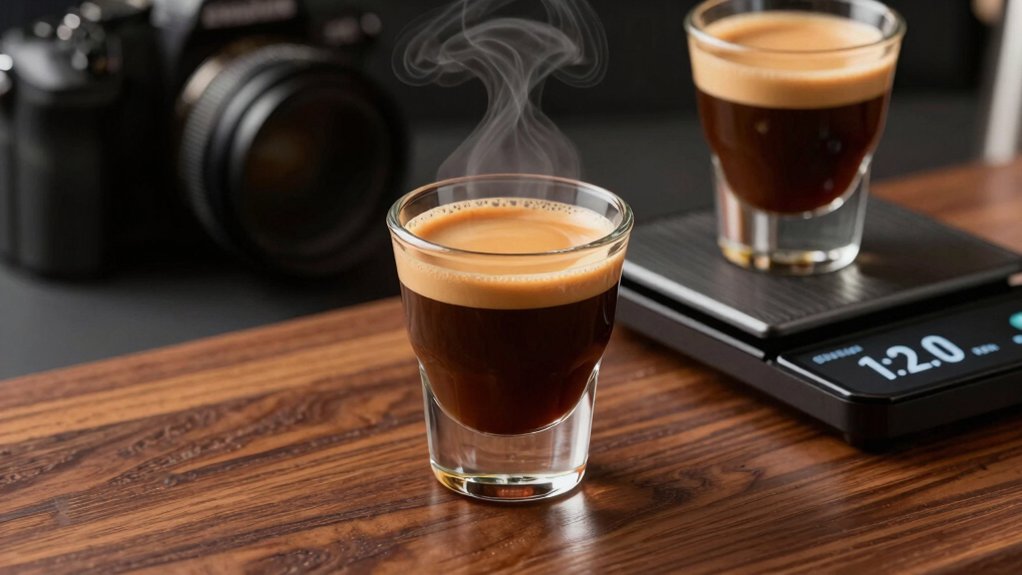
Why does your espresso taste different from shot to shot, even when you’re using the same beans and machine? The answer lies in your brew ratio—the relationship between your dose of ground coffee and the yield you pull into your cup.
You’ll measure this relationship by weight, not volume, because crema and extraction can skew visual measurements. A typical brew ratio like 1:2 means you’re pulling twice the weight of espresso as your initial dose. For a 20 g dose, you’d target 40 g of output.
This ratio directly shapes your shot’s taste and body. By dialing in your brew ratio consistently, you’ll account for roast level and bean hardness, producing repeatable, balanced espresso every time. Consistently tracking both dose and yield helps you compare results across different beans and setups, and many modern devices can assist with this precision data tracking for improved reproducibility.
Dose: The First Variable in Your Ratio
How do you start building a repeatable espresso recipe? You begin with dose—the weight of dry coffee in your portafilter, measured in grams. Your basket size determines your target dose. A 20g basket typically calls for 18.5g as a practical starting point, though common targets range from 7–10g for singles to 20–22g for triples.
Dose directly shapes your brew ratio and extraction potential. When you underfill your basket, you’ll encounter uneven extraction. Overfilling causes channeling and inconsistent flavors. Measuring your dose precisely lets you dial in recipes with confidence and match your intended brew ratios consistently.
The dose controls how many coffee solids are available for extraction, fundamentally influencing your shot’s yield and flavor balance. Get this variable right first, and everything else follows.
Yield: Measuring the Output Side of the Equation
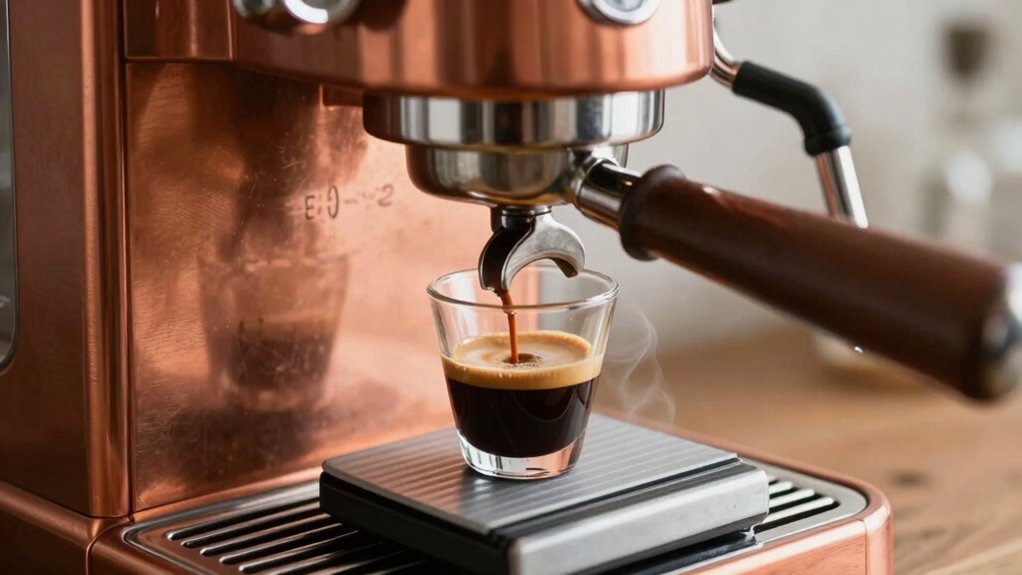
Once you’ve nailed your dose, the next critical variable is yield—the weight of liquid espresso that flows into your cup, measured in grams. You’ll measure yield with a scale instead of volume because crema and off-gassing distort volume-based estimates. This measurement guarantees accurate brew ratio control and repeatability across shots.
Your target yield establishes extraction balance. If your shot reaches target yield too quickly, grind finer to slow flow. Grind coarser to speed extraction. This adjustment keeps you within the ideal 25–35 second window, controlling both strength and flavor development. Bean Adapt Technology
The 1:2 Ratio: Why This Balance Works
As you move from simply hitting your dose to controlling your yield, the 1:2 ratio emerges as the goldilocks zone for espresso—not too concentrated, not too diluted.
This balance means your dose produces double its weight in espresso: 18 grams in yields 36 grams out. You’ll achieve full flavor extraction without excessive dilution that weakens body and complexity.
The beauty of this ratio lies in flexibility. You can extend extraction times or grind finer while staying within your 25–30 second window. A 20-gram dose producing 40 grams maintains consistency across shots, making it your reliability anchor.
Using a scale to verify both dose and yield eliminates guesswork, ensuring you hit your target repeatedly. This precision transforms espresso-making from guesswork into reproducible craft. For many setups, aiming for a precise espresso yield helps maintain consistency across different beans and grinders.
Hitting Your Extraction Window: 25–30 Seconds
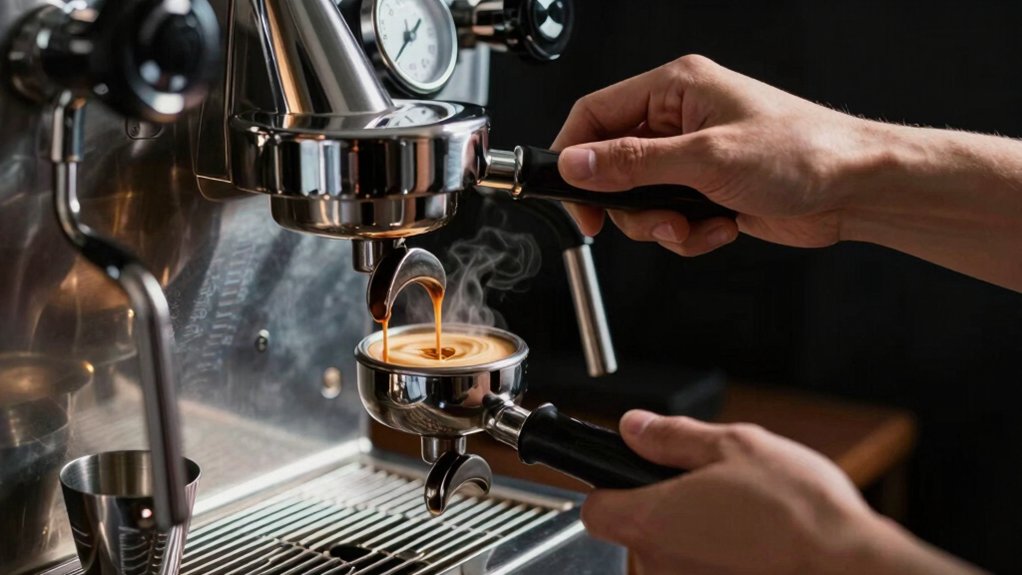
Why does timing matter so much in espresso extraction? You’re pulling a shot that’ll either taste flat or bitter if you miss your window. Aim for 25–30 seconds from first contact with water to finishing your extraction. This timeframe lets you balance sweetness, acidity, and body perfectly. Grind size adjustments directly influence yield and extraction speed, and the use of unbleached filters can further impact bitterness by removing oils filter quality. You’ll adjust your grind size to hit this target. If your extraction finishes under 25 seconds, grind finer to slow the water’s passage through the coffee. If it stretches beyond 30 seconds, grind coarser to speed things up. Your extraction time directly controls your yield quality—18.5 grams in, 37 grams out.
Stay consistent with your tamp pressure and maintain water temperature between 93–95°C. These variables keep you dialed in.
Grind Size: Your Primary Dial-In Lever
Grind size is your most powerful adjustment tool because it directly controls how fast water flows through your coffee bed, which then determines both your extraction time and flavor balance.
Use these adjustments to dial in your shot:
- Too fast (under 20 seconds): grind finer to increase resistance and slow water flow
- Too slow (over 35 seconds): grind coarser to decrease resistance and speed extraction
- Sweet spot (25–30 seconds): achieve balanced extraction with a medium-fine grind at your target brew ratio
- Consistency matters: maintain identical grind settings across pulls to produce stable, reproducible flavors
Small grind adjustments shift flavor dramatically by altering contact time between water and coffee. When you’re chasing a 1:2 ratio with consistent extraction time, grind size becomes your primary dial-in lever for hitting sweetness or reducing bitterness. Grind settings provide a structured path to dialing in both extraction time and flavor balance across different brewing methods.
Setting Temperature and Pressure: One-Time Calibration
You’ll establish your machine’s baseline by setting it to 200°F (93°C) and confirming 9 bars of pressure—this one-time calibration anchors all your future adjustments. Verify stability by pulling a 20g dose into 40g of espresso within 25–30 seconds while monitoring both your thermometer and pressure gauge to ensure they stay within 93–95°C and near 9 bars respectively. Once you’ve locked in these foundational parameters, you won’t need to recalibrate; instead, you’ll make only minor tweaks of ±1–2°C or ±0.5–1 bar to dial in roast-specific flavors.
Machine Baseline Calibration
Before you can dial in espresso recipes, your machine’s brew boiler temperature and pump pressure must align with factory specifications. This one-time calibration establishes your espresso baseline and prevents recipe drift.
Start by setting these foundational parameters:
- Temperature: Adjust your brew boiler to 200°F (93°C), staying within the 195–205°F range
- Pressure: Target 9 bars on your La Marzocco pump during extraction
- Test shots: Pull several shots and verify output weight matches your intended brew ratio (like 1:2 for a doppio)
- Documentation: Record all calibrated numbers for future reference
- Consistency check: After confirming stability across multiple extractions, confirm that the baseline remains stable when using different grounds or dose amounts. Precise calibration
Pressure And Temperature Stability
Why does your espresso taste inconsistent from shot to shot? Unstable temperature and pressure are likely culprits. You’ll achieve extraction consistency by committing to a one-time calibration approach: set your La Marzocco machine to 200°F (93°C) and 9 bars pressure, then leave them alone. Consistent data logging from a compatible scale can help verify that your grind size and dose remain steady, reinforcing the stability of your setpoints real-time readings. Temperature stability and pressure stability work together to minimize variability in extraction rate and contact time. This foundation makes your brew ratios repeatable and predictable. When adjustments become necessary, change only one parameter at a time—either temperature or pressure. This isolated approach lets you accurately attribute taste changes to specific modifications.
Taste-Driven Adjustments: When to Grind Finer or Coarser
Once you’ve dialed in your temperature and pressure, you’ll use grind adjustments to fine-tune flavor by controlling extraction speed and the sequence of compounds that reach your cup.
If your shot pulls too quickly or tastes flat, you’ll grind finer to slow flow and boost body; conversely, if it drags or turns bitter, you’ll grind coarser to accelerate extraction and reduce harshness.
When you switch roast profiles or origins, recalibrate your grind size first—before tweaking dose or timing—to maintain the balance your palate expects.
Extraction Speed and Grind Adjustments
How do you know when your grind needs adjusting? Watch your extraction speed and shot volume carefully. If you’re pulling a 30-second shot that yields 37 g but tastes sour, you’ve ground too coarse. Conversely, bitter notes signal over-extraction from a fine grind.
Your approach should be methodical:
- Adjust grind size in single notches only
- Monitor extraction time between 25–30 seconds
- Track output weight consistently with a scale
- Re-test after each adjustment to assess flavor changes
These grind adjustments directly impact how quickly water flows through your puck. Slower extraction from finer grounds risks bitterness, while faster pulls from coarse grinds produce sourness. By coupling extraction speed observations with taste feedback, you’ll dial in the sweetness and balance your espresso needs.
Flavor Sequence and Timing Cues
Understanding your espresso’s flavor progression is the key to knowing whether you should grind finer or coarser. Salts and acids emerge first during extraction time, followed by sugars, then bitterness—this sequence guides your adjustments. When your shot tastes sour, you’re catching the early compounds; grind finer to extend contact time and let sweetness develop. If bitterness dominates, you’ve over-extracted; grind coarser to speed things up. Your target extraction time sits between 25–35 seconds, where perceived sweetness and body typically emerge. Small grind size adjustments—even a single notch—shift your flavor balance immediately. By aligning grind size with your dose and yield, you’ll consistently hit that sweet spot where your shot tastes balanced and complete.
Dose and Roast Profile Considerations
Your roast profile fundamentally shapes which adjustments—finer or coarser grinds—will actually improve your shot. Darker roasts demand smaller brew ratios and finer grinds to build body, while lighter roasts thrive with larger ratios and slightly coarser grinds to preserve acidity and clarity.
When targeting stronger shots, you’ll grind finer to slow extraction and maintain your 25–30 second window at a 1:2 to 1:2.5 dose-to-yield ratio. If extraction stalls, adjust coarser to regain balance.
Key adjustments for dose and roast considerations:
- Increase grind fineness incrementally if your shot tastes thin or weak
- Maintain an 18–20 g dose for consistent baseline pulls
- Shift toward 1:2.5–1:3 ratios to emphasize sweetness in lighter roasts
- Monitor even ±1 g dose changes, which significantly alter perceived strength
Frequently Asked Questions
How Often Should I Replace My Espresso Machine’s Group Head Gasket and Shower Screen?
You should replace your group head gasket every 6-12 months with regular use, depending on your machine’s usage frequency. You’ll want to clean your shower screen weekly and replace it annually to maintain prime espresso extraction and machine performance.
Can I Achieve Proper Espresso Extraction Using Pre-Ground Coffee From a Bag?
You’ll struggle achieving proper espresso extraction with pre-ground coffee because it loses aromatics quickly and won’t compact consistently. You’ll get better results grinding beans immediately before brewing for ideal flavor and crema development.
What’s the Ideal Way to Clean My Portafilter Between Consecutive Espresso Shots?
You’ll purge the group head first, then knock out the puck firmly. Wipe the portafilter basket with a damp cloth, dry it thoroughly, and backflush if your machine allows it to remove residual oils.
How Does Altitude Affect Espresso Extraction and Should I Adjust My Parameters?
You’ll need to adjust your parameters at higher altitudes because lower air pressure reduces water’s boiling point, speeding extraction. You should increase your grind fineness and potentially raise water temperature to compensate.
Why Does My Espresso Taste Different on Humid Versus Dry Days?
You’re tasting differences because humidity affects your coffee grounds’ moisture content, which changes how water flows through them during extraction. You’ll need to adjust your grind size and tamping pressure to compensate for these seasonal variations.
In Summary
You’ve now got the fundamentals to dial in your espresso. Start with a consistent brew ratio, nail your grind size, and you’ll hit that sweet extraction window every time. You’ll taste the difference immediately. Keep adjusting based on what’s in your cup, not just the numbers on your scale. Your palate’s your best tool—trust it, and you’ll master espresso.


