
Pick fresh, high‑quality beans and note the roast date—ideally within two weeks—to keep brightness and acidity. Choose an origin that matches your desired flavor (Ethiopia for fruit, Colombia for balance, Brazil for nutty depth) and grind just before brewing. Use a burr grinder, digital scale, and a temperature‑controlled kettle to hit 90‑96 °C, then follow a 1:15 coffee‑to‑water ratio with a consistent pour. Adjust grind size, brew time, and agitation to fine‑tune sweetness and body, and log each batch’s variables and notes. Keep your gear clean daily and deep‑clean monthly; a simple journal will reveal patterns and help you perfect your cup. Continue exploring, and you’ll uncover deeper techniques.
Choose Fresh, High‑Quality Beans for Artisan Coffee Brewing
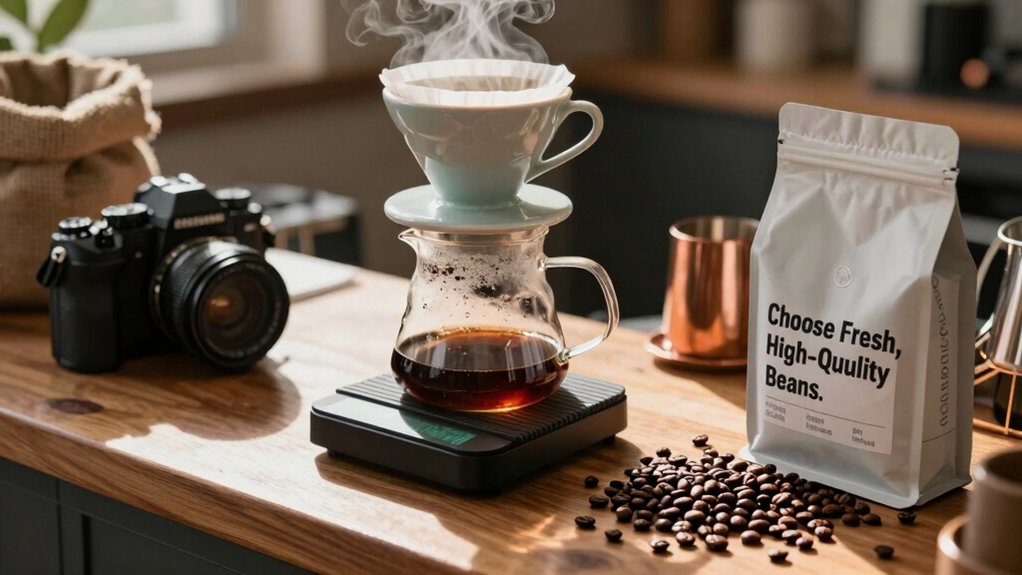
Ever wondered why a great cup starts with the beans? You’ll notice that fresh beans hold the bright acidity and nuanced aromatics you crave. Check the roast date; if it’s within the last two weeks, the oils are still vibrant and the flavor hasn’t dulled. When you buy, prioritize bean freshness over convenience—skip the stale supermarket bags and seek out roasters who label each batch. A recent roast date guarantees that the natural sugars and acids remain intact, delivering a café‑quality extraction at home bean freshness and aligns with the idea that measurement markings help you pour with precision.
Select the Right Roast Date & Origin to Match Your Flavor Profile
You’ll want beans roasted within the past two weeks to capture peak flavor and freshness. Pick an origin that mirrors your taste—Ethiopia for bright fruit, Colombia for sweet balance, Brazil for nutty richness—and match it with a roast level that highlights those notes. Once you’ve nailed a profile, experiment with single‑origin beans or blends to expand your palate while staying clear of stale supermarket coffee. Additionally, consider aligning your roast date with your preferred coffee-scented ambiance, since certain aromas can pair particularly well with specific candle notes scent diffusion concepts.
Fresh Roast Timing
When you choose beans roasted within the last two weeks, you lock in peak flavor and aroma for your brew. Fresh roast timing matters because the volatile oils that give coffee its brightness degrade quickly; the sooner you grind, the more you preserve that freshness. Store your beans in an airtight container, away from light and heat, to extend that freshness until you’re ready to brew. Timer modes help you optimize extraction by aligning grind size and brew time with the roast date and origin for consistent results.
Origin Flavor Alignment
Which roast date and origin will best echo the flavor you crave? Aim for beans roasted within two weeks; freshness preserves the nuanced flavor you’re chasing. If you love bright, citrusy notes, choose an Ethiopian origin; for a sweeter, balanced cup, go Colombian; for a rich, nutty profile, pick Brazilian. Once you pinpoint your preferred flavor, experiment with single‑origin beans or blends to fine‑tune the profile. Keep a log of origin, roast level, and how each batch tastes, noting shifts in acidity and sweetness. Pair your chosen origin with the appropriate grind size and brewing method—coarse for French press, medium for drip, fine for espresso—to maximize extraction and let the flavor shine. Roast Date Best Practice Tracking freshness and roast date helps you maintain flavor consistency across batches.
Gear Up: Why a Burr Grinder, Scale, and the Right Brewer Matter
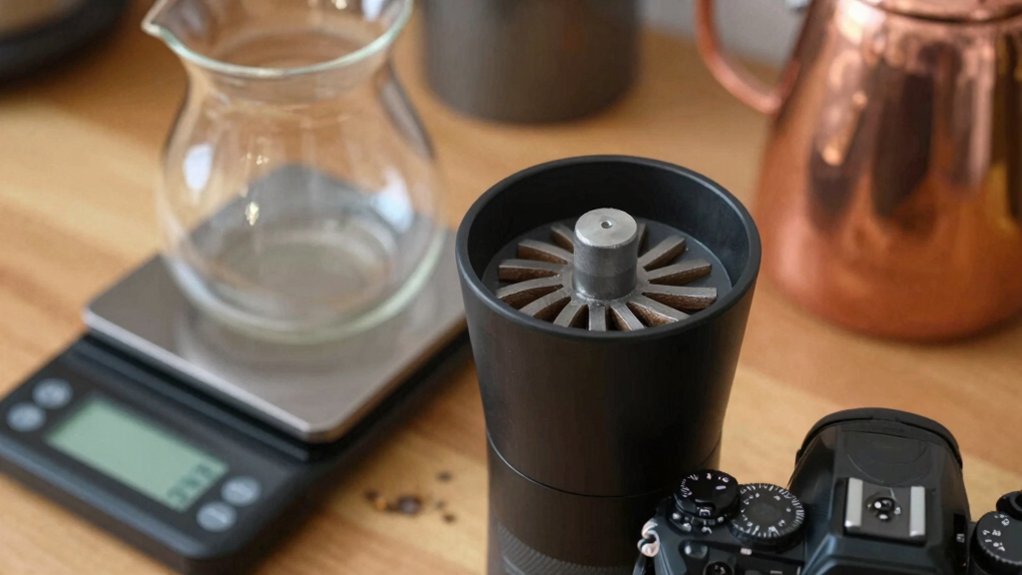
You’ll notice a burr grinder gives you a uniform grind that eliminates the uneven extraction you get from blade grinders. Pair it with a digital scale, and you can hit exact coffee‑to‑water ratios—like 1:15—for repeatable results. Choosing the right brewer for your grind size and method then lets you extract the flavors you’re after, keeping variables under control. Date tracker
Consistent Burr Grind
A burr grinder gives you uniform particle size, eliminating the uneven extraction that blade grinders produce. When you set the grind size on your burr grinder, you lock in grind consistency that translates into predictable flavor. Pair the grinder with a digital scale, then weigh coffee and water for each brew; the scale removes guesswork and lets you repeat the exact ratio every time. Choose the right size for your method—coarse for French press, medium for pour‑over, fine for espresso—and adjust the burr grinder until the extraction feels balanced. Clean the burr regularly, recalibrate the settings, and you’ll capture café‑quality results cup after cup without over‑ or under‑extraction. Regular maintenance supports long‑lasting performance and helps ensure foam texture and temperature control stay consistent across uses foam texture consistency.
Precise Coffee Measurements
Uniform grind size sets the stage, but without exact coffee‑to‑water ratios the brew can still miss the mark. A digital scale lets you log each gram, so you can hit a consistent brew ratio every time. Weigh 18 g of coffee and 270 g of water for a 1:15 ratio, then adjust within the 1:13‑1:15 window to suit your taste. Precise measurements eliminate guesswork, letting you replicate the same extraction across French press, AeroPress, pour‑over, or espresso. Pair the scale with a thermometer, and you’ll know when water hits the optimal temperature for your chosen grinder. Investing in these tools transforms hobby brewing into a repeatable, café‑level ritual tooling essentials and complements the use of high‑quality Chemex brewers for clean, flavor‑focused cups.
Optimal Brewer Selection
Why settle for a one‑size‑fits‑all brewer when the right match can unleash your coffee’s full potential? Pair your burr grinder with a digital scale, then match the brewer to your preferred method. The grinder gives uniform particles, the scale guarantees precision, and the brewer translates those variables into flavor. When each component works together, you eliminate uneven extraction and achieve café‑quality results at home. Regular cleaning and calibration keep your setup reliable, so every cup reflects the precision you’ve built into the process. Grinder Consistency ensures uniform grind size, which supports repeatable extraction across brews.
Match Grind Size to Your Brewing Method for Consistent Extraction
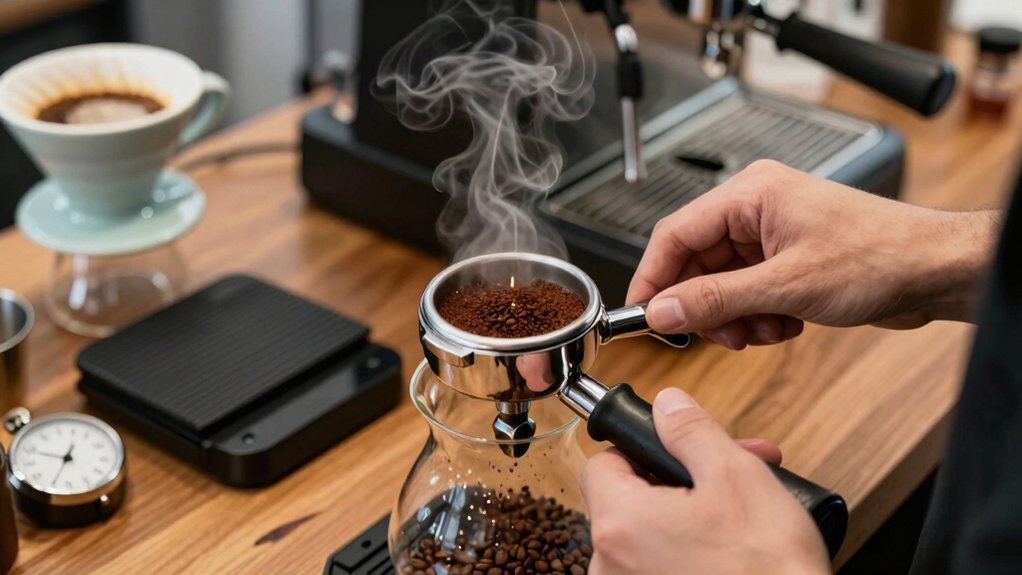
Ever wondered why your pour‑over sometimes tastes weak while your espresso bursts with flavor? You can fix that by matching grind size to your brewing method. A burr grinder gives you uniform particles, so you hit consistent extraction every time. Coarse grinds work for French press and cold brew, medium for pour‑over, AeroPress, and drip, and fine for espresso. If a brew feels flat or sour, tweak a notch finer for pour‑over or coarser for drip, then log the change.
| Method | Recommended Grind |
|---|---|
| French press | Coarse |
| Cold brew | Coarse |
| Pour‑over | Medium |
| Drip | Medium |
| Espresso | Fine |
Calibrate, record, repeat—your flavor profile becomes reliable and delicious.
Calculate the Ideal Water‑to‑Coffee Ratio for Balanced Taste
Wondering how to hit the perfect balance between strength and clarity? Start with a 1:15 coffee‑to‑water ratio for pour‑over, then tweak it until the cup sings. Measure every gram on a digital scale; consistency breeds repeatable flavor. Record each batch in a tasting journal so you can compare lighter 1:15 brews with fuller 1:13 or 1:14 attempts. Pair your chosen ratio with a medium grind and appropriate brew time to hit the sweet spot of extraction.
- Use 1:15 for a bright, delicate cup.
- Drop to 1:14 when you want a richer body.
- Go to 1:13 for a bold, concentrated brew.
Adjust, taste, and note results to craft a personalized, balanced pour‑over profile.
Control Water Temperature: Tools for 90‑96 °C Precision
You’ll get the most consistent brew by using a temperature‑controlled kettle that hits 90‑96 °C on cue. If you rely on a regular kettle, let the water sit about 30 seconds after boiling and double‑check the reading with a calibrated thermometer.
Keep your thermometer’s accuracy in check, and you’ll avoid under‑ or over‑extraction every time.
Temperature‑Controlled Kettle
How can you guarantee the perfect extraction every time? You rely on a temperature‑controlled kettle to hit 90‑96 °C with pinpoint accuracy. This temperature control eliminates guesswork, letting you focus on flavor rather than heat. When a smart kettle isn’t on hand, you can still achieve a boil‑to‑temp approach: bring water to a rolling boil, then wait 30 seconds before pouring. Consistent heat delivers balanced sweetness and body, whether you’re pulling a precision pour‑over or an AeroPress.
- Set the desired temperature on the kettle and let it stabilize before brewing.
- Use the boil‑to‑temp fallback for manual control when the kettle drifts.
- Record the exact temperature each session to compare grind sizes and coffee beans.
Thermometer Calibration Tips
A temperature‑controlled kettle gives you the exact 90‑96 °C range you need, but even the best kettle can drift, so you must trust a calibrated thermometer.
Start by testing your thermometer in ice‑water (0 °C) and boiling water (adjusted for altitude). Note any deviation and apply the correction factor in your brewing log.
When you pour, watch the water temperature closely; a few degrees off can ruin brewing consistency.
Keep a spare thermometer on hand and repeat the calibration weekly, especially after a kitchen move or a temperature shock.
Record each reading alongside grind size and brew time, then compare batches to fine‑tune your 90‑96 °C profile.
This routine ensures reliable water temperature and repeatable flavor.
Pre‑Boil Cooling Method
Ever wonder how a simple 30‑second pause can lock in the perfect 90‑96 °C brew? You just boiled water, now let it sit for about half a minute. That brief pre‑boil cooling drops the temperature from 100 °C to the sweet spot where extraction is balanced. Use a temperature‑controlled kettle or a reliable thermometer to hit the target window; if you lack a smart kettle, the 30‑second rule works just as well. By keeping water temperature within 90‑96 °C, you avoid bitterness from over‑extraction and prevent under‑extraction that dulls flavor. Consistent extraction becomes second nature when you repeat this step each batch.
- Measure precisely, then wait 30 seconds.
- Aim for 90‑96 °C before pouring.
- Maintain this routine for repeatable results.
Step‑by‑Step Pour‑Over Routine for a Clean, Bright Cup
Ready to nail a clean, bright cup? Start by measuring a 1:15 coffee‑to‑water ratio on a digital scale. Use a medium grind size for consistency, then rinse your paper filter and pre‑wet it in the dripper. Heat water to 90–96 °C (195–205 °F). Begin the pour‑over by adding just enough water to saturate the grounds—this is the bloom—wait 30‑45 seconds. Continue pouring in a slow, circular motion, maintaining an even flow. Add the remaining water in stages, keeping the water level steady to avoid channeling. After the brew finishes, taste and note any adjustments needed in grind size, uniformity, or pour rate for the next cup. This routine delivers a bright, clean flavor profile.
Master the French Press: Stir, Steep, and Press for Full‑Body Flavor
Want a full‑body cup that’s rich and smooth? Start by preheating your French press carafe, then add a coarse grind and pour 90–96 °C water. Immediately stir the grounds to wet them evenly, ensuring consistent extraction. Let the brew steep for four minutes—no more, no less—so the flavors develop fully. When time’s up, press gently, decant right away, and enjoy within minutes for peak aroma and mouthfeel.
- Stir right after pouring to avoid channeling and achieve uniform saturation.
- Steep exactly four minutes at the right temperature to balance body and acidity.
- Press steadily, then decant promptly to prevent over‑extraction and bitterness.
AeroPress Inverted Technique: Boost Strength & Complexity
After mastering the French press’s steady stir‑steep‑press rhythm, you can crank up body and complexity with the AeroPress inverted method. Start by placing the plunger at the bottom, then add your coffee and hot water. Stir briefly, then let the grounds steep for 1–2 minutes—no drip, just pure contact that boosts extraction. Attach the filter cap, flip the chamber, and press quickly into a cup or carafe. Using a finer grind and a higher coffee‑to‑water ratio in this inverted method yields a richer, more robust cup than the standard setup. Finish by rinsing the chamber and backflushing with water to clear any oil residue, keeping each brew clean and flavorful.
Tweak Brew Variables: Adjust Ratio, Time, and Agitation
How does tweaking the coffee‑to‑water ratio, brew time, and agitation reshape your cup? You’ll notice that a 1:15 ratio yields a balanced brew, while moving to 1:14 or 1:13 deepens body and acidity. Adjusting the time by a few seconds can shift sweetness toward brightness or darkness. Changing agitation—whether you stir gently during extraction or keep the flow steady—modulates extraction uniformity and flavor harmony. Keep a journal, record each variable, and compare results to fine‑tune your personal profile.
- Small ratio tweaks (±1 g coffee or ±5 ml water) reveal subtle taste shifts.
- Varying brew time isolates its impact on sweetness and mouthfeel.
- Different agitation methods expose how extraction dynamics affect balance.
Troubleshoot Common Off‑Flavors in Artisan Coffee
Ever noticed a sour bite, bitter edge, or grassy note in your cup? Those clues point to under‑extraction, over‑extraction, or immature beans. Start by tweaking grind size: a finer grind slows extraction, reducing sourness, while a coarser grind prevents bitterness.
Next, check water temperature; aim for 195‑205 °F (90‑96 °C). Too low leaves a thin, sour profile, too high extracts harsh, burnt flavors.
Adjust brew time accordingly—shorten it if you taste bitterness, lengthen it for a balanced body. If off‑flavors linger, replace the beans with a fresh roast, clean your grinder and brewer, and verify water quality. By isolating each variable, you’ll pinpoint the source and restore your coffee’s true character.
Maintain Your Artisan Brewing Gear Daily & Monthly
Do you know that a few simple daily habits can keep your artisan brewing gear performing like new? You’ll notice fresher cups when you rinse the brewer after each brew, discard spent filters promptly, and wipe the grinder’s burrs. Consistent equipment cleaning protects flavor and extends lifespan, while a disciplined brewing routine builds confidence.
- Grinder hygiene: brush out residual grounds nightly to stop stale notes from seeping into the next shot.
- Daily equipment cleaning: rinse all parts immediately after use, wiping away oils and coffee residue.
- Monthly deep‑clean: soak the brewer in a vinegar solution, then scrub seals and filters for thorough sanitization.
Stick to these steps, and your gear will stay as crisp as the first brew you ever made.
Document Your Artisan Coffee Experiments in a Personal Journal
Keeping your gear spotless sets the stage for meaningful experimentation, and the next step is to capture each brew’s story in a personal journal. Open a coffee journal and start a brew log for every session. Write down coffee weight, water weight, grind size, brew time, and water temperature. Include bean origin, roast date, roast level, and whether it’s a single origin or blend. Note grinder model, brewer type, filter size, and kettle design so you can link gear to flavor. Add sensory notes—aroma, flavor, sweetness, acidity, body, aftertaste—and give each attribute a score. Review entries every two to four weeks, spot patterns, and tweak variables to hone a repeatable, preferred profile.
Frequently Asked Questions
How Does Altitude Affect Coffee Extraction Consistency?
You’ll notice that higher altitude lowers boiling point, so water extracts coffee slower; you must adjust temperature, brew time, or grind size to keep extraction consistent, otherwise flavors become weak or over‑extracted.
Can I Use Filtered Tap Water Without Mineral Adjustments?
You can use filtered tap water, but if it lacks minerals you’ll miss flavor balance and extraction consistency; consider adding a pinch of calcium carbonate or a commercial mineral blend for ideal results.
What’s the Ideal Brewing Time for a 30‑Gram Dose?
You should steep the 30‑gram dose for about three minutes, then press and rinse briefly. This timing extracts balanced flavor, avoids over‑extraction, and yields a smooth, aromatic cup every time.
Do Different Coffee Bean Shapes Influence Grind Uniformity?
Yes, you’ll notice that irregularly shaped beans create uneven particle sizes, so the grind becomes less uniform. Round, consistent beans tend to produce a more even grind, improving extraction and flavor balance.
How Often Should I Replace the Burrs on My Grinder?
You should replace your burrs every 300–500 hours of use, or when you notice uneven grind, dull edges, or a drop in extraction quality; regular checks keep flavor consistent and prevent motor strain.
In Summary
By mastering fresh beans, precise ratios, and the right gear, you’ll turn every cup into a personal masterpiece. Keep tweaking grind size, brew time, and agitation until the flavors sing, and log each experiment to track progress. Regular maintenance guarantees consistency, while troubleshooting sharpens your palate. With these artisan techniques in your toolkit, you’ll consistently brew coffee that’s rich, balanced, and unmistakably yours.


