
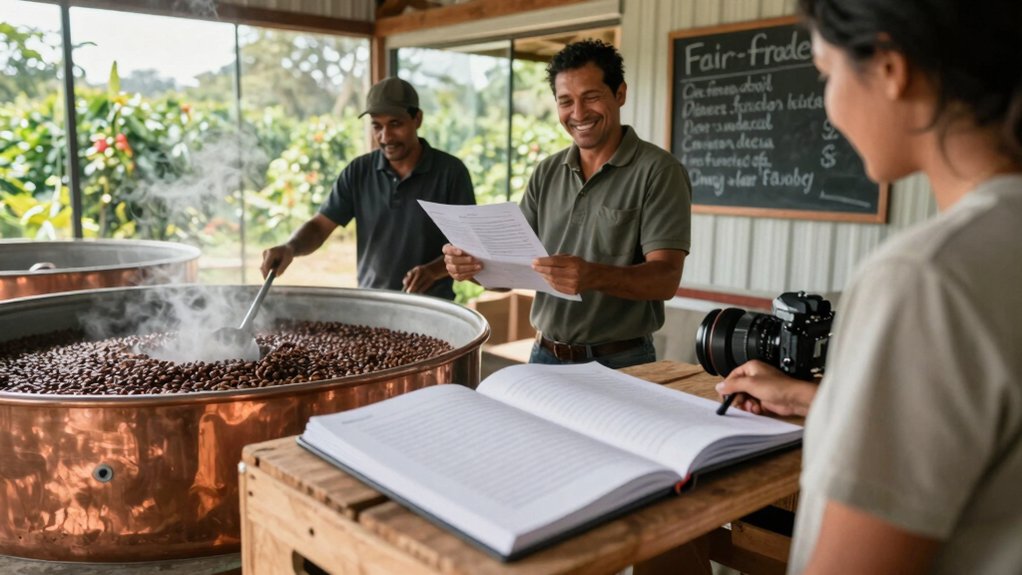
Start by defining direct‑trade coffee and why transparency matters, then map every step from farm gate to cup. Choose a farmer with ethical, sustainable practices and negotiate a base price plus quality premiums that beat certification minimums. Draft a clear agreement covering lot IDs, cupping scores, and payment milestones. Use a shared ledger to record prices, certifications, and quality data in real time. Share farm stories, virtual tours, and packaging details to build consumer trust, and set up quarterly reviews to keep the partnership open and accountable—more details await if you keep going.
Define Direct‑Trade Coffee and Explain Why Transparency Matters

What exactly is direct‑trade coffee? You partner straight with a farmer or cooperative, skipping middlemen to secure higher quality and fairer pay. This Direct Trade model means you control Sourcing, set premiums tied to post‑harvest quality, and invest in sustainable practices instead of relying on fixed certifications. Transparency becomes the backbone of that relationship: you disclose farm names, locations, processing methods, and the price paid at origin. When you share those details openly, consumers can trace each dollar from the farm gate to the export dock, building trust and accountability. Transparent communication also lets you plan supply, give feedback, and fund equipment upgrades, ensuring long‑term growth for both roaster and farmer. Traceability framework supports clear attribution of value along every step of the supply chain.
Map the Entire Direct‑Trade Supply Chain From Farm Gate to Consumer Cup
You’ll start by sketching a traceability roadmap that links every lot from the farm gate to the consumer cup.
Then you’ll set up a pricing transparency ledger that records the exact pound‑price paid at origin and every subsequent transaction.
Finally, you’ll embed quality‑assurance protocols that capture cupping scores, lot numbers, and processing notes throughout the chain. Traceability roadmap
Traceability Roadmap
Where does each bean travel before it reaches your cup? You follow a Direct Trade Traceability map that records every handoff, so you can see exactly how each lot moves from farm gate to consumer. By documenting farm name, location, methods, lot ID, harvest date, processing type, and price per pound, you build a transparent chain that roasters can link to cupping notes and quality scores. In doing so, you can verify certifications and ensure consistent traceability across the supply chain certifications.
Pricing Transparency Ledger
Ever wondered how each dollar you spend on a cup of coffee actually travels from farm gate to your hands? A Pricing Transparency Ledger maps every price touchpoint—farm gate, processing, transport, export, shipping, import, and finally the consumer cup. It shows the exact amount paid to farmers per lot, any premiums above Fair Trade, and quality‑based bonuses. All intermediaries, fees, and markup rationales appear alongside timestamps and lot IDs, linking price to harvest date and farm location. In a Direct Trade model, this ledger guarantees clear Farmer earnings, sets realistic roaster margins, and lets you see the value chain in real time.
| Stage | Key Data |
|---|---|
| Farm Gate | Farmer earnings, premium |
| Processing | Lot ID, timestamp |
| Transport | Fees, route |
| Export/Import | Shipping cost, duties |
| Consumer Cup | Final price, margin |
Quality Assurance Protocols
A robust quality‑assurance protocol stitches together every link in the direct‑trade chain—farm gate, processing, drying, storage, transport, and roaster handoff—by requiring standardized lot documentation, real‑time digital traceability, and collaborative checkpoints that let you and the farmer verify harvest practices, moisture levels, cupping scores, and corrective actions before the beans reach the consumer cup.
- Lot tagging: Assign a unique ID at the farm gate, record origin, farmer, harvest year, and processing method.
- Digital traceability: Use a cloud‑based ledger that updates moisture readings, cupping scores, and corrective actions at each stage.
- Feedback loops: Share tasting notes and post‑shipment reports with the farmer, then adjust handling responsibilities for the next lot.
- In addition to the above, implement real‑time moisture tracking to ensure beans retain optimal moisture as they move through drying and storage stages, aligning with the cupping profiles and harvest practices.
Choose the Right Farm Partner: Ethical and Sustainable Practices Checklist
When you evaluate potential partners, start with a concise, consented checklist that verifies the farm’s name, location, processing method, harvest date, and a recognized cup score—this guarantees both quality and traceability before you commit to a long‑term, transparent relationship. Use the checklist to confirm Direct Trade values, Transparent Pricing details, and Sustainable Farming practices. Ask for documentation on shade-grown methods, soil conservation, biodiversity corridors, and community impact plans. Keep communication lines open for feedback and future collaborations. Farm identity remains the cornerstone of traceability, ensuring every future batch can be accurately linked to its origin. Traceability
Negotiate Fair Pricing and Premiums That Exceed Certification Minimums
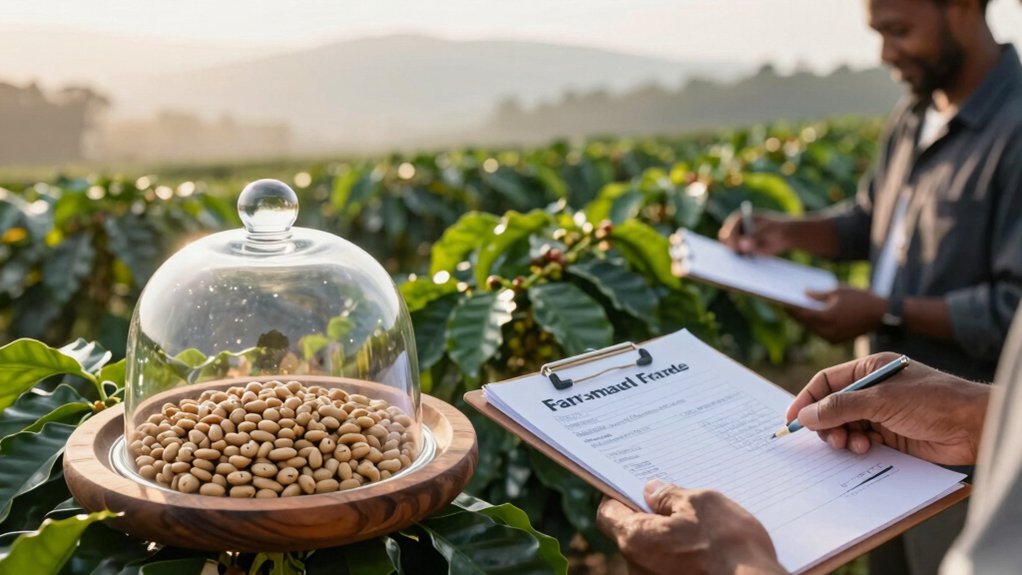
How can you secure a price that truly reflects your coffee’s quality and the farmer’s sustainable investments? In Direct Trade you negotiate pricing that rewards measurable improvements, not just a baseline certification. Start by breaking down the cost structure: share the origin price per pound, then layer premiums for lot quality, processing method, and sustainability upgrades. This transparency lets both sides see how each dollar adds value.
1) Quantify quality metrics – cup scores, defect rates, and post‑harvest practices.
2) Tie premiums to specific investments – equipment, shade trees, water‑saving tech.
3) Set a review schedule – quarterly checks ensure premiums stay ahead of certification minimums.
Incorporate portable learning concepts to ensure teams understand how brewing guides relate to sourcing quality, and use those insights to reinforce why premiums should accompany measurable improvements.
Draft a Direct‑Trade Coffee Agreement That Sets Quality, Quantity, and Pricing
You’ll start by defining clear quality metrics—lot IDs, cup scores, and origin certificates—so both sides know what “acceptable” looks like. In addition, specify USB-C rechargeable power options for on-site processing of samples and ensure equipment compatibility. Next, you’ll lay out a pricing formula that ties the origin price per pound to agreed‑upon premiums and payment milestones. Finally, you’ll lock in quantity commitments, delivery windows, and responsibility charts to keep the supply chain predictable and disputes minimal.
Quality Metrics Definition
What’s essential in a Direct‑Trade Coffee Agreement is a clear, measurable quality metric that aligns farmer and roaster expectations. You’ll set a minimum cupping score—say 80+—and a standardized tasting protocol, so every lot passes the same test before you approve it. Transparent Pricing then ties premiums directly to those scores, letting both sides see exactly how quality drives earnings.
- Score threshold – define the exact cupping score and the scale you’ll use.
- Sampling method – outline how many beans, from which zones, and when you’ll cup each lot.
- Documentation – require altitude, processing notes, lot ID, and cupping sheets for auditability.
Pricing Formula Structure
Having defined the quality metrics, you now need a pricing formula that translates those scores into a concrete payment structure. Set a Base price per pound at origin and add a cup score premium that scales with UI results—e.g., $0.50 for 88‑89, $1.00 for 90‑91, up to $2.00 for 92+. Include EXW origin terms, making the farmer responsible for loading while you handle shipping, insurance, and freight. Specify minimum and maximum annual quantities—1,000 to 5,000 kg—and break them into micro‑lots or single‑origin lots with clear delivery windows. Tie price adjustments to seasonal indices or a fixed evaluation period, and align payment milestones with pre‑harvest commitment, post‑harvest processing confirmation, and arrival cupping review, settling in USD within 30‑45 days.
Implement Ongoing Quality Checks and Real‑Time Feedback Loops
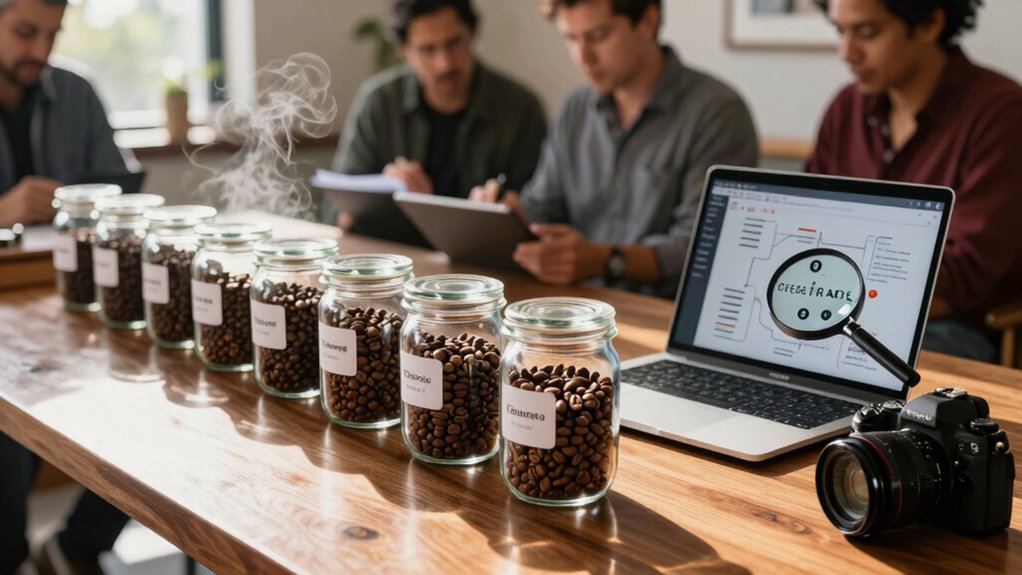
How can you guarantee that each harvest meets your roaster’s quality standards? By embedding real‑time cupping data into a transparent Direct Trade workflow, you create a loop where every lot gets scored, notes are logged, and deviations are flagged instantly. This continuous quality feedback lets you and the farmer adjust before the next shipment.
- Set a weekly cadence for harvest updates and bi‑weekly cupping reports, linking each score to a lot ID and processing method.
- Deploy a digital dashboard that sends alerts for off‑flavors, moisture loss, or other variances, prompting immediate corrective actions.
- Schedule virtual cupping sessions or farm visits within one two harvestss so producers can experiment changes and confirm improvements.
These steps keep transparency high, reduce waste, and ensure consistent flavor profiles.
Publish Farm Details, Processing Methods, and Pricing Data
By linking the real‑time cupping scores you just set up to each farm’s profile, you can now publish a full snapshot of where the coffee comes from, how it’s processed, and what the farmer actually earns. In a Direct Trade model, list the farm name, GPS location, and harvest date alongside processing details—wet, dry, or honey, fermentation length, drying method, moisture content, and any post‑harvest notes that shape flavor. Attach the Pricing Data you paid per pound at origin, noting any premium above commodity benchmarks or certification rates. Highlight organic, SHB, or other certifications, and include logistics notes such as export compliance. This Transparency lets buyers compare lots, verify farmer earnings, and trust the supply chain.
Invest in Sustainable Farming Techniques and Long‑Term Farm Improvements
You can boost farm resilience by funding agroforestry trees that shade beans and restore ecosystems.
Investing in soil‑health programs—like cover crops and compost—improves fertility and reduces erosion.
Adding renewable energy, such as solar‑powered processing, cuts costs and lowers the farm’s carbon footprint.
Agroforestry Investment
Ever wondered how your direct‑trade partnership can turn a coffee farm into a thriving agroforestry hub? By channeling premium revenues into agroforestry investment, you give farmers the capital and confidence to plant shade canopies, restore biodiversity corridors, and reforest degraded land. Transparent pricing lets them map multi‑year projects, while your long‑term commitment reduces climate risk and boosts yields.
- 1. Fund shade trees that moderate microclimates and protect beans.
- 2. Support water‑management upgrades that preserve soil moisture.
- 3. Provide training for sustainable processing that enhances quality and ecosystem health.
These steps turn your direct trade into a catalyst for resilient, productive farms that thrive for years.
Soil Health Programs
A solid soil‑health program turns premium direct‑trade revenues into measurable, long‑term gains for farms. You’ll fund soil testing, organic‑matter additions, and erosion control, then track metrics like pH and organic‑matter percentage. By adopting cover crops, composting, and cutting synthetic fertilizers, you boost biodiversity and improve water retention, which directly lifts cup quality.
Transparent reporting in your direct‑trade contracts shows progress harvest after harvest, building trust with buyers and justifying premium prices. Long‑term improvements also reduce runoff and increase drought resilience, safeguarding yields amid climate swings.
When you share clear data on soil health, you reinforce transparency, demonstrate tangible returns on investment, and create a virtuous cycle of sustainable coffee production.
Renewable Energy Adoption
Because renewable energy cuts fossil‑fuel costs and steadies operating expenses, direct‑trade partners can channel premium revenues into solar panels, biogas digesters, and micro‑hydro systems on coffee farms. You’ll see how that investment fuels resilience: farmers lower electricity bills, roasters gain predictable supply, and both parties showcase transparency in sustainability reporting.
- Solar arrays power processing stations, cutting diesel use and delivering clean electricity.
- Biogas digesters turn coffee pulp into methane, providing heat for drying while reducing waste.
- Micro‑hydro turbines harness stream flow, delivering steady power even during dry spells.
Direct Trade creates a clear audit trail, letting you track each renewable energy project’s impact on yield stability, shade coverage, and water savings. This collaborative funding model aligns incentives, turning premium prices into long‑term farm improvements that withstand climate shocks.
Share Farm Stories and Build Trust Through Visits and Virtual Tours
How can you turn a coffee’s origin into a compelling story? You start by scheduling visits to farms like Los Pirineos, MAV Coffee, and Tierra Bendita. Face‑to‑face meetings let you see on‑site processing, verify Direct Trade agreements, and capture authentic Farm Stories. During meet‑the‑producer events, listen to farmers describe altitude, processing methods, and sustainability practices that shape cup quality. Record Transparent Pricing details—farm name, altitude, method, and price paid—so you can later link premium costs to real inputs. When travel isn’t feasible, create virtual tours that showcase harvest timing, processing, and environmental commitments. Share these visuals and data with buyers to build trust, justify pricing, and strengthen your direct trade relationships.
Communicate the Direct‑Trade Coffee Narrative to Consumers Across Channels
Showcasing the farm stories you captured turns them into a consumer‑facing narrative that highlights exactly where each bean comes from, who grew it, and what the premium price funds. You then spread that narrative across every touchpoint—social posts, packaging, and email—to make Direct Trade feel personal and credible. Use vivid photos of Diego’s hillside, short videos of Irene’s processing, and clear infographics that break down the premium’s impact. Keep the story tight, and the data transparent, and the traceability obvious.
- Social media reels that pair farmer quotes with cup‑score graphics.
- Packaging labels that list origin, farmer name, and exact price paid per pound.
- Email newsletters that link to interactive maps showing each farm’s location and sustainability projects.
These channels reinforce Transparency and Traceability while deepening consumer connection.
Monitor, Review, and Refine the Partnership for Continuous Transparency
What’s the best way to keep your direct‑trade coffee partnership transparent and thriving? Schedule periodic performance reviews that tie cupping scores, processing quality, and on‑farm sustainability metrics to clear, actionable feedback. Use a shared, real‑time documentation system to capture farm location, lot origin, harvest date, price paid at origin, and any premium payments, ensuring traceability across the supply chain. Set re‑evaluation triggers—significant cupping score shifts, supply disruptions, or farming method changes—and define how pricing and contracts will adjust. Hold quarterly alignment meetings with roastery, importer, and producer teams, publishing minutes for full transparency. Finally, commission independent audits of farm practices and fair‑pay compliance, and share audit summaries publicly to cement accountability.
Frequently Asked Questions
How Are Currency Fluctuations Handled in Direct‑Trade Contracts?
You’ll usually include a currency‑adjustment clause that ties payments to a reference rate, so when exchange rates shift you recalculate the price, protecting both parties from sudden valuation changes.
Can Roasters Request Third‑Party Certifications for Farm Sustainability?
Yes, you can ask for third‑party sustainability certifications; you’ll negotiate the criteria, share audit costs, and ensure the farm meets recognized standards like Fair Trade, Rainforest Alliance, or Organic.
What Legal Protections Exist if a Farm Cannot Meet Agreed‑Upon Quality?
You’ll rely on contract clauses—force‑majeure, breach, and warranty provisions—plus local commercial codes and arbitration agreements, which let you claim damages, require remediation, or terminate the deal if quality falls short.
How Are Transportation Costs Allocated Between Farmer and Roaster?
You split transportation costs based on negotiated terms: often you cover freight to the port, then the roaster pays for inland trucking, or you share expenses proportionally to shipment weight and distance.
Is There a Standard Timeline for Renegotiating Pricing After Harvest?
You usually renegotiate pricing within three to six months after harvest, giving both parties time to assess market shifts and quality outcomes before committing to the next contract cycle.
In Summary
By keeping every step—from farm gate to cup—open and honest, you’ll build trust, command premium prices, and drive lasting impact. Transparent direct‑trade relationships let you showcase farmer stories, ensure fair pay, and guarantee sustainable practices. Keep revisiting agreements, investing in the farm, and sharing the journey. This ongoing commitment fuels quality, loyalty, and a coffee culture that truly respects its origins.


