

You keep cupping scores consistent by standardizing every variable: use the same water source with 125‑175 ppm TDS, brew at a stable 93 °C, grind uniformly with a calibrated scale, and follow a precise 15 g/1:6 ratio and 4‑minute brew. Roast each bean to the same level, let it rest the prescribed time, and use a repeatable stirring and crust‑break schedule. Calibrate your palate against a reference coffee and record all origin, roast, and equipment details. Continue and and you’ll discover how each step ties into reliable scoring.
Why a Standard Cupping Protocol Matters
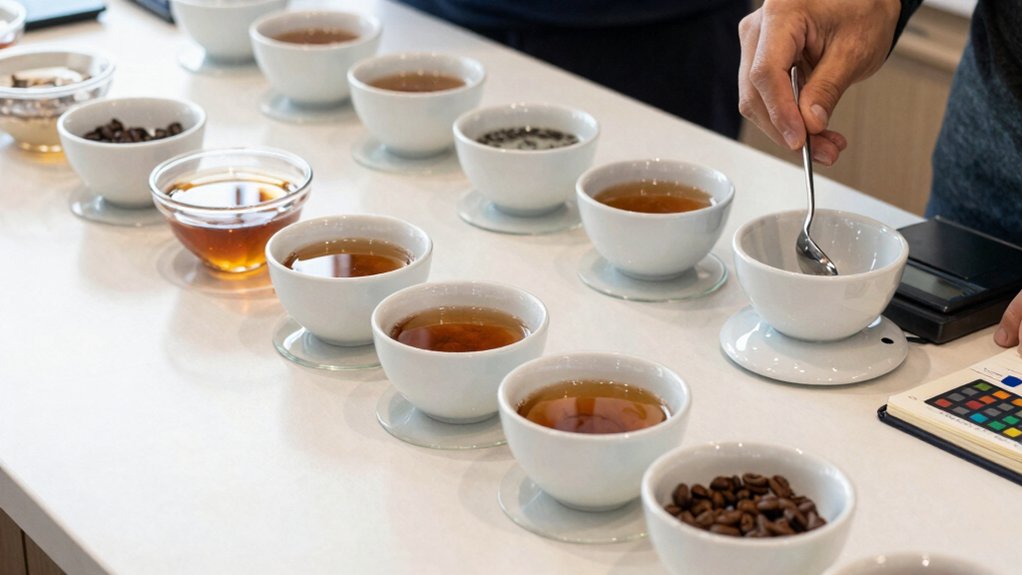
A standard cupping protocol is the backbone of reliable coffee evaluation. You follow the SCA 100‑point scale, so every cup you taste can be compared across labs, origins, and cuppers. By fixing Water quality—125–175 ppm TDS, clean and odor‑free—you eliminate a major source of variability. You also control pour temperature, grind size, rest time, and cup etiquette, ensuring each sample presents the same sensory canvas. Consistent equipment and meticulous documentation let you audit results and spot deviations. Training and calibration, using reference foods and cross‑country tastings, align your palate with a shared sensory language. Together, these steps make the Standard cupping protocol a repeatable, auditable system that yields trustworthy scores. Portable passport to coffee mastery
Control Water Quality in a Standardized Cupping Protocol
How can you keep cupping scores reliable?
Control water quality by using a single, tested source that stays within the ideal TDS range of 125–175 ppm.
Use a single, tested water source maintaining TDS between 125–175 ppm for consistent cupping.
Avoid distilled or softened water, which can mute mineral extraction and skew flavor perception.
Stick to the same water for every session, and run weekly TDS checks to catch any drift in mineral content or hardness.
Record the source and test results in your cupping protocol so you can trace any anomalies back to the water.
If the water deviates, replace it before the next round of cups.
Consistent water quality eliminates location‑based variation, letting you attribute score changes solely to the coffee itself.
Consider using a refractometer-backed protocol for more precise TDS tracking ATC-enabled measurements to ensure stability across sessions.
Set Precise Water Temperature for Replicable Cups
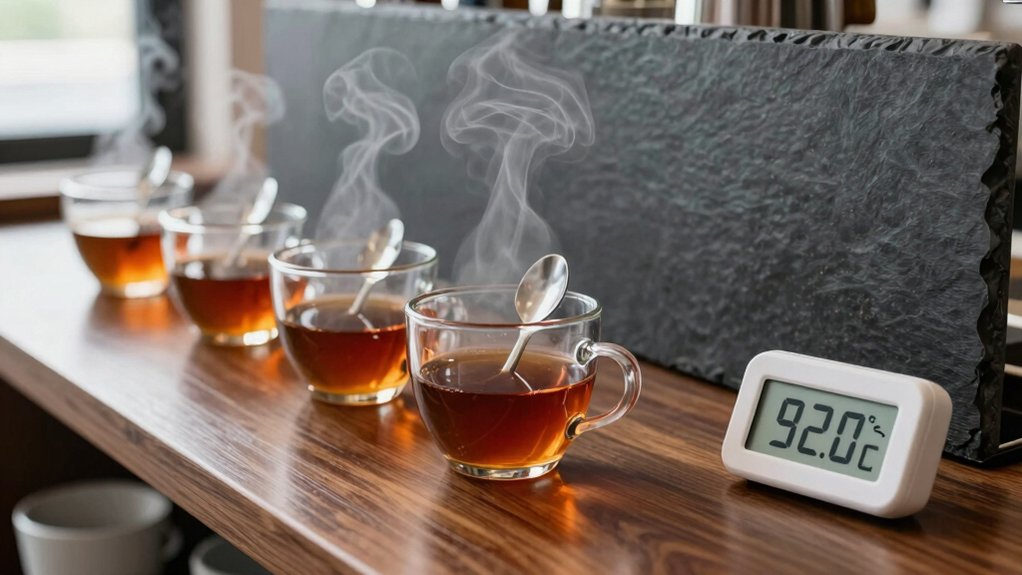
Ever wondered why a few degrees can swing your cupping scores? You’ll quickly learn that precise temperature control is the linchpin of a reliable cupping protocol. Aim for a pour temperature around 200 °F (93 °C) and keep it stable from kettle to cup. A large, insulated kettle minimizes heat loss, while a gooseneck can bleed temperature if you don’t monitor it. Consistent heat reduces water loss to the air and guarantees uniform extraction timing, aligning your results with SCA guidelines. Use a calibrated thermometer for every batch. Pre‑heat the kettle and keep the lid on. Record the exact temperature before each pour. Replace the kettle if it can’t hold the target range. Stability
Roast Level, Rest Time, and Flavor Control
What role do roast level and rest time play in flavor control? You’ll find that a medium roast level paired with a 24‑hour rest time yields bright acidity, while a dark roast level with a 48‑hour rest time deepens body and sweetness. Adjusting rest time after roasting lets volatile compounds settle, stabilizing aroma and flavor for more reliable cupping scores. Urnex grinder cleaning tablets can help maintain consistent flavor by removing oils and residues that might alter taste across batches Recommended Cleaning Protocol.
| Roast Level | Rest Time | Dominant Flavor |
|---|---|---|
| Light | 12 h | Citrus, floral |
| Light‑Medium | 24 h | Sweet, fruity |
| Medium | 24 h | Balanced acidity |
| Medium‑Dark | 36 h | Nutty, caramel |
| Dark | 48 h | Chocolate, smoky |
Ensuring Uniform Grind Size to Prevent Extraction Variability
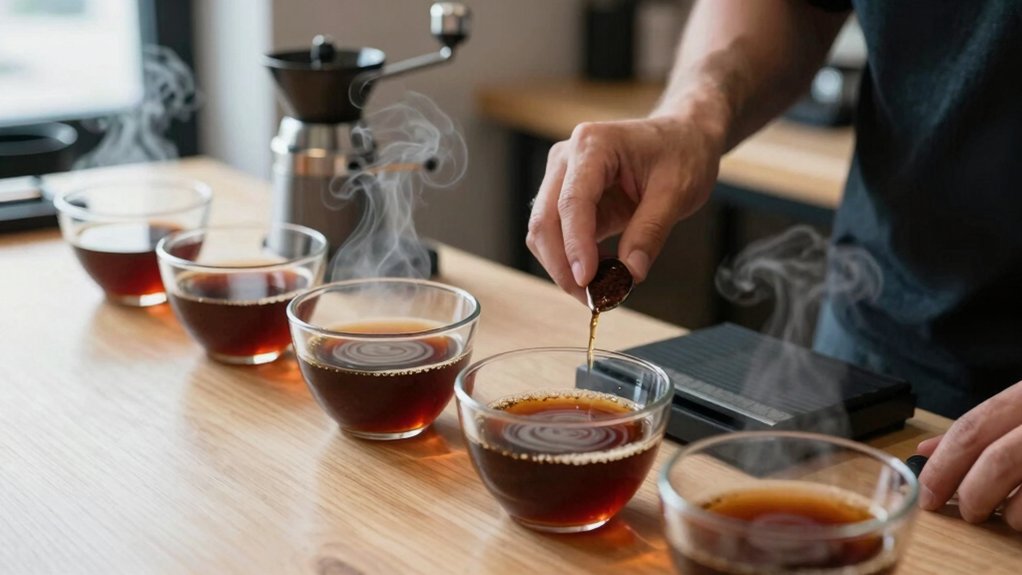
You’ll set a standardized grind setting and check the particle distribution with a sieve to keep the size uniform. Additionally, consider aligning your scale choice with a model that offers a precise 0.1 g resolution and a stable surface for repeatable cupping results, such as the Greater Goods Digital Coffee Scale with Timer (Onyx) with its bright display and 3 kg range 0.1 g accuracy.
Standardized Grind Settings
How does a uniform grind keep your cupping scores steady? When you lock in standardized grind settings, you curb particle size spread, so extraction stays predictable and your cupping scores reflect true coffee quality, not brew variance. This practice also aligns with consistent filtering outcomes, ensuring comparable mouthfeel and aroma across tastings. Grind Uniformity ensures that every batch benefits from stable extraction kinetics and repeatable results.
Consistent Particle Distribution
Why does a consistent particle distribution matter for cupping? You need uniform grind size to keep extraction steady, so each sip reflects the coffee’s true flavor, not a batch‑to‑batch variation. When particle distribution stays tight, surface area remains predictable, and aroma, flavor, and body judgments stay reliable. Use a set of sieves to check that your grind consistency meets the target range; this cuts down on differences that could skew scores. Clean your grinder thoroughly to avoid carryover from previous roasts, which otherwise contaminates the cup. By controlling fines and boulders, you maintain a steady extraction rate, letting you compare coffees with confidence and keep your cupping scores consistent. Gooseneck electric kettle and other precise brewing tools can further stabilize temperature control during extraction, supporting consistent results across tastings.
Minimize Fines and Boulders
A tight particle distribution only works when the grind itself stays uniform, and that means keeping fines and boulders in check. You’ll notice that even a handful of overly fine particles or large boulders skews extraction, causing cupping scores to swing unpredictably. By monitoring grind size and regularly cleaning your grinder, you preserve a consistent brew strength and flavor profile across lots. Use a sieve set after each grind to confirm the distribution, and discard a small batch of grounds before cupping to eliminate cross‑contamination. Aligning grind size with your cupping parameters and storage conditions safeguards the SCA‑style 100‑point system.
- Check sieves for fines and boulders each session
- Clean grinder between coffees, discard first grounds
- Match grind size to water temperature and brew ratio
- Store grounds in airtight containers to prevent moisture buildup
How to Prep Samples So Only Coffee Matters
Ever wondered why your cupping scores swing despite the same beans? Follow the cupping protocol to lock out every variable except the coffee itself. Start with sample preparation: weigh 15 g of ground coffee, use a 1:6 coffee‑to‑water ratio, and pour water heated to 93 °C. Use a single, tested water source with 125–175 ppm TDS, and let the brew rest for exactly four minutes before breaking the crust. Rinse and dry each spoon, then use a fresh spoon for every cup. Keep the environment stable—same room temperature, lighting, and no lingering aromas. By standardizing these steps, you ensure that each score reflects only the coffee’s intrinsic qualities.
Cup‑Breaking, Stirring, Timing, and Immediate Evaluation
You’ll notice that breaking the crust at the right moment releases the core aromas and sets the stage for accurate tasting. Keep your stirring motion steady and brief, using a clean spoon each time to avoid cross‑contamination. Then, evaluate the cup immediately after the stir so the flavors are fresh and the scores stay consistent.
Crust Break Timing
When you break the crust, a quick, controlled stir releases the coffee’s fragrance and levels the extraction, so timing must be identical for every cup. A consistent crust break ensures the aroma bursts at the same moment, letting you compare acidity and sweetness without bias. Stick to the cupping protocols: start the stir at the same second, pause for the same interval, and evaluate immediately. Any lag skews the sensory notes and inflates variance between samples.
- Begin the stir exactly 30 seconds after the pour.
- Rotate the spoon for a uniform 3‑second motion.
- Stop and sniff within 5 seconds of the stir.
- Record impressions before the next pour.
Stirring Consistency
Why is stirring consistency the linchpin of reliable cupping scores? You control the aroma, wet aroma, and taste by breaking the crust, then stirring with a steady, circular motion for exactly 15 seconds. Any curling or uneven stirring creates regional extraction differences, skewing flavor and after‑taste readings. By using the same spoon technique, timing, and immediate evaluation, you eliminate personal bias and align on fragrance, brightness, and body categories. Documenting water temperature, grind size, and sample order ensures you can reproduce the results session after session.
| Step | Action |
|---|---|
| 1 | Break crust uniformly |
| 2 | Stir clockwise, 15 s |
| 3 | Stop, sniff dry aroma |
| 4 | Add water, stir again |
| 5 | Evaluate wet aroma and taste immediately |
Calibration Practices for a Standardized Cupping Protocol
How do you keep cupping scores reliable across batches and cuppers? You start with a strict calibration routine that ties every taster to the SCA 100‑point scale. By tasting a shared reference lot each session, you align aroma, flavor, acidity, body, balance, and overall impression. The cupping protocol then controls water quality (125‑175 ppm TDS), pour temperature (~93 °C), and grind size, while you follow three crust breaks, stir consistently, rinse spoons, and work in a quiet room.
Strict calibration ties each taster to the SCA 100‑point scale, using shared references, controlled water, temperature, and grind.
- Run a lab‑style tasting of the same origin lot before each session.
- Verify water TDS and temperature with calibrated meters.
- Use a standardized grind and brewing equipment.
- Document scores and compare them to the internal baseline (83‑85 for blends, 86+ for single origins).
Blind Comparisons to Neutralize Bias and Preference
You’ll start each session with a blind tasting protocol that hides origin and price, then shuffle the cups so the sample order is random every time.
Using a standardized scoring sheet aligned with the SCA’s 100‑point scale lets you rate aroma, flavor, acidity, body, and balance without bias.
Blind Tasting Protocols
Ever wondered how a cupping panel can truly isolate a coffee’s intrinsic qualities? You’ll find that a strict blind tasting protocol strips away origin, brand, and lot cues, letting only aroma, flavor, acidity, body, balance, and finish drive the score. By coding cups and using identical vessels, you eliminate visual and tactile clues. Randomized presentation and reference coffees keep every session calibrated, boosting inter‑cupper reliability and overall consistency.
- Code each sample; hide all identifiers.
- Use identical, opaque cups for every pour.
- Randomize serving order for each panelist.
- Include a calibrated reference coffee for benchmark checks.
Random Sample Order
Can a simple shuffle truly erase the influence of habit and reputation? When you randomize the tasting sequence, you create a Blind comparison that blocks any cue about origin, processing method, or lot familiarity. This neutralizes expectation effects, so your scores reflect pure cup quality rather than personal preference or brand reputation. A randomized order also boosts reproducibility; each cupper experiences the same set of samples in a different sequence, aligning their calibrations to the SCA‑style 100‑point scale. By removing order bias, you prevent aroma, flavor, or aftertaste from being artificially enhanced or suppressed by the previous cup.
Implementing a Randomized, Blind protocol is thus essential for reliable, consistent scoring across teams and cu.
Standardized Scoring Sheets
How do standardized scoring sheets keep your cupping results reliable? You fill out Cupping sheets that follow the SCA scale, so each attribute—fragrance/aroma, flavor, aftertaste, acidity, body, balance, uniformity, clean cup, sweetness, overall—gets the same numeric treatment. Blind comparisons strip away origin, price, or brand cues, letting you judge purely on sensory data. Calibration sessions lock your perception to a shared reference, while clear thresholds (80‑82, 83‑85, 86‑87, 88‑89, 90+) act as objective anchors. Consistent prep, rest, and brewing variables cement comparability across labs and sessions.
- Blind samples neutralize personal bias
- Uniform categories enforce SCA scale consistency
- Calibration aligns individual perception
- Defined score ranges guide repeatable judgments
Why Recording Origin and Roast Details Keeps Your Scores Trustworthy
Why does it matter to note every detail about a coffee’s origin and roast? You capture the bean’s true character, not the noise of processing or storage. Precise origin data—farm, lot, method, harvest year—lets you calibrate expectations and compare across batches. Recording roast level, rest time, and grind size locks cupping conditions, so scores stay reliable. Freshness logs (packaging, storage, days since roast) reveal aroma shifts, preventing hidden bias. Consistent records build a trustworthy benchmark for future tastings and procurement decisions.
| Detail | Why It Matters |
|---|---|
| Origin (farm, lot) | Sets flavor baseline |
| Processing method | Influences acidity & body |
| Harvest year | Tracks climate impact |
| Roast level & rest time | Controls extraction |
| Grind size | Ensures uniform extraction |
Using Consistent Scores to Guide Buying and Roasting Choices
Ever wondered how reliable cupping scores can steer both your purchasing decisions and roasting strategies? When you trust a score’s consistency, you can compare origins, micro‑lots, and batches without second‑guessing. You’ll spot high‑quality producers quickly, and you’ll know which roast level preserves the flavor profile you love. Use the data to match inventory age, storage conditions, and roast curves, ensuring each cup meets your standards.
- Align buying decisions with scores that reflect true cup quality, not lab quirks.
- Choose roasts that complement the evaluated acidity, body, and balance.
- Factor in freshness and storage age alongside the score for optimal flavor.
- Apply standardized SCA weights to keep your evaluations repeatable across sessions.
Frequently Asked Questions
What Is a Good Cupping Score for Coffee?
You’ll consider a cupping score of 85 or higher good; 85‑89.99 signals excellent quality, while 90+ marks outstanding, rare complexity. Scores below 80 usually indicate below‑average or flawed coffees.
What Is the 15-15-15 Rule for Coffee?
You use 15 g coffee, wait 15 minutes between cupping rounds, and brew with 15 g water per gram of coffee. This keeps grind size, temperature, and timing steady, ensuring repeatable scores.
What Is the 80 20 Rule for Coffee?
You focus 80% of your effort on the 20% of variables—like roast level, grind uniformity, water temperature, and extraction timing—that most affect cupping scores, driving consistent, reliable results.
Is Coffee Intensity 7 Strong?
Yes, a 7‑point intensity feels strong to most palates—it’s bold, pronounced, and often borders on high‑energy. You’ll notice a robust body and vivid flavor, though it isn’t the most extreme level.
In Summary
By sticking to a strict cupping protocol—standard water, precise temperature, consistent grind, calibrated equipment, and blind tasting—you’ll cut out the variables that skew scores. Recording every detail, from origin to roast level, lets you track what truly matters. This consistency not only builds confidence in your evaluations but also gives you reliable data to fine‑tune buying decisions and roasting profiles.


