

You start by grinding 8.25 g of coffee to a uniform size, labeling cups, and pouring 200 °F water for a consistent brew ratio and steep time. Use the slurp method to capture the burst of flavor, then note how aroma, acidity, body, and aftertaste blend without any one dominating. Score each attribute on the 6‑10 scale, log any faults, and compare the total to the 80‑point benchmark. Keep uniformity across replicates, and you’ll discover deeper techniques for mastering balance and harmony.
Explain Why Balance Matters in Coffee Cupping
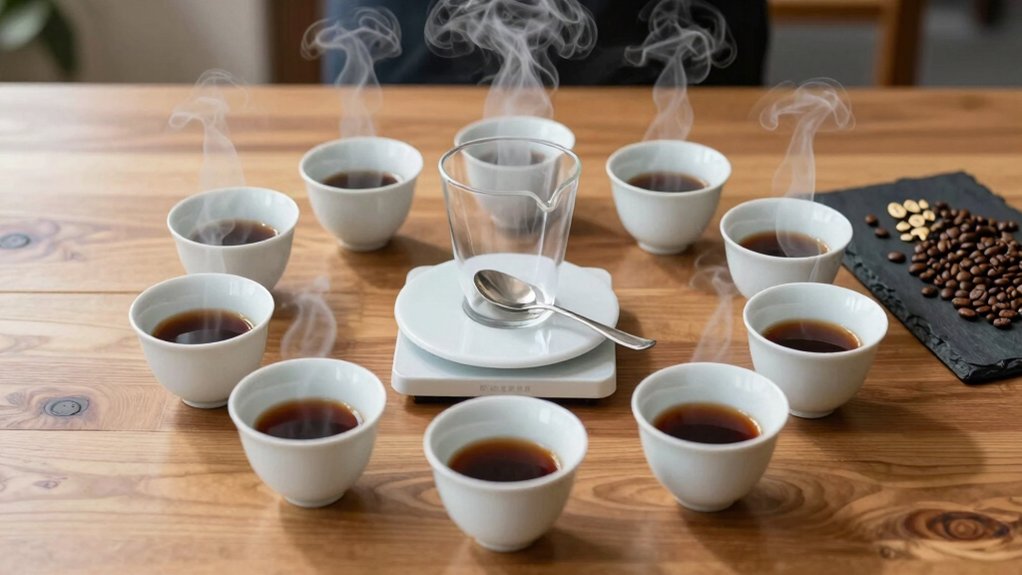
Balance is what lets every element sing together, and recognizing how origin, processing, roast, and brew method influence that balance helps you calibrate your cupping against consistent standards. SCA standards guide you in evaluating the harmony across flavor, acidity, body, and aftertaste, ensuring you measure how well attributes blend into a single, coherent profile.
Understand the 100‑Point Coffee Cupping Scale and Thresholds
You’ll notice that each point on the 100‑point scale carries weight, and small jumps—like from 82 to 83—are tougher to earn than larger ones. In practice, you’ll also see how factors such as aroma, flavor, acidity, and texture interrelate to influence overall scores, and you can anticipate how fault deductions in those attributes can shave off those critical points aroma interactions.
Scoring Sc Thresholds
Ever wondered how a single point on the 100‑point SCA cupping scale can feel like a leap in quality? You’ll notice that a move from 82 to 83 often feels bigger than a jump from 87 to 88 because the scale is non‑linear. Scores above 90 are ultra‑rare, signaling crystal‑clear clarity, deep complexity, and a perfect blend of Balance and Harmony—think Cup of Excellence territory. Bold Bean calibrates its internal weights to the SCA protocol, scoring fragrance, flavor, aftertaste, acidity, body, Balance, uniformity, clean cup, sweetness, and overall. For blends, aim for at least 83 points, usually 84‑85; single‑origin lots start around 86 and cluster in the 87‑88 range. Remember, these thresholds guide internal discipline and communication, not price tags. Balance and Harmony considerations help define where a coffee sits on the spectrum of overall cup quality and consistency.
Scoring Ranges Explained
From the moment you start cupping, the 100‑point SCA scale feels like a ladder where each rung isn’t evenly spaced—moving from 82 to 83 is noticeably tougher than jumping from 87 to 88, and consistent scoring can be aided by using a calibrated refractometer to monitor extraction levels ATC temperature compensation.
Fault Deductions Impact
Why do fault deductions matter so much in cupping? Because each defect you log directly chips away from the 100‑point score and can tip the Balance of a cup below internal thresholds. After you assess fragrance, flavor, acidity, body, and Balance, you apply deductions—Taint ‑2, Fault ‑4, etc.—to reflect real‑world flaws. This ensures the final number truly represents quality and guides culling decisions. You must document every defect; otherwise the team may miss a critical issue and keep a sub‑par batch. Understanding the brush sectors in routine cleaning helps you maintain consistency in equipment that influences cupping outcomes, such as steam wands and group heads, ensuring clean flavor extraction Heat‑resistant nylon during routine maintenance.
| Attribute | Typical Deduction |
|---|---|
| Taint | ‑2 |
| Fault | ‑4 |
| Off‑note | ‑3 |
| Overall | Adjusted Score |
Keeping a tight defect log protects your blend’s baseline (≥83) or single‑origin target (≈86), preserving consistency and consumer trust.
Prepare a Consistent Coffee Cupping Session
You’ll start by grinding each sample to the same size and weighing 8.25 g, then label the cups clearly and start the timer the moment you pour the 200°F water. Keep the brew ratio, temperature, and steep time identical for every cup so the only variable left is the coffee itself. This uniform setup lets you compare fragrance, flavor, acidity, body, and aftertaste without any hidden inconsistencies. The setup can be monitored and adjusted remotely via app-based control to maintain consistency across sessions Smart/App Connectivity.
Sample Preparation Consistency
A consistent cupping session starts with identical preparation of each sample, so you’ll get reliable, apples‑to‑apples comparisons. Use light‑to‑medium roasts and keep the roast profile the same across all beans. Grind each portion to a coarse, uniform size and weigh exactly 8.25 g. Pour 200 °F water using the same swirl and start the timer simultaneously, then label each cup with roast level and brew details. Rotate cups and repeat at varied temperatures to watch the Balance in coffee evolve while preserving the Cupping form you’ve established. Release Method: Twist to release
Accurate Labeling & Timing
After grinding the beans to a consistent coarse size, you now turn to labeling each cup and timing every step. Consistent labeling—roast level, origin, and sample ID—creates the Balance needed for apples‑to‑apples comparisons, so write every detail on identical cups before you start. Use a standard cupping form to record fragrance, aroma, and bloom times in real time. Begin the aroma assessment exactly when you finish grinding, then watch the CO2 bloom for a precise 3‑5 minutes. Keep the brew ratio, water temperature, and slurping protocol uniform across all samples, and stop each phase with a timer. This disciplined timing and clear labeling let you calibrate your palate and compare results without ambiguity.
Uniform Grinding & Water Temperature
Why does uniform grinding matter? You’ll notice that consistent particle size eliminates extraction variance, letting you taste true balance of sweetness, acidity, and body. Pair that with a stable water temperature—about 200 °F (93 °C)—and you remove temperature‑driven strength differences that could skew aroma and flavor perception.
- Grind fresh before each cup, using the same grinder settings.
- Keep the brew ratio and water temperature identical for every sample.
- Use identical cups, pour sequence, and a standardized rest time between pours.
- Calibrate cuppers with the same roast level and prep within a narrow time window.
Following these steps ensures that every sip reflects the coffee’s inherent harmony, not procedural inconsistencies.
Score Fragrance & Aroma in Coffee Cupping
What does the coffee whisper to you when you first lift the cup? You sniff the dry grounds, noting the Fragrance: is it bright, muted, or layered with floral, nutty, or earthy tones? Next, you stir and inhale the wet brew, capturing the Aroma. Assess clarity, presence, and tonal impression, documenting any distinctive or off‑smells. Score each on the 6.00–10.00 SCA scale, reflecting both dry‑ground and post‑infusion qualities. A clear Aroma suggests balanced origin and roast characteristics that will likely carry through the cup. Record positive traits—citrus, chocolate, berry—and any faults, such as sour or musty notes. This precise log guides calibration and future cupping decisions, ensuring consistent evaluation of balance and harmony.
Score Flavor and Aftertaste Using the Slurp Method

You’ll start by taking a deep slurp, letting the coffee sweep across your palate and into the retronasal passage so the aroma can shape the flavor perception. Then, assess how the individual notes blend—citrus, cherry, caramel, chocolate—and whether they support a cohesive balance of sweetness, acidity, and body. Finally, note any off‑flavors that emerge, as they can signal defects that disrupt the overall harmony.
Slurp Technique Basics
Mastery of the slurp technique unbinds the full palate, letting you spray coffee across every taste zone so flavor and aftertaste reveal themselves instantly. You’ll use a deep, brisk slurp with a strong audible intake, sending aroma compounds through both olfactory and retronasal pathways. Each pass at a different temperature uncovers how acidity, sweetness, and balance shift as the cup cools. When you score, link the perceived flavor and aftertaste of each slurp to the overall balance, noting consistency across samples. Pair these observations with clear notes on aroma and mouthfeel for objective comparisons.
- Take a deep slurp, note immediate flavor burst.
- Repeat at a cooler temperature, capture evolving aftertaste.
- Record balance of acidity versus sweetness.
- Compare notes across samples for consistent balance.
Flavor Integration Assessment
How does the slurp reveal the coffee’s full flavor tapestry? You draw the liquid across your palate, letting it surge through the retronasal passage so taste and aroma merge. As you slurp, note whether citrus, cherry, chocolate, caramel, and florals appear distinctly yet weave together, preserving the origin character alongside roast. Score the flavor on a 6‑10 scale, focusing on balance among sweetness, acidity, and body—no single note should dominate. Then assess aftertaste: sip, swallow, and listen for the echo of flavor that lingers, judging its duration, pleasantness, and any defects. Record each impression, compare with standardized cupping charts, and calibrate your palate to ensure consistent flavor integration judgments across tasters.
Rate Acidity and Body for Coffee Cupping Balance
Why does acidity feel lively yet harmonious? You’ll notice that a bright Acidity lifts the cup, but only when it syncs with body and flavor does it create true Balance. Rate the interplay by listening for a seamless lift rather than a sharp edge. Use a 6‑10 scale, noting how the acidity amplifies sweetness and adds dynamism without overwhelming the palate.
- Intensity – Is the brightness vivid yet controlled?
- Integration – Does acidity blend with body, enriching texture?
- Harmony – Are flavor notes cohesive, avoiding disjointed spikes?
- Consistency – Do roast, grind, and brew parameters keep the acidity steady across sips?
When you score each factor, you’ll capture the cup’s overall harmony and ensure the acidity contributes positively to the cupping Balance.
Verify Uniformity and Clean Cup Across Replicates
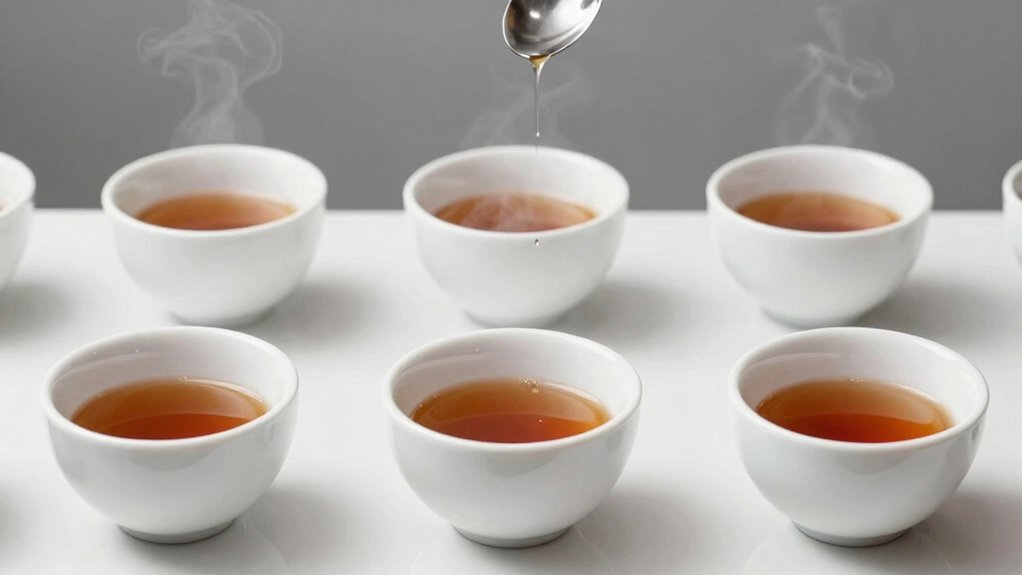
Ever wondered how to guarantee each cupping bowl tells the same story? You start by checking Uniformity across replicates. Taste every bowl side‑by‑side, noting flavor, aroma, and any defect. If one bowl shows mudiness, off‑notes, or fermentation, your Clean Cup fails, and you flag that replicate as an outlier. Record the deviation, then trace it back to roasting, grinding, or extraction. Regular cross‑sample calibration with fellow cuppers sharpens objectivity and keeps subjectivity in check.
| Aspect | Action |
|---|---|
| Flavor | Compare intensity and character |
| Aroma | Verify identical scent profile |
| Defects | Spot mud, fermentation, phenolics |
| Clean Cup | Ensure no off‑notes present |
| Documentation | Log outliers for further analysis |
Assess Overall Balance: No Attribute Overpowers the Cup
What makes a cup feel harmonious? You sense a seamless integration of flavor, acidity, body, and aftertaste where none dominates. To gauge that balance, focus on how origin character, roast notes, and processing‑derived acids align. You’ll notice a cohesive profile when sweetness, brightness, mouthfeel, and lingering notes support each other rather than clash.
A seamless blend of flavor, acidity, body, and aftertaste creates a truly harmonious cup.
- Flavor – does it mingle with acidity?
- Acidity – is it bright but not sharp?
- Body – does it provide mouthfeel without overwhelming?
- Aftertaste – does it linger in a balanced way?
When these four elements integrate, the cup achieves true harmony, reflecting precise control of variables and calibrated tasting. This ensures no single attribute overpowers the cup.
Interpret Overall Scores and Fault Deductions
How do you translate the raw numbers on a SCA cupping sheet into a clear picture of a cup’s overall quality? First, add the four attribute scores—flavor, acidity, body, and aftertaste—to get the raw total. Then, apply any fault deductions for off‑flavors, defects, or inconsistencies; each deduction subtracts a set number of points, usually one or two per fault. The resulting figure becomes your overall score, which you compare against the 80‑point benchmark for a well‑balanced cup. When you see a high total but a low balance rating, you know the attributes are uneven despite the numeric strength. Conversely, a modest total with strong balance judgments signals harmony that compensates for lower intensity. Use this arithmetic to convey both quantitative strength and qualitative harmony.
Apply Balance Insights to Roast Profiles, Procurement, and Menus
When you understand how balance emerges from the interplay of flavor, acidity, body, and aftertaste, you can translate those insights into concrete decisions about roast profiles, bean sourcing, and menu design. Use cupping data to guide every step: a well‑aligned cup tells you which roast level preserves bright acids while supporting body, which origins consistently hit your target balance, and how to position drinks on a menu for maximum appeal.
Use cupping data to align roast, sourcing, and menu for balanced, vibrant coffee experiences.
- Choose roast profiles that mute harsh acids yet keep vibrancy.
- Source beans whose natural balance matches your flavor goals.
- Align brewing parameters to enhance harmony across the cup.
- Design menu sections that highlight balanced offerings, reinforcing brand consistency.
Frequently Asked Questions
How Does Water Temperature Affect Perceived Balance?
You’ll notice that hotter water extracts more acidity and bright notes, while cooler water emphasizes body and sweetness, so adjusting temperature shifts the balance, making the cup feel either sharper or smoother.
Can Grind Size Influence Body and Acidity Harmony?
Yes, grind size drives body and acidity harmony; a finer grind extracts more soluble compounds, boosting body but risking excess acidity, while a coarser grind softens acidity, yielding a smoother balance.
Do Different Brewing Methods Alter Uniformity Across Pours?
Yes, you’ll notice that methods like pour‑over, French press, and espresso each extract differently, so the consistency between pours changes—some give uniform flavor, others reveal distinct layers with each pour.
What Role Does Cup Cleanliness Play in Aftertaste Evaluation?
You’ll find that a clean cup eliminates lingering residues, so you can taste the coffee’s true aftertaste without interference; any leftover oils or detergents mask subtle flavors and skew your evaluation.
How Often Should Cuppers Recalibrate Their Scoring Scale?
You should recalibrate your scoring scale at least every six months, or whenever you introduce new beans, equipment, or notice drift in your ratings, to keep your assessments consistent and reliable.
In Summary
By mastering the 100‑point scale, you’ll spot when acidity, body, sweetness, and bitterness harmonize instead of clash. Consistent cupping, careful aroma and flavor scoring, and uniformity checks let you pinpoint balance flaws. Use those insights to tweak roast profiles, choose beans that fit your menu, and keep your coffee consistently delightful.


