
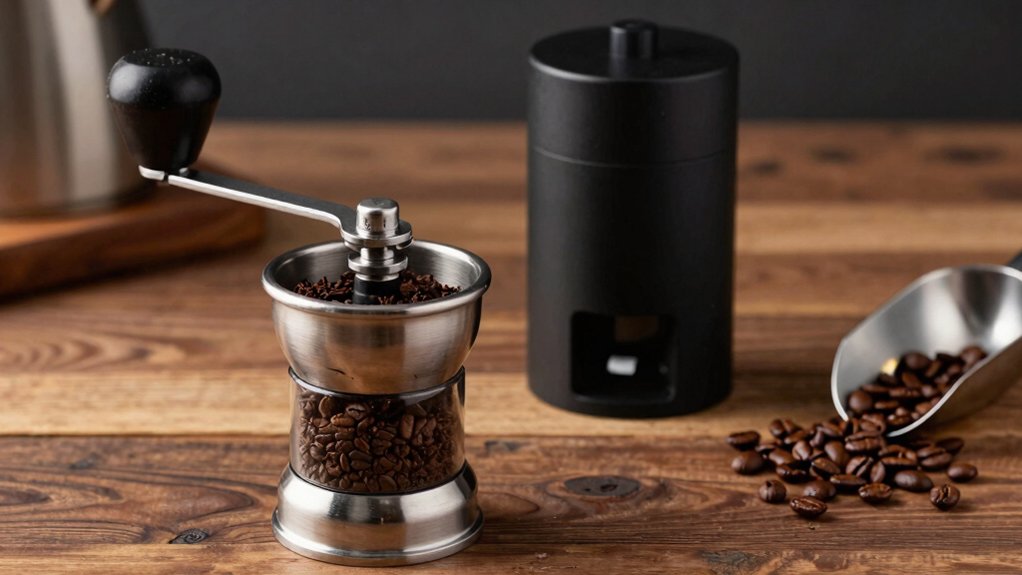
You’ll get a tighter, more predictable particle size with a burr grinder, which means each cup extracts evenly, tastes smoother, and avoids the bitterness that over‑extraction creates. Burrs crush beans instead of chopping them, keeping heat low and preserving delicate aromatics. The adjustable burr gap lets you dial in the perfect grind for French press, pour‑over, or espresso. If you keep going, you’ll discover how to choose the right burr type and maintain it for optimal flavor.
Why Burr Grinders Beat Blade Grinders
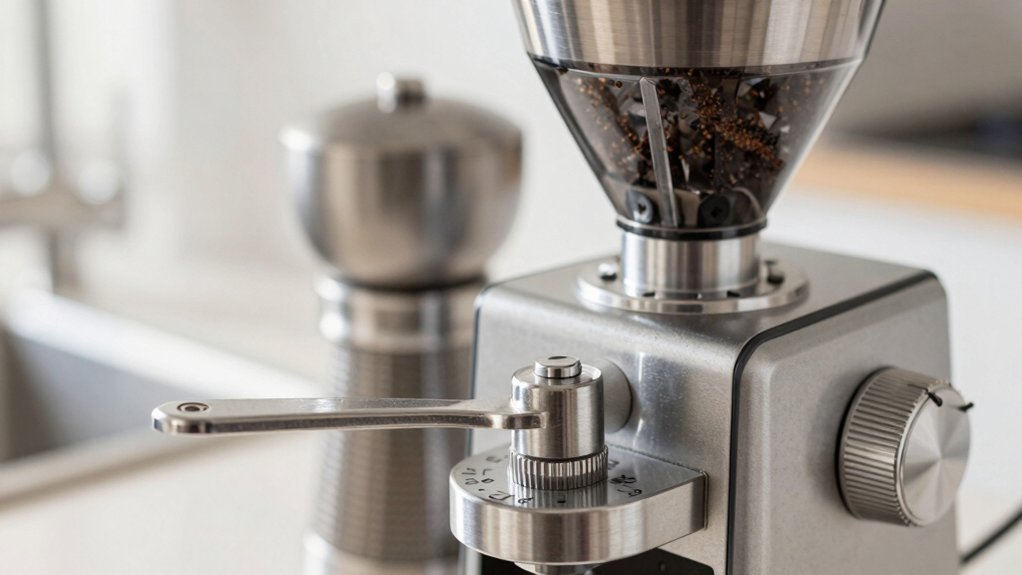
Ever wondered why your coffee tastes so different when you switch grinders? You’ll notice that burr grinders deliver grind consistency that blade grinders can’t match. Their adjustable burr distance gives you precise grind size control, letting you dial in the perfect particle range for pour‑over, French press, or espresso. Because burrs crush beans rather than chop them, they generate fewer ultra-fine particles, cutting the risk of over‑extraction and bitterness. The gentler grinding action also reduces heat buildup, which means more flavor preservation and brighter aromatics in every cup. When you fine‑tune micro‑adjustments, you’ll see how uniform particles extract evenly, giving you a smoother, more predictable brew each time. Thermal management helps preserve delicate flavors during grinding, especially for lighter roasts.
Burr vs. Blade Grinders: Core Differences Explained
What really sets burr grinders apart from blade grinders is how they process each bean. Burr grinders crush beans between two burrs, letting you dial in exact grind size and keep consistency across every batch. Blade grinders spin a blade that chops, creating a random mix of coarse chunks and fine dust, so you lose control over particle distribution. With burr grinders you can adjust the burr gap for fine‑tuning, which translates to stable temperature and reproducible flavor in espresso, pour‑over, or French press. By choosing burr grinders, you gain precise control, reliable consistency, and better overall coffee quality. ICC IPX4
How Burrs Produce Uniform Particle Sizes
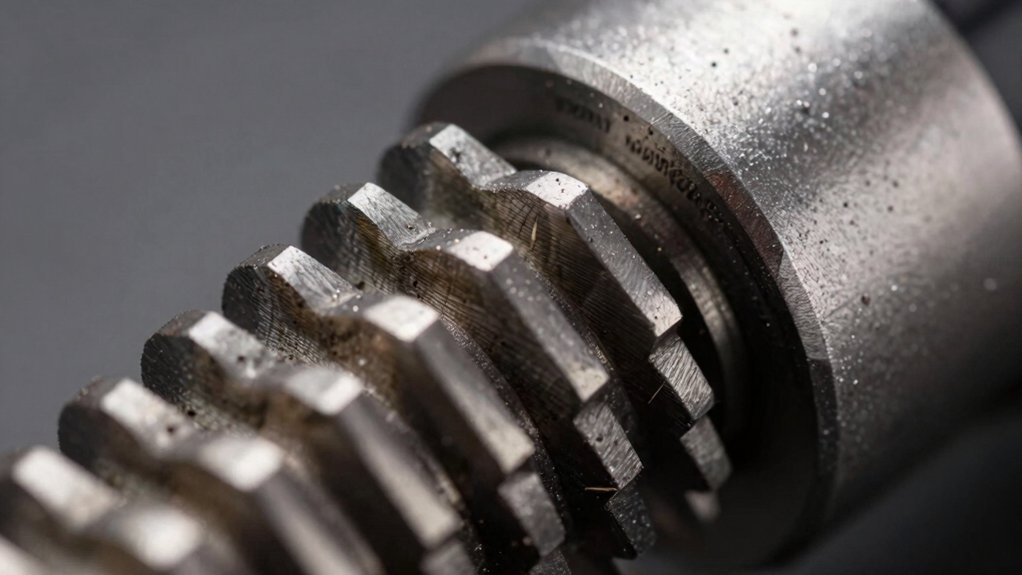
Because burr grinders crush beans between two precisely machined surfaces, each particle emerges from a consistent gap rather than a chaotic chop. You’ll notice that the adjustable grind adjustment lets you set the exactly between the burrs, so every batch repeats the same uniform particle sizes. The precision‑cut teeth on the burrs produce a narrow distribution, keeping ultra‑fine fragments to a minimum. Cross-back designs in gear and durable hardware show how focused design reduces strain and fatigue during long sessions, aligning with professional-grade equipment cross-back design. When you switch to a conical set, you get a touch more fines for body; a flat burr gives an even tighter grind with greater clarity. Because the beans are crushed, not sliced, heat stays low and irregular chunks disappear, ensuring your coffee extracts predictably each time.
The Impact of Consistent Grind on Extraction and Flavor
Uniform grind is the backbone of a balanced extraction, and burr grinders deliver that precision by producing a narrow particle size distribution. When you achieve grind consistency, water extracts each particle at the same rate, so the overall extraction stays balanced. A tight particle size distribution means you won’t get a flood of ultra‑fine particles that over‑extract and turn your brew bitter, nor large chunks that under‑extract and leave it sour. Burrs cut the beans with precision, giving you that narrow distribution and preventing channeling, which lets the brew flow evenly through the grounds. The result is a cleaner, more defined flavor profile that repeats from pot to pot. You’ll notice fewer sudden flavor shifts and a steadier, more predictable cup every time. Ground uniformity
How to Adjust Burr Settings for French Press, Pour‑Over, and Espresso
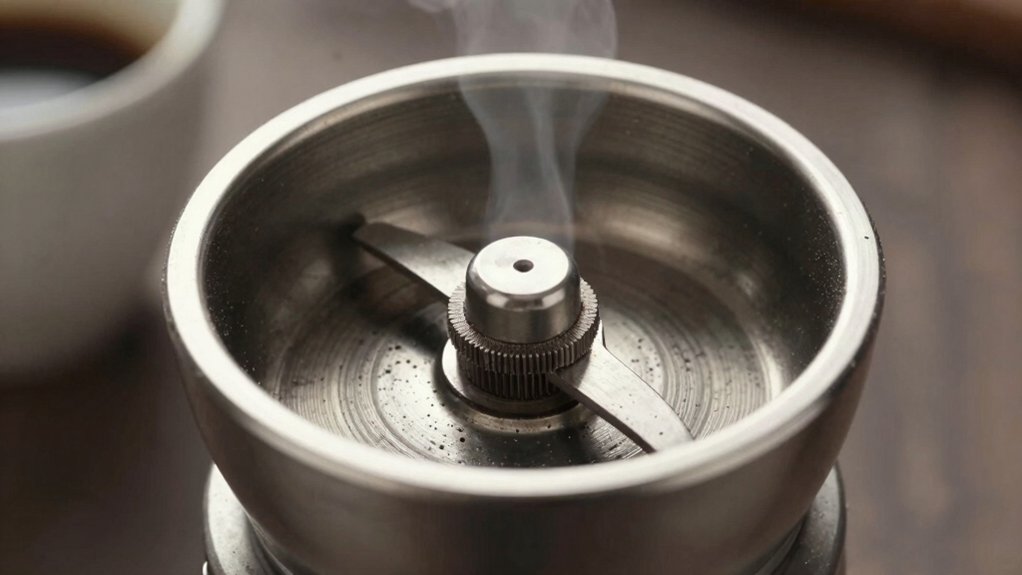
A grinder’s burr gap is the dial you’ll turn to match each brew method, so start with the coarsest setting for French press and gradually tighten it in 0.1‑0.2 increments until you hit the 800–900‑micron sweet spot. The choice of burr material (ceramic, stainless steel, or all‑metal) also influences heat generation and grind consistency, so consider how your burrs interact with your preferred method burr material. From there, shift to a medium grind (600–800 µm) for pour‑over, then dial down to 200–400 µm for espresso, testing each step with a small dose. Watch flow, taste, and adjust the burr grind settings to fine‑tune extraction control. Small increments keep the grind size consistent and prevent over‑extraction across methods.
- French press: 800–900 µm, coarse, steep 4‑5 min
- Pour‑over: 600–800 µm, medium, steady drip
- Espresso: 200–400 µm, fine, 25‑30 s extraction
- Test‑and‑tune: grind a trial dose, brew, observe, refine.
Heat Build‑up and Aroma Retention in Coffee Grinding
You’ll notice that burr grinders keep the temperature low by grinding more slowly and with precise burr teeth, which protects the beans’ volatile aromatics. Introducing a design principle that aligns with energy-efficient heating and insulation concepts from car cup holders, the slow, controlled grinding also minimizes heat generation in the grinding chamber. thermal efficiency remains a core consideration in maintaining aroma, and using robust, insulated components helps preserve volatile compounds during operation. Even a hand‑crank burr can preserve aroma better than any electric blade.
Heat Generation Minimization
Ever wonder why your coffee loses its perfume when you grind it? Burr grinders keep heat low by using a slower, controlled motion and a fixed burr gap. That steadier torque cuts friction, so you avoid the temperature spikes that flatten flavor. With less heat, the volatile oils stay intact, and you get a reliable grind size that translates into consistent extraction. Conical burrs channel grounds efficiently, minimizing resistance. Lower heat retention helps preserve aroma compounds during grinding, contributing to flavor integrity across batches. Stable heat control yields uniform grind size and flavor consistency.
Aroma Preservation Techniques
Most coffee lovers notice that a cooler grind keeps the brew’s perfume intact; burr grinders achieve this by grinding more slowly and maintaining a steady torque, which cuts friction and limits temperature spikes. You’ll find that aroma preservation hinges on two factors: heat control and a uniform grind. Burrs generate less heat than blades, so volatile compounds stay intact instead of breaking down. Conical burrs stay especially cool, reducing friction and keeping the brew’s delicate notes from fading. The consistent particle size a uniform grind provides ensures even extraction, so the aroma releases steadily during brewing. By grinding just before you brew, you capture the full fragrance profile, and the precise, repeatable settings of a burr grinder let you lock in that freshness every time.
Conical vs. Flat Burrs: Choosing the Right Geometry
What sets conical and flat burrs apart is the way they shape the grind. You’ll notice conical burrs feed beans from the top, expelling grounds below, which creates a broader particle distribution and a gentler heat profile. The geometry directly impacts grind consistency: conical burrs retain more fines that add body, while flat burrs produce fewer fines for cleaner cup profiles. Choose based on your brewing method, budget, and noise tolerance.
- Conical burrs: affordable, quieter, broader distribution
- Flat burrs: higher cost, tighter tolerances, uniform particles
- Heat management: conical less buildup, flat more potential
- Brew suitability: pour‑over/dip vs. espresso calibration
Hand‑Held Burr Grinders: Portability Without Compromise
Looking for a grinder that fits in your backpack yet still delivers café‑grade consistency? A handheld burr grinder gives you portability without sacrificing the uniform particle size you crave. You crank the two burrs manually, and the conical design feeds beans from the top, letting you dial a coarse French‑press grind to a fine espresso setting. Because the burrs, not a blade, you get far more consistency than a cheap blade grinder, and you pay far less than for an electric burr model. Higher‑end units offer stepless or micro‑adjustments, so you can fine‑tune extraction without sacrificing durability. The trade‑off is a bit more effort and time, especially for espresso‑fine grinds, but the portable, consistent results make it ideal for travel, camping, or a compact kitchen.
Choosing Burr Grinder Type Within Your Budget
You can start by weighing handheld burr options against your space and travel needs, then compare conical and flat burrs for noise, heat, and grind consistency.
Keep an eye on the price‑performance balance to ensure you get the precision you want without overspending.
This quick assessment will guide you to the grinder that fits both your budget and brewing goals.
Handheld Burr Options
Ever wondered why a handheld burr grinder can outshine a blade model without breaking the bank? You’ll find that a handheld burr delivers grind consistency that rivals cheap electric units while staying quiet and electricity‑free. The manual grinder’s top‑bean, bottom‑grounds design keeps the burrs aligned, so each turn yields uniform particles—perfect for pour‑over or espresso. Plus, the compact size fits in a backpack, making it ideal for travel or small kitchens.
- 1Zpresso J Manual Coffee Grinder – precise micro‑adjustments, robust build
- Porlex Mini – lightweight, stainless steel burrs, easy to clean
- Timemore Chestnut C2 – affordable, smooth grind, ergonomic crank
- Hario Skerton Pro – classic design, interchangeable burrs for versatility
Conical vs. Flat Burrs
Handheld burr grinders give you the consistency of a larger electric unit, and the next decision is whether that burr is conical or flat. Conical burrs feed beans from the top, run cooler, and stay quieter, making them budget‑friendly and easy to carry. Flat burrs crush beans between two parallel discs, delivering razor‑sharp grind consistency and clearer flavor, though they generate more heat and cost more. When you weigh cost against precision, conical burrs win for versatility, while flat burrs excel for espresso‑level uniformity.
| Feature | Conical burrs | Flat burrs |
|---|---|---|
| Heat generation | Low | Higher |
| Size & weight | Compact | Bulkier |
| Grind consistency | Good | Excellent |
| Price range | Affordable | Premium |
| Maintenance | Simple | Precise alignment required |
Price‑Performance Balance
How much can you extract from each dollar spent on a burr grinder? You’ll find that a modest investment in a quality burr grinder yields far more grind consistency than a cheap blade model, turning every cup into a reliable showcase of flavor. The upfront cost balances out quickly because you avoid replacing beans that taste off due to uneven extraction, and you skip the frequent upgrades blade grinders often demand.
- Hand‑held burrs give portability and low entry price while still delivering uniform particles.
- Electric conical burrs provide high throughput for daily brewing without sacrificing consistency.
- Flat‑burr units excel at espresso precision, justifying a higher price for serious enthusiasts.
- Long‑term durability cuts replacement cycles, boosting overall cost efficiency.
Keeping Your Grinder Sharp: Maintenance Essentials
Keeping your grinder sharp is the key to consistent flavor, and regular maintenance makes that easy. For grind maintenance, start by unplugging the unit and removing any beans. Use a soft brush or a dedicated cleaning disc to sweep out grounds from the burrs, then wipe the housing with a damp cloth. If you notice uneven extraction or excess fines, inspect the burrs for wear; conical burrs often stay sharper longer, but flat burrs may need more frequent checks. When the grind size drifts despite adjustments, consider replacement burrs—most manufacturers sell them as a set for quick swap. Finally, store the grinder in a dry place, avoid moisture, and repeat this routine weekly for optimal performance.
Situations Where a Blade Grinder Is Acceptable (Budget & Travel)
When you’ve just finished sharpening your burrs, you might wonder whether a blade grinder could ever fit the bill. If you’re pinching pennies or packing light, a blade grinder can be a pragmatic stop‑gap. Its low price and tiny footprint let you brew on the road without breaking the bank. While it won’t deliver espresso‑grade consistency, it can handle casual drip coffee, French press, or a quick pour‑over when flavor precision isn’t critical. You’ll also appreciate the simple rice‑cleaning hack that clears oils in seconds, keeping the grinder ready for the next brew.
- Budget‑friendly price point
- Compact size ideal for travel
- Quick, hassle‑free cleaning with rice
- Sufficient for casual drip or French‑press coffee
Common Misconceptions About Burr and Blade Grinders
Ever wondered why people claim burr grinders are always superior? You might think they’re pricier and only for pros, but the real myth is that blade grinders can’t ever match grind size consistency. In truth, burr grinders crush beans between two burrs, delivering uniform particles that keep extraction steady, while blade grinders chop irregularly, producing fines and chunks that cause uneven flavor. Some assume conical burrs overheat, yet they actually run cooler than flat burrs and handle a broader range. grind sizes. Others believe you can fine‑tune a blade grinder, but only burr grinders offer stepless or micro‑adjustments for espresso to French press. Remember, the key difference lies in the consistency of the grind, not just the price tag.
Frequently Asked Questions
Do Burr Grinders Affect Caffeine Content?
You’ll find burr grinders preserve more caffeine because they produce uniform particles, preventing over‑extraction. Their consistent grind lets you control brew time, so you extract the intended caffeine amount without waste.
Can I Use a Burr Grinder for Spices?
Yes, you can use a burr grinder for spices, but keep it clean and dry; the consistent grind size preserves flavor, and the slower, crushing action prevents overheating that can degrade essential oils.
Are Burr Grinders Noisy Compared to Blades?
You’ll find burr grinders quieter than blades; they hum steadily instead of clicking loudly, so you can grind coffee or spices without startling anyone in the kitchen.
Do Burr Grinders Require Special Electricity?
You don’t need special electricity for burr grinders; they run on standard household outlets just like most kitchen appliances. Just ensure the outlet matches the grinder’s voltage and amperage rating for safe operation.
How Often Should I Replace Burrs?
You should replace burrs every 12–18 months, depending on usage and grind consistency; if you notice dullness, uneven particles, or a drop in flavor, swap them out promptly to maintain optimal performance.
In Summary
So, if you want consistent flavor, precise control, and better extraction, a burr grinder is the clear winner. Its uniform particles let you dial in the perfect grind for any brew method, while a blade grinder leaves you guessing. Even though a blade can work in a pinch or on a tight budget, investing in a burr grinder pays off in taste and repeatability—making every cup worth the effort.


